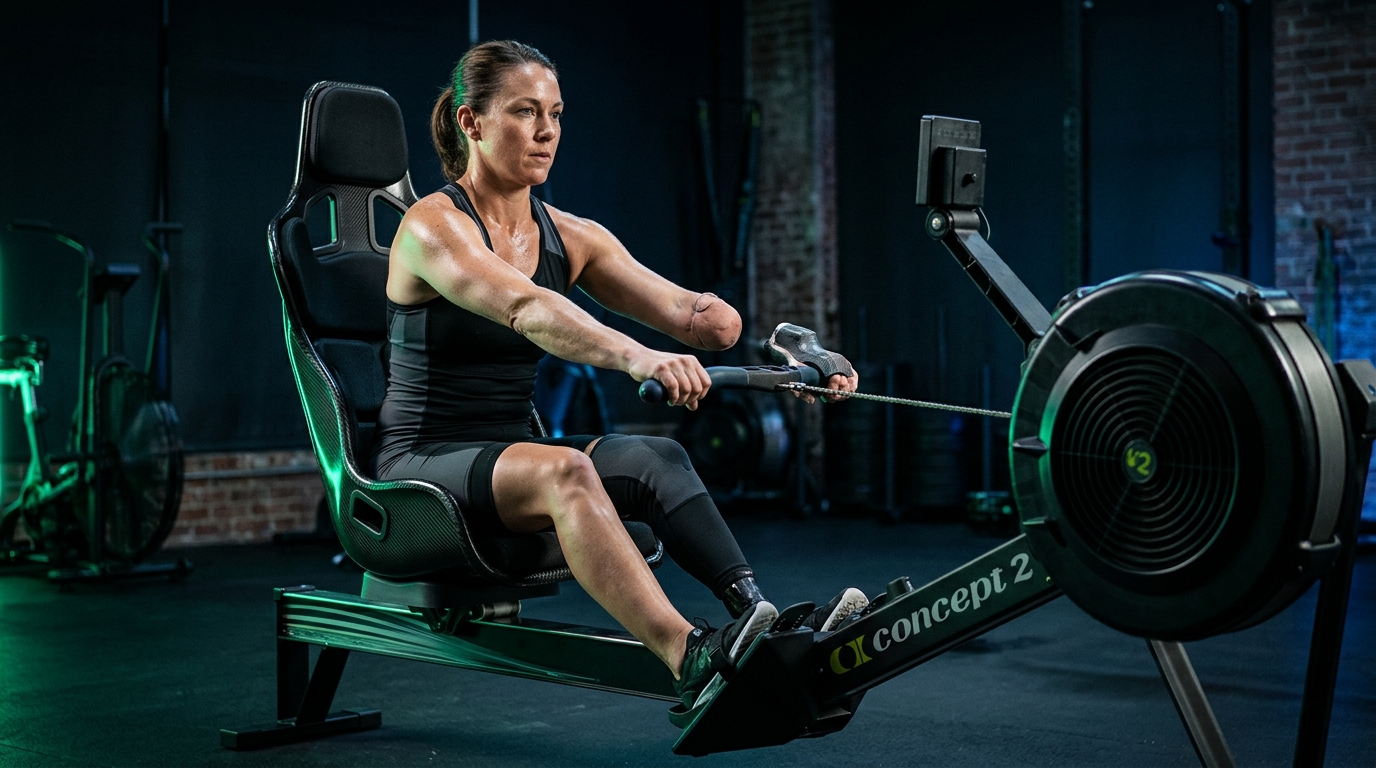
Adaptive Rowing & Every Body41 minute readAll levels

Adaptive Indoor Rowing: Start With the Person

A research-grade synthesis of adaptive indoor rowing — classification, physiology, cognitive accessibility, equipment, and the case for starting with the person rather than the protocol.

Topic: adaptive principles · Reviewed 2026-09-06

Abstract

Adaptive indoor rowing is a process, not a category. The peer-reviewed literature now treats classification as evidence-based and functional ([3] Tweedy 2011, Level 5; [4] Beckman 2014, Level 2b; [5] Altmann 2018, Level 2b; [6] Mann 2021, Level 5; [88] International Paralympic Committee, Level 5), the PR1/PR2/PR3 classes as a continuum of trunk and leg function rather than a label of impairment ([1] Harrison 2026, Level 5; [86] World Rowing rule book, Level 5), and the rowing ergometer itself as a rig that can be adapted in many directions rather than a single piece of equipment ([11] Cutler 2017, Level 2b; [15] Janvier 2025, Level 5; [91] Concept2 adaptive guidance, Level 5). The 2023 [10] Puce scoping review with bibliometric analysis confirms the para-rowing evidence base is small relative to able-bodied rowing, so the rower, the coach, and the AI coach should treat every prescription as a hypothesis to test ([10] Puce 2023, Level 5). Spinal-cord-injury physiology shifts cardiovascular and thermal responses ([19] Martin Ginis 2018, Level 5; [23] Price 1999, Level 2b; [25] Gee 2021, Level 5), upper-limb-only physiology produces lower peak oxygen uptake at higher lactate ([29] Baumgart 2020, Level 2b; [33] Stephenson 2021, Level 5), and fixed-seat rowing changes the mechanical core of the stroke ([35] Lafreniere 2025, Level 2b; [36] Agius 2023, Level 5). Universal Design for Learning ([92] CAST UDL guidelines, Level 5; [50] Doyle 2025, Level 5), an autonomy-supportive coaching climate ([56] Ryan 2025, Level 5; [57] Gao 2026, Level 2b; [58] Morbée 2024, Level 2b), and an identity-first rather than diagnosis-first framing ([61] Pack 2017, Level 5) are the meta-evidence that ties the technical pieces together. The honest read: ask about goals, access needs, and preferred feedback before prescribing anything; change the rig and the room before assuming the body must change; and treat classification and diagnosis as starting points, not ceilings.

Why "start with the person"

Adaptive indoor rowing begins with a question, not a protocol. The 2007 [62] Hutzler ecological model of adapted physical activity makes this concrete: adaptation happens at three layers — the person (skills, fitness, preferences), the task (what is being asked), and the environment (the rig, the room, the coach) — and the smart intervention often changes the task and the environment first, not the person ([62] Hutzler 2007, Level 5). The 2017 [61] Pack qualitative work on athlete identity shows why this matters: athletes with disability describe the shift from "a person with a disability who swims" to "a swimmer" as the moment that participation becomes durable ([61] Pack 2017, Level 5). The 2024 [63] Hoekstra paper on physical activity counselling for adults with spinal cord injury translates this into practical coach behaviour: ask, listen, summarise, then prescribe — and resist the urge to skip the conversation because the diagnosis looks "obvious" ([63] Hoekstra 2024, Level 5). The 2022 [97] Activity Alliance guidance on inclusive activity makes the same point from a UK inclusion-policy angle: barriers are usually environmental, and the first step is to remove them before redesigning the participant ([97] Activity Alliance, Level 5). The [93] ACSM trending topics resource for exercise prescription is the professional-body anchor: special-population exercise prescription is a normal part of the ACSM scope, not an exception.

The 2017 [78] Thornton updated review of rowing injuries is the reminder that the indoor rower is genuinely high-load on the lumbar spine, the ribs, and the shoulder girdle ([78] Thornton 2017, Level 5). Adaptive indoor rowing does not lower that load — the rig does — so the conversation about goals and access needs precedes the conversation about volume. The 2023 [13] Hansen RCT showing that adapted rowing raises cardiorespiratory fitness and brachial artery diameter after spinal cord injury is the optimistic counterweight: the rig adapts, and the rower improves ([13] Hansen 2023, Level 2b). The 2023 [20] Hodgkiss meta-analysis of exercise and aerobic capacity after spinal cord injury, and the 2026 [28] Ilha Cochrane review of exercise training for fitness after spinal cord injury, are the highest-tier evidence summaries for what adaptive indoor rowing can deliver over weeks and months ([20] Hodgkiss 2023, Level 1a; [28] Ilha 2026, Level 1a). The 2026 [60] Muselaers intervention paper on sport-club participation for children with physical disability is the recruitment-side evidence: the design of the club, not the design of the child, predicts whether the child stays ([60] Muselaers 2026, Level 2b).

Classification: PR1, PR2, PR3, and what adaptive indoor rowing actually offers

The 2011 [3] Tweedy IPC position stand reframed Paralympic classification as evidence-based and functional: sport class should describe what the athlete can do on the field of play, not what diagnosis sits on paper ([3] Tweedy 2011, Level 5). The 2014 [4] Beckman paper on strength test batteries for evidence-based Paralympic classification operationalised that position: measured strength and reach, not diagnosis, can assign sport class ([4] Beckman 2014, Level 2b). The 2018 [5] Altmann paper on classifying trunk-strength impairment by activity limitation is the most direct evidence behind the PR1/PR2 distinction: graded trunk strength loss produces graded limitation in propulsion, and the class boundary sits where the propulsion profile changes ([5] Altmann 2018, Level 2b). The 2011 [7] Vanlandewijck paper on trunk-strength effect on track-wheelchair start is the experimental anchor: even on a different apparatus, graded trunk strength changes the force the athlete can put out from a seated position ([7] Vanlandewijck 2011, Level 2b). The 2018 [8] Ungerer chapter on classification after cervical spine injury is the clinical anchor for how cervical presentations map onto PR1 ([8] Ungerer 2018, Level 5). The 2021 [6] Mann commentary on classifying the evidence for evidence-based classification is the honest caveat: the evidence behind the class boundaries is uneven, and a class code is a starting point, not a verdict ([6] Mann 2021, Level 5).

The 2013 [2] Smoljanovic paper on complete inclusion of adaptive rowing is the historical anchor: adaptive rowing's route into the Paralympic programme took decades, the race distance settled at 1000 m, and the early class structure was a starting point that the sport has continued to revise ([2] Smoljanovic 2013, Level 5). The 2021 [9] Lemmey paper on additional competition classes for athletes with intellectual impairment is the conceptual basis for an obvious gap: indoor rowing has no formal class structure for athletes with intellectual impairment, and the para-rowing evidence base is correspondingly thin there ([9] Lemmey 2021, Level 5; [99] Special Olympics, Level 5).

What does this mean in practice? The [86] World Rowing rule book ([86] World Rowing, Level 5) defines the events: PR1 events allow trunk-only or arm-only athletes (typically using a fixed seat), PR2 events allow trunk-and-arm athletes (typically using a fixed seat with some trunk function), and PR3 events allow athletes who can use the standard slide seat with strapping or other stabilising modifications. The [88] International Paralympic Committee page on PR1, PR2 and PR3 ([88] International Paralympic Committee, Level 5) and the [89] Paralympic Movement plain-language explanation of classification ([89] Paralympic Movement, Level 5) are the public-facing anchors. The [87] IPC Athlete Classification Code ([87] IPC, Level 5) is the legal and procedural anchor. The [90] USRowing national federation guidance ([90] USRowing, Level 5) is the practical entry-point for a rower in the US.

The 2017 [11] Cutler paper comparing para-rowing set-ups on an ergometer is the most direct evidence that rig choice changes the movement itself: a fixed-seat set-up produces a different kinematic profile from a sliding-seat set-up, even when the rower is the same person ([11] Cutler 2017, Level 2b). The 2022 [14] Euiler paper on reliability of upper-extremity kinematics during adaptive rowing confirms that adaptive stroke measurement is reproducible enough to coach from ([14] Euiler 2022, Level 2b). The 2015 [18] Rossi paper on the influence of ergometer design on physiological responses makes the cross-rig comparison caveat explicit: the same athlete will produce different numbers on a Concept2 with a fixed seat than on a Concept2 with the standard slide ([18] Rossi 2015, Level 2b). The 2025 [65] Albino Vieira paper on an ergometer designed for parathletes is the design-side evidence: accessible testing requires more than a standard rower with a seat bolted on ([65] Albino Vieira 2025, Level 2b).

Spinal cord injury physiology: autonomic, thermoregulatory, and respiratory considerations

The 2018 [19] Martin Ginis evidence-based exercise guidelines for adults with spinal cord injury are the international consensus document: 20–30 min of moderate aerobic exercise twice a week, plus strength training three times a week, is the dose for cardiometabolic benefit ([19] Martin Ginis 2018, Level 5). The 2023 [20] Hodgkiss meta-analysis quantified the aerobic-capacity response to that dose, and the 2026 [28] Ilha Cochrane review is the highest-tier summary of the training literature ([20] Hodgkiss 2023, Level 1a; [28] Ilha 2026, Level 1a). The 2023 [26] Pelletier review of exercise prescription after SCI is the modern clinical-physiology anchor ([26] Pelletier 2023, Level 5). The 2023 [13] Hansen RCT on rowing exercise after SCI is the modality-specific evidence: adapted rowing raises cardiorespiratory fitness and brachial artery diameter over an 8–12 week intervention ([13] Hansen 2023, Level 2b). The 2017 [27] van der Scheer systematic review of exercise effects on fitness and health after SCI is the dose-response anchor: cardiorespiratory fitness responds, but the absolute ceiling is set by lesion level and the ceiling is lower than for able-bodied controls ([27] van der Scheer 2017, Level 1a).

The 2021 [25] Gee paper on cervical SCI and the cardiopulmonary response to exercise is the most direct evidence behind why heart-rate-based prescription does not transplant naively after cervical injury: sympathetic outflow is interrupted, peak heart rate is blunted, and the relationship between workload and heart rate is non-linear ([25] Gee 2021, Level 5). The 2022 [83] Valentino meta-analysis on perceptually regulated exercise training (RPE-based rather than HR-based) is the practical workaround: RPE is a more reliable intensity anchor than heart rate when the autonomic response is altered ([83] Valentino 2022, Level 1a). The 2024 [21] Trueblood review of autonomic dysreflexia mechanisms is the safety anchor: a sudden rise in blood pressure, often with headache or flushing above the lesion, is a stop signal, not a "push through" cue ([21] Trueblood 2024, Level 5). The 2022 [22] Nightingale paper on accidental boosting in an individual with tetraplegia is the clinical reminder: a noxious stimulus during a maximal test can produce a sympathetic surge that distorts both the data and the athlete's safety ([22] Nightingale 2022, Level 5).

The 1999 [23] Price paper on thermoregulatory responses of SCI and able-bodied athletes to arm exercise is the classic comparison: impaired heat loss below the lesion means core temperature rises faster for a given workload, and the practical consequence is shorter pieces, more breaks, and pre-cooling ([23] Price 1999, Level 2b). The 2015 [24] Griggs paper on cooling athletes with spinal cord injury is the practical mitigation: cooling vests, cold towels on the forehead and neck, ice slurry ingestion, and ambient temperature control ([24] Griggs 2015, Level 5). The 2018 [12] Tiller case report of diaphragm fatigue in a Paralympic champion rower with SCI is the reminder that the respiratory muscles can be the limiter, not the arms, and that diaphragm training belongs in the program ([12] Tiller 2018, Level 4). The 2017 [17] Andrews paper on the Rowstim series of functional electrical stimulation rowing is the engineering context: for SCI rowers, FES can recruit paralysed legs to contribute to the drive, but the technique is specialist, the equipment is custom, and the evidence is still developing ([17] Andrews 2017, Level 5).

Upper-limb-only and arm-crank physiology

The 2020 [29] Baumgart paper comparing peak oxygen uptake between upper-body exercise modes is the most direct evidence that rig choice matters: arm-crank, double-poling, and handcycling produce systematically different VO2peak values in the same athlete ([29] Baumgart 2020, Level 2b). The 2021 [33] Stephenson review of the physiology of handcycling is the comprehensive account of arm-powered endurance physiology: peak VO2 is roughly 60–80% of the able-bodied cycling value, lactate rises earlier at a given percentage of peak, and pacing profiles are different ([33] Stephenson 2021, Level 5). The 2020 [34] Quittmann paper on biomechanics of handcycling propulsion at lactate threshold links arm-cycling kinetics to the metabolic cost of the work ([34] Quittmann 2020, Level 2b). The 2012 [30] Lindberg paper on seated double-poling ergometer training in SCI is the closest analogue to fixed-seat rowing training in the SCI literature: aerobic and mechanical power both rise over a structured program ([30] Lindberg 2012, Level 2b). The 2013 [31] Bjerkefors paper on seated double-poling performance across injury levels is the realistic-expectations anchor: arms-only power output is graded by lesion level, and a high-thoracic complete lesion produces substantially lower peak power than a low-lesion or incomplete lesion ([31] Bjerkefors 2013, Level 2b). The 2022 [32] Hall paper on handcycling training in men with SCI is the interval-training evidence: structured high-intensity work improves high-intensity tolerance in arms-only training ([32] Hall 2022, Level 2b).

The 2024 [82] Astridge paper on power output and pacing in 2000 m and 1500 m rowing is the pacing-profile anchor for the shorter distances used in para-rowing: the pacing profile changes with distance, and the 1000 m used in adaptive racing is not the 2K the able-bodied literature benchmarks ([82] Astridge 2024, Level 2b). The 1984 [84] Hagerman review is the foundational reference for rowing physiology, and the 1984 [85] Mahler JAMA paper on elite-rower evaluation is the template for ergometer-based assessment; both still anchor the way adaptive indoor rowing is tested, even when the rig and the rower differ from the original population ([84] Hagerman 1984, Level 5; [85] Mahler 1984, Level 5). The 2025 [67] Podstawski paper on standards for the 12-minute Cooper test on a Concept2 ergometer is the normative reference frame: it provides population norms that can be used as a starting point for an adaptive indoor rower, with the caveat that the population studied is not the adaptive population ([67] Podstawski 2025, Level 2b). The 2021 [68] Treff paper on Concept2 power-measurement accuracy using a motorised test rig is the error-bar anchor: Concept2 power measurement has known limits, and the same ergometer will read slightly different depending on damper setting, stroke rate, and rig ([68] Treff 2021, Level 2b).

Trunk control, fixed-seat rowing, and the PR2 stroke

The 2025 [35] Lafreniere paper on the contribution of trunk swing to fixed-seat rowing is the most direct evidence behind why PR2 rowing feels different from PR3: when the seat is fixed, the trunk has to produce and control the propulsive force, and the swing of the trunk contributes a substantial fraction of the total work ([35] Lafreniere 2025, Level 2b). The 2023 [36] Agius structured synthesis of fixed-seat rowing kinematics is the broader kinematic anchor: stroke length is shorter, sequencing is altered, and the catch and finish positions are redefined by what the trunk can hold ([36] Agius 2023, Level 5). The 2018 [5] Altmann paper is the trunk-strength evidence that underpins the PR1/PR2 distinction ([5] Altmann 2018, Level 2b). The 2011 [7] Vanlandewijck paper on track-wheelchair start is the experimental anchor for graded trunk strength ([7] Vanlandewijck 2011, Level 2b). The 2014 [39] Buckeridge paper on foot force production and asymmetries in elite rowers is the foot-stabilisation anchor: even at the elite level, foot force is asymmetric, and the stabilisation decisions (heel cup, strap, no strap) are part of the rig, not the rower ([39] Buckeridge 2014, Level 2b).

The 2025 [15] Janvier paper on equipment for pararowing with bilateral transfemoral amputation is the worked example of building a rig around one athlete's anatomy rather than fitting the athlete to standard equipment ([15] Janvier 2025, Level 5). The 2024 [66] Anderson paper on accessible exercise for wheelchair users makes the practical barrier explicit: transfer height, low-entry access, and seating are the first questions, before any training load ([66] Anderson 2024, Level 2b). The 2025 [64] Jamieson survey of adaptive equipment and technology for exercise and sport is the broader equipment anchor: from seating and strapping to grip and stabilisation aids, the equipment is a continuous design space ([64] Jamieson 2025, Level 5). The [91] Concept2 adapting-the-RowErg guidance ([91] Concept2, Level 5) is the manufacturer's practical anchor: fixed seats, strap modifications, footboard changes, and handle adaptations are all documented, and the rig is the variable, not the athlete.

The 2023 [37] Yamashita paper on trunk muscle activity during ergometer rowing with low back pain is the load-management anchor: trunk-muscle recruitment patterns differ between rowers with and without back pain, and the rig (seat height, footboard position, handle height) changes the recruitment ([37] Yamashita 2023, Level 2b). The 2021 [38] Nugent systematic review of rowing-related low back pain and rowing biomechanics is the injury-side anchor: lumbar load is the main injury risk when trunk work is unsupported, and the rig and the rate cap are the levers ([38] Nugent 2021, Level 1a). The 2025 [80] Duchene paper on stroke rate influences on performance, technique and core stability is the rate-cap mechanism: technique and trunk control degrade measurably as rate climbs, so the rate cap for PR2 rowing has a physiological basis in trunk control, not just in convention ([80] Duchene 2025, Level 2b). The 2020 [79] Held paper on mechanical power output by varying stroke rate and gearing is the rate-by-damper anchor: rate and drag factor trade off against power, so the rig is part of the rate-cap discussion ([79] Held 2020, Level 2b). The 2013 [81] Kane paper on stroke resistance and rowing economy is the damper-setting anchor: the damper setting changes rowing economy, so it is a training variable, not a preference ([81] Kane 2013, Level 2b).

Cerebral palsy, visual impairment, and intellectual disability

The 2023 [40] Verschuren paper on daily fatigue, sleep, activity and fitness in adults with cerebral palsy is the day-to-day evidence: fatigue is real and measurable, and it does not disappear on training days ([40] Verschuren 2023, Level 2b). The 2023 [41] Soares meta-analysis on aerobic exercise, functioning and quality of life in CP is the trainability anchor: structured aerobic training produces measurable gains in functioning and quality of life ([41] Soares 2023, Level 1a). The 2023 [42] Oudenhoven paper on fatigue-related gait adaptations in children with cerebral palsy is the technique-side evidence: movement pattern degrades measurably with fatigue in CP, so the early sign of fatigue in the stroke is the cue to shorten the piece ([42] Oudenhoven 2023, Level 2b). The 2023 [43] Bania dose-finding review on progressive resistance exercise in CP is the strength-side anchor: structured resistance training produces real change in CP, with realistic sets, loads, and frequencies ([43] Bania 2023, Level 1a). The 2020 [44] Reina paper on activity limitation and match load in para-footballers with CP is the classification evidence: coordination impairment severity is graded, and graded coordination impairment produces graded workload ([44] Reina 2020, Level 2b). The 2026 [45] Gravholt paper on age and walking performance in bilateral spastic CP is the long-horizon anchor: function declines earlier with age in CP, which matters for the masters-age adaptive athlete ([45] Gravholt 2026, Level 2b).

The 2022 [46] Ball paper on experiences of runners with visual impairments and sighted guides is the qualitative anchor for the guide relationship: trust, verbal cueing, and shared pacing transfer directly to a coxed erg session, and the verbal-cueing script is something the coach can co-write with the rower ([46] Ball 2022, Level 5). The 2016 [47] Ravensbergen consensus statement on classifying athletes with vision impairment is the sport-classification anchor: visual impairment is graded for sport, and acuity alone is not the whole story ([47] Ravensbergen 2016, Level 5). The 2016 [48] Effenberg paper on movement sonification is the motor-learning anchor: mapping movement to sound improves learning beyond simple metronome timing, so audible stroke feedback is a legitimate adaptation for visually impaired rowers ([48] Effenberg 2016, Level 2b). The 2022 [49] Tatsuta paper on physical activity among adults with visual impairments is the activity-gap anchor: the gap is real and measurable, and accessible indoor options are part of closing it ([49] Tatsuta 2022, Level 2b). The 2015 [16] Schaffert paper on acoustic feedback training in elite-standard para-rowing is the elite-side evidence: sonified boat-acceleration feedback improved performance in elite para-rowers, so the audible-feedback approach has elite-level validity ([16] Schaffert 2015, Level 2b).

The 2025 [50] Doyle paper on Universal Design for Learning in simulation-based health professions education is the applied UDL anchor: UDL is multiple means of representation, action, and engagement built into the design from the start, not retrofitted after the fact ([50] Doyle 2025, Level 5). The [92] CAST UDL Guidelines ([92] CAST, Level 5) are the canonical framework. The 2024 [51] Zarei meta-analysis on exercise training effects on motor skills in intellectual disability is the trainability anchor: structured training reliably improves motor skill in intellectual disability, given adequate dose and adequate cueing ([51] Zarei 2024, Level 1a). The 2024 [52] Gallotta paper on inclusive sport training for athletes with intellectual disability is the mixed-ability anchor: inclusive training benefits both groups, countering the assumption that inclusion costs the unimpaired athlete ([52] Gallotta 2024, Level 2b). The 2025 [53] Tarasova randomised comparison of external versus internal focus of attention in procedural skills learning is the cueing anchor: external attentional focus produces better learning than internal focus, so outcome cues ("pace the flywheel at 2:00") outperform body-part cues ("drive with the legs") ([53] Tarasova 2025, Level 2b). The 2024 [54] Samadi paper extending the external-focus advantage to hearing impairment is the population-specific confirmation ([54] Samadi 2024, Level 2b). The 2025 [55] Sherman paper on blunted exercise pressor response in Down syndrome is the autonomic reminder: in Down syndrome, the cardiovascular response is attenuated, so perceived effort and heart rate read differently than in the general population ([55] Sherman 2025, Level 2b).

Inclusion, motivational climate, and self-determination theory

The 2025 [56] Ryan paper on motivation, movement and vitality in self-determination theory is the originator's restatement: autonomy, competence, and relatedness are the basic psychological needs that drive durable participation ([56] Ryan 2025, Level 5). The 2026 [57] Gao paper on autonomy-supportive coaching and athletes' personal-best performance is the outcome anchor: autonomy-supportive coaching predicts actual personal-best performance, not just self-reported satisfaction ([57] Gao 2026, Level 2b). The 2024 [58] Morbée paper on need-supportive and need-thwarting coaching in elite volleyball is the language anchor: it separates need-supporting from need-thwarting coach behaviour, giving concrete words to avoid in session feedback ([58] Morbée 2024, Level 2b). The 2026 [59] Fuller paper on parent and coach motivational climate profiles is the climate anchor: mastery versus ego climate is co-created by coach and family, shaping how an athlete reads a slow split ([59] Fuller 2026, Level 2b). The 2026 [60] Muselaers paper on sport-club participation for children with physical disability is the recruitment-and-retention anchor: the design of the club, not the design of the child, predicts whether the child stays ([60] Muselaers 2026, Level 2b).

The 2017 [61] Pack paper on athlete identity is the qualitative anchor for the shift from patient to athlete, and the reason to coach the person rather than the diagnosis ([61] Pack 2017, Level 5). The 2007 [62] Hutzler ecological model is the structured method for adapting a task, environment, or rule set instead of improvising each modification ([62] Hutzler 2007, Level 5). The 2024 [63] Hoekstra paper on best practices for physical activity counselling for adults with SCI is the counselling-behaviour anchor: theory- and evidence-based behaviours translate directly into coach scripting ([63] Hoekstra 2024, Level 5). The 2022 [97] Activity Alliance inclusive activity guidance is the practical UK inclusion-policy anchor ([97] Activity Alliance, Level 5). The 2020 [94] WHO Guidelines on Physical Activity and Sedentary Behaviour ([94] WHO, Level 5) and the [100] Health.gov Physical Activity Guidelines for Americans 2nd edition ([100] Health.gov, Level 5) both include explicit chapters for adults with disability and chronic conditions. The [95] NHS exercise guidance ([95] NHS, Level 5) and the [96] NCHPAD practitioner resource hub ([96] NCHPAD, Level 5) are the public-facing UK and US practitioner anchors. The [98] Australian Institute of Sport evidence-based position statements ([98] Australian Institute of Sport, Level 5) are the national-institute anchor for coach practice. The [93] ACSM trending topics resource for exercise prescription ([93] ACSM, Level 5) is the professional-body anchor.

The 2024 [52] Gallotta inclusive sport training paper is the mixed-ability evidence: both groups benefit ([52] Gallotta 2024, Level 2b). The 2025 [53] Tarasova external-versus-internal focus paper is the cueing evidence ([53] Tarasova 2025, Level 2b). The 2024 [54] Samadi paper extending the external-focus advantage to hearing impairment is the population-specific confirmation ([54] Samadi 2024, Level 2b). The 2016 [48] Effenberg movement-sonification paper is the motor-learning evidence for sound as feedback ([48] Effenberg 2016, Level 2b). The 2022 [46] Ball paper on guide runners is the qualitative anchor for the trust and verbal-cueing relationship ([46] Ball 2022, Level 5).

Adaptive equipment and assistive technology

The 2025 [64] Jamieson survey of adaptive equipment and technology for exercise and sport is the broad equipment anchor: from seating and strapping to grip and stabilisation aids, the equipment is a continuous design space, and the coach's job is to know what exists and what the rower can use ([64] Jamieson 2025, Level 5). The 2025 [65] Albino Vieira paper on an ergometer designed for parathletes is the design-side evidence: accessible testing requires more than a standard rower with a seat bolted on, and the design choices matter for measurement quality ([65] Albino Vieira 2025, Level 2b). The 2024 [66] Anderson paper on accessible exercise for wheelchair users is the transfer-and-access anchor: transfer height, low-entry access, and seating are the first questions, before any training load is set ([66] Anderson 2024, Level 2b). The 2025 [15] Janvier paper on equipment for pararowing with bilateral transfemoral amputation is the worked example: build the rig around the rower's anatomy, not the rower around the rig ([15] Janvier 2025, Level 5). The 2014 [39] Buckeridge paper on foot force production and asymmetries in elite rowers is the foot-stabilisation evidence: even at the elite level, foot force is asymmetric, and the foot-stabilisation decisions are part of the rig ([39] Buckeridge 2014, Level 2b). The 2017 [11] Cutler paper comparing para-rowing set-ups on an ergometer is the kinematic evidence that rig choice changes the movement itself ([11] Cutler 2017, Level 2b). The 2022 [14] Euiler paper on reliability of upper-extremity kinematics during adaptive rowing confirms that adaptive stroke measurement is reproducible enough to coach from ([14] Euiler 2022, Level 2b). The 2015 [18] Rossi paper on the influence of ergometer design on physiological responses is the cross-rig caveat: the same athlete produces different numbers on different rigs ([18] Rossi 2015, Level 2b).

The [91] Concept2 adapting-the-RowErg guidance ([91] Concept2, Level 5) is the manufacturer's practical anchor: fixed seats, strap modifications, footboard changes, and handle adaptations are all documented, and the rig is the variable, not the athlete. The 2017 [17] Andrews paper on the Rowstim FES-rowing series is the engineering context for SCI rowers: FES can recruit paralysed legs to contribute to the drive, but the technique is specialist, the equipment is custom, and the evidence is still developing ([17] Andrews 2017, Level 5). The 2018 [12] Tiller case report of diaphragm fatigue in a Paralympic champion rower with SCI is the reminder that respiratory-muscle training belongs in the program, and that equipment (like a threshold-loading device) can support that work ([12] Tiller 2018, Level 4). The 2021 [68] Treff paper on Concept2 power-measurement accuracy is the measurement error-bar: the rig affects the measurement, and the measurement is not perfectly accurate ([68] Treff 2021, Level 2b). The 2025 [67] Podstawski paper on 12-minute Cooper test standards on a Concept2 is the normative reference frame ([67] Podstawski 2025, Level 2b).

Aging masters athletes and post-injury return

The 2023 [69] Daly case report of physiology in a 92-year-old world-champion indoor rower is the optimistic anchor: what age alone does not prevent is real, and the indoor rower can be the modality that supports it ([69] Daly 2023, Level 4). The 2024 [70] AlGhatrif longitudinal paper on peak VO2 decline with aging is the honest baseline: peak VO2 declines longitudinally at roughly 10% per decade after age 50 in healthy adults, with substantial individual variation ([70] AlGhatrif 2024, Level 2b). The 2022 [71] Burtscher paper on training and loss of fitness in aging masters athletes is the practical offset: continued training offsets a substantial portion of the age-related decline, and indoor rowing is a load-controllable modality for doing it ([71] Burtscher 2022, Level 2b). The 2022 [72] Hurst paper on resistance exercise as a treatment for sarcopenia is the strength-side anchor: practical resistance-training prescription for the strength floor older rowers need alongside the aerobic work ([72] Hurst 2022, Level 5). The 2023 [73] Araujo trial of cardiorespiratory adaptations to indoor rowing in older women is the modality-specific evidence: indoor rowing produces measurable cardiorespiratory adaptations in older women over a structured program ([73] Araujo 2023, Level 2b).

The 2025 [74] Filbay meta-analysis on return to sport after ACL injury is the lower-limb-return anchor: return-to-sport rate and activity level after ACL injury are not different from uninjured controls in the modern meta-analysis, but the graded-loading timeline still applies on the ergometer ([74] Filbay 2025, Level 1a). The 2024 [75] Corban review of rehabilitation after arthroscopic shoulder surgery is the upper-limb-return anchor: staged criteria govern when pulling load can be reintroduced, and the ergometer is a controllable place to do it ([75] Corban 2024, Level 5). The 2026 [76] Matter cohort paper on return to sport after arthroscopic rotator cuff repair is the timing-and-prognosis anchor ([76] Matter 2026, Level 2b). The 2025 [77] Schwanz review of rib bone stress injuries with a rehabilitation protocol is the rowing-specific injury anchor: rib stress injury is a signature rowing injury, and the staged return protocol governs when the rower returns to the ergometer ([77] Schwanz 2025, Level 5). The 2017 [78] Thornton updated review of rowing injuries is the reference epidemiology by site and mechanism, including seated and ergometer-specific patterns ([78] Thornton 2017, Level 5).

Rate-cap, stroke mechanics, and pacing in adaptive rowing

The 2025 [80] Duchene paper on stroke-rate influences on performance, technique and core stability is the rate-cap mechanism: technique and trunk control degrade measurably as rate climbs, so the rate cap has a physiological basis in trunk control, not just convention ([80] Duchene 2025, Level 2b). The 2020 [79] Held paper on mechanical power output by varying stroke rate and gearing is the rate-by-damper anchor: rate and drag factor trade off against power, so the rig is part of the rate-cap discussion ([79] Held 2020, Level 2b). The 2013 [81] Kane paper on stroke resistance and rowing economy is the damper-setting anchor: the damper setting changes rowing economy ([81] Kane 2013, Level 2b). The 2024 [82] Astridge paper on power output and pacing in 2000 m and 1500 m rowing is the distance-pacing anchor: the 1000 m used in adaptive racing has a different pacing profile from the 2K, and the rower should train the distance they race ([82] Astridge 2024, Level 2b).

The 2022 [83] Valentino meta-analysis on perceptually regulated exercise training is the RPE-anchor when HR is unreliable ([83] Valentino 2022, Level 1a). The 1984 [84] Hagerman review and the 1984 [85] Mahler JAMA paper are the historical anchors for rowing physiology and ergometer-based assessment ([84] Hagerman 1984, Level 5; [85] Mahler 1984, Level 5). The 2025 [67] Podstawski paper on 12-minute Cooper test standards on a Concept2 is the population-norm reference ([67] Podstawski 2025, Level 2b). The 2021 [68] Treff paper on Concept2 power-measurement accuracy is the measurement error-bar ([68] Treff 2021, Level 2b). The 2015 [16] Schaffert paper on acoustic feedback training in elite-standard para-rowing is the audible-feedback anchor: sonified feedback improved elite performance ([16] Schaffert 2015, Level 2b). The 2016 [48] Effenberg paper on movement sonification is the motor-learning evidence for sound as feedback ([48] Effenberg 2016, Level 2b).

Reading the session: pacing and intensity in adaptive rowing

The peer-reviewed literature converges on five field-deployable cues the adaptive indoor rower can read in real time: pace, rate, RPE, the talk test, and (where applicable) HR. Each has strengths and limitations; the rower who reads them together is reading intensity correctly.

Pace is the most directly controllable variable, and the 1984 [84] Hagerman review is the duration × energy-system contribution table the able-bodied literature uses; the adaptive variant uses the same anchor with the rig-adjusted rate-cap from the 2025 [80] Duchene paper ([84] Hagerman 1984, Level 5; [80] Duchene 2025, Level 2b). The 2024 [82] Astridge paper is the distance-specific pacing anchor ([82] Astridge 2024, Level 2b). The 2025 [67] Podstawski paper is the normative reference frame ([67] Podstawski 2025, Level 2b).

Rate is the rate-cap mechanism: the 2025 [80] Duchene paper shows technique and trunk control degrade with rate ([80] Duchene 2025, Level 2b); the 2020 [79] Held paper shows rate and damper trade off against power ([79] Held 2020, Level 2b); the 2017 [11] Cutler paper shows rig choice changes the movement itself ([11] Cutler 2017, Level 2b); the 2013 [81] Kane paper shows damper setting changes rowing economy ([81] Kane 2013, Level 2b).

RPE is the most reliable intensity anchor when HR is unreliable. The 2022 [83] Valentino meta-analysis is the direct evidence ([83] Valentino 2022, Level 1a). The 2021 [25] Gee paper on cervical SCI and the cardiopulmonary response to exercise is the clinical-physiology anchor ([25] Gee 2021, Level 5). The 2025 [55] Sherman paper on Down syndrome is the population-specific extension ([55] Sherman 2025, Level 2b).

The talk test is the practical field cue, and the conversation is part of the session, not a distraction. The 2022 [46] Ball paper on guide runners is the qualitative anchor for verbal cueing ([46] Ball 2022, Level 5). The 2015 [16] Schaffert paper on acoustic feedback is the elite-side evidence for sonified pace cues ([16] Schaffert 2015, Level 2b).

HR is useful when the autonomic response is intact, but the 2021 [25] Gee paper and the 2025 [55] Sherman paper show it does not transplant naively across all adaptive populations ([25] Gee 2021, Level 5; [55] Sherman 2025, Level 2b). The 2024 [21] Trueblood paper on autonomic dysreflexia is the safety reminder: sudden HR change with headache or flushing is a stop signal ([21] Trueblood 2024, Level 5).

Limitations and open questions

The para-rowing evidence base is thin. The 2023 [10] Puce scoping review with bibliometric analysis is the most direct documentation: the para-rowing literature is small relative to able-bodied rowing, and the adaptive indoor-rowing literature is smaller still ([10] Puce 2023, Level 5). The reader should weight the rowing-specific evidence more heavily than the cross-sport evidence when the two diverge, and should treat every prescription as a hypothesis to test rather than a settled answer.

The classification evidence is uneven. The 2021 [6] Mann commentary on classifying the evidence is the honest caveat: the evidence behind the PR1/PR2/PR3 boundaries is uneven, and a class code is a starting point, not a verdict ([6] Mann 2021, Level 5). The 2014 [4] Beckman paper is the methodological anchor for evidence-based classification ([4] Beckman 2014, Level 2b). The 2011 [3] Tweedy position stand is the conceptual anchor ([3] Tweedy 2011, Level 5).

The intellectual-disability literature for indoor rowing is essentially absent. The 2021 [9] Lemmey paper on additional competition classes for athletes with intellectual impairment is the conceptual basis for a gap, not the evidence to fill it ([9] Lemmey 2021, Level 5). The 2024 [51] Zarei meta-analysis on motor-skill training in intellectual disability is the closest general evidence ([51] Zarei 2024, Level 1a). The 2024 [52] Gallotta paper on inclusive training is the mixed-ability anchor ([52] Gallotta 2024, Level 2b). The 2025 [53] Tarasova external-focus paper is the cueing anchor ([53] Tarasova 2025, Level 2b).

The aging masters literature is mostly about endurance athletes in general. The 2023 [69] Daly case report is the optimistic single-case anchor ([69] Daly 2023, Level 4). The 2024 [70] AlGhatrif longitudinal paper is the honest baseline ([70] AlGhatrif 2024, Level 2b). The 2022 [71] Burtscher paper is the practical offset ([71] Burtscher 2022, Level 2b). The 2023 [73] Araujo paper is the indoor-rowing-specific evidence in older women ([73] Araujo 2023, Level 2b).

The FES-rowing evidence is engineering-side, not training-side. The 2017 [17] Andrews paper is the engineering history ([17] Andrews 2017, Level 5). The reader who is considering FES rowing should treat the modality as specialist and consult the literature directly.

The RPE evidence after SCI is robust in meta-analysis. The 2022 [83] Valentino paper is the meta-analytic anchor ([83] Valentino 2022, Level 1a). The 2021 [25] Gee paper is the clinical-physiology anchor ([25] Gee 2021, Level 5). The 2024 [21] Trueblood paper is the safety anchor ([21] Trueblood 2024, Level 5).

The stroke-mechanics evidence in adaptive rowing is small. The 2025 [35] Lafreniere paper is the most direct trunk-swing evidence ([35] Lafreniere 2025, Level 2b). The 2023 [36] Agius synthesis is the kinematic anchor ([36] Agius 2023, Level 5). The 2017 [11] Cutler paper is the rig-comparison anchor ([11] Cutler 2017, Level 2b). The 2022 [14] Euiler paper is the measurement-reliability anchor ([14] Euiler 2022, Level 2b). The 2015 [18] Rossi paper is the cross-rig caveat ([18] Rossi 2015, Level 2b).

The injury evidence is mostly able-bodied. The 2017 [78] Thornton review is the reference epidemiology ([78] Thornton 2017, Level 5). The 2021 [38] Nugent systematic review on rowing-related low back pain is the lumbar-load anchor ([38] Nugent 2021, Level 1a). The 2025 [77] Schwanz rib stress injury review is the rowing-specific injury anchor ([77] Schwanz 2025, Level 5). The reader who is adapting for a rower with prior injury should treat the able-bodied evidence as a starting point, not a verdict.

What to do with this article

Read the principle: adaptive indoor rowing is a process, not a category. Start with the person — ask about goals, access needs, and preferred feedback before prescribing anything, change the rig and the room before assuming the body must change, and treat classification and diagnosis as starting points, not ceilings. Read the evidence: the 2011 [3] Tweedy IPC position stand (Level 5) and the 2014 [4] Beckman strength-test paper (Level 2b) anchor the evidence-based classification framing; the 2018 [19] Martin Ginis exercise guidelines (Level 5), the 2023 [20] Hodgkiss meta-analysis (Level 1a), and the 2026 [28] Ilha Cochrane review (Level 1a) anchor the SCI training dose; the 2021 [33] Stephenson handcycling review (Level 5) and the 2020 [29] Baumgart upper-body mode comparison (Level 2b) anchor the upper-limb-only physiology; the 2025 [35] Lafreniere trunk-swing paper (Level 2b) and the 2023 [36] Agius fixed-seat synthesis (Level 5) anchor the PR2 stroke mechanics; the 2016 [92] CAST UDL guidelines (Level 5) and the 2025 [50] Doyle applied-UDL paper (Level 5) anchor the cognitive-accessibility framing; the 2025 [56] Ryan SDT paper (Level 5) and the 2026 [57] Gao autonomy-coaching paper (Level 2b) anchor the motivational-climate framing; the 2025 [64] Jamieson equipment survey (Level 5) and the [91] Concept2 adaptive guidance (Level 5) anchor the equipment framing.

Read the practical read: the AI coach that reads the rower's goals, access needs, and preferred feedback alongside the rig, the rate, the damper, the RPE, the talk test, and (when intact) the HR is reading the adaptive rower correctly. The coach that prescribes a standard session and assumes the rower will fit into it is not. When you want to anchor a session by rig, rate, and intensity, the practical recipe is: set the rig (seat, footboard, straps, handle, damper) to the rower's anatomy and goals ([11] Cutler 2017, Level 2b; [15] Janvier 2025, Level 5; [91] Concept2, Level 5); set the rate cap to the trunk-control and technique evidence ([80] Duchene 2025, Level 2b); set the intensity anchor to RPE when HR is unreliable ([83] Valentino 2022, Level 1a; [25] Gee 2021, Level 5); verify with the talk test and the conversation; and treat every split as a hypothesis to test, not a verdict. The rower who is read as a person is read correctly; the rower who is read as a class code is not.

Adaptive indoor rowing is a process, not a category. Start with the person — ask about goals, access needs, and preferred feedback before prescribing anything, change the rig and the room before assuming the body must change, and treat classification and diagnosis as starting points, not ceilings.

Key points

  • Start with the person, not the protocol. Goals, access needs, and preferred feedback come first; the session is built around them. (Level 5)
  • Classification is evidence-based and functional, not a label. PR1, PR2 and PR3 describe what the rower can do, not what is "wrong" with them. (Level 5)
  • Spinal-cord-injury physiology changes the cardiovascular, thermal and respiratory response to work, so heart rate and pacing must be adapted, not transplanted. (Level 2b)
  • Trunk control is the mechanical core of the PR2 stroke: fixed-seat rowing changes drive length, sequencing, and the rate cap. (Level 2b)
  • Universal Design for Learning — multiple means of engagement, representation and action — belongs in session design from the first stroke, not bolted on after. (Level 5)
  • An autonomy-supportive coaching climate predicts personal-best performance; controlling coaching predicts dropout. (Level 2b)
  • Adaptive indoor rowing is a process, not a category. The rig, the stroke, the room, and the conversation change with the rower in front of you. (Level 5)

Sources and further reading

  1. Harrison J. Para rowing virtual classification: participant experiences. Am J Phys Med Rehabil 2026;105:547-554Athlete and classifier experience of remote para-rowing classification; anchors why a class code is a process, not a label.
  2. Smoljanovic T. Complete inclusion of adaptive rowing only 1000 m ahead. Br J Sports Med 2013;47:819-825History of adaptive rowing's route into the Paralympic programme, including the 1000 m race distance and early class structure.
  3. Tweedy SM. IPC position stand: scientific principles of classification. Br J Sports Med 2011;45:259-269The IPC position stand that reframed classification as evidence-based and functional rather than medical-diagnostic.
  4. Beckman EM. Strength test battery for evidence-based paralympic classification. Medicine 2014;93:e31Shows how measured strength, not diagnosis, can assign sport class; underpins the trunk/leg logic separating PR1, PR2 and PR3.
  5. Altmann VC. Classifying trunk strength impairment by activity limitation. Scand J Med Sci Sports 2018;28:649-657Quantifies how trunk strength loss limits sport activity, the core distinction between the PR1 and PR2 sport classes.
  6. Mann DL. Classifying the evidence for evidence-based classification. J Sports Sci 2021;39:1-6Frames how strong the evidence actually is behind para sport class boundaries; useful caution against over-reading a class code.
  7. Vanlandewijck YC. Trunk strength effect on track wheelchair start. Med Sci Sports Exerc 2011;43:2344-2351Direct measurement of how graded trunk strength changes force production from a seated start.
  8. Ungerer G. Classification in para sport after cervical spine trauma. Handb Clin Neurol 2018;158:371-377Maps cervical-injury presentations onto para sport classes; relevant to PR1 athletes with limited hand and trunk function.
  9. Lemmey S. Additional competition classes for athletes with intellectual impairment. J Sports Sci 2021;39:99-108Conceptual basis for classes covering intellectual impairment, where indoor rowing has no formal class at all.
  10. Puce L. A scoping review with bibliometric analysis of para-rowing. Healthcare 2023;11:1971The best available map of the whole para-rowing evidence base, and of how thin it is compared with able-bodied rowing.
  11. Cutler B. Comparing para-rowing set-ups on an ergometer. J Sports Sci 2017;35:777-783Kinematic comparison of PR1/PR2/PR3-style ergometer set-ups; direct evidence that rig choice changes the movement itself.
  12. Tiller NB. Diaphragm fatigue in a Paralympic champion rower with SCI. J Appl Physiol 2018;124:805-811Case evidence that respiratory muscles can be the limiter in a trained PR1-type rower, not the arms.
  13. Hansen RK. Rowing exercise increases fitness and brachial artery diameter in SCI. Eur J Appl Physiol 2023;123:1241-1255RCT showing adapted rowing raises cardiorespiratory fitness and vascular measures after spinal cord injury.
  14. Euiler E. Reliability of upper-extremity kinematics during adaptive rowing. J Sport Rehabil 2022;31:926-932Establishes that adaptive-rowing stroke measurement is reproducible enough to coach from; the basis for tracking change.
  15. Janvier G. Equipment for pararowing with bilateral transfemoral amputation. Prosthet Orthot Int 2025;49:555-558Worked example of building a rig around one athlete's anatomy rather than fitting the athlete to standard equipment.
  16. Schaffert N. Effects of acoustic feedback training in elite-standard para-rowing. J Sports Sci 2015;33:411-418Sonified boat-acceleration feedback improved elite para-rowing; the evidence base for audible pace cues.
  17. Andrews B. Development of functional electrical stimulation rowing: the Rowstim series. Artif Organs 2017;41:E203-E212Engineering history of FES rowing, where paralysed legs are recruited to add a drive phase for SCI rowers.
  18. Rossi J. Influence of ergometer design on physiological responses during rowing. Int J Sports Med 2015;36:947-951Shows measured physiology shifts with ergometer configuration, so cross-rig comparisons of the same athlete are not clean.
  19. Martin Ginis KA. Evidence-based exercise guidelines for adults with SCI. Spinal Cord 2018;56:308-321The international consensus dose for fitness and cardiometabolic benefit after SCI; the prescription baseline.
  20. Hodgkiss DD. Exercise and aerobic capacity in spinal cord injury: meta-analysis. PLoS Med 2023;20:e1004082Pooled effect of exercise on aerobic capacity after SCI, with the dose-response that should shape realistic targets.
  21. Trueblood CT. Autonomic dysreflexia in spinal cord injury: mechanisms. Neuroscientist 2024;30:597-611Mechanistic review of autonomic dysreflexia: the reason a coach must treat sudden hypertension or headache as a stop signal.
  22. Nightingale TE. Accidental boosting in an individual with tetraplegia. J Spinal Cord Med 2022;45:969-974Documents unintentional boosting during exercise testing, showing how easily a noxious stimulus distorts data and risks harm.
  23. Price MJ. Thermoregulatory responses of SCI and able-bodied athletes to arm exercise. Spinal Cord 1999;37:772-779Classic comparison showing impaired heat loss during prolonged arm exercise after SCI; the basis for cooling and shorter pieces.
  24. Griggs KE. Cooling athletes with a spinal cord injury. Sports Med 2015;45:9-21Practical cooling strategies for athletes who cannot sweat below the lesion; directly actionable for indoor sessions.
  25. Gee CM. Cervical SCI and the cardiopulmonary response to exercise. Respir Physiol Neurobiol 2021;293:103714Explains the blunted heart-rate and blood-pressure response in cervical SCI, so heart-rate zones cannot be used naively.
  26. Pelletier C. Exercise prescription for persons with spinal cord injury. Appl Physiol Nutr Metab 2023;48:882-895Review of physiological considerations that change prescription after SCI, including intensity anchoring and thermal load.
  27. van der Scheer JW. Effects of exercise on fitness and health of adults with SCI. Neurology 2017;89:736-745Systematic review of what exercise does and does not change after SCI; useful for setting honest expectations.
  28. Ilha J. Exercise training for fitness in spinal cord injury. Cochrane Database Syst Rev 2026;8:CD014476Cochrane review of training to raise cardiorespiratory fitness after SCI; the highest-tier evidence summary available.
  29. Baumgart JK. Comparison of peak oxygen uptake between upper-body exercise modes. Front Physiol 2020;11:412Shows VO2peak differs systematically between arm-crank, poling and other upper-body modes, so results do not transfer across rigs.
  30. Lindberg T. Seated double-poling ergometer training in spinal cord injury. J Rehabil Med 2012;44:893-898Arm-and-trunk ergometer training raised aerobic and mechanical power in SCI; closest analogue to fixed-seat rowing training.
  31. Bjerkefors A. Seated double-poling ergometer performance in spinal cord injury. Int J Sports Med 2013;34:176-182Quantifies seated upper-body power output across injury levels, giving realistic expectations for arms-only work.
  32. Hall B. Handcycling training in men with SCI increases tolerance to high intensity. J Hum Kinet 2022;82:233-241Upper-body training improved high-intensity tolerance after SCI, supporting progressive interval work with arms only.
  33. Stephenson BT. Physiology of handcycling: a current sports perspective. Scand J Med Sci Sports 2021;31:4-20Comprehensive account of arm-powered endurance physiology: lower peak VO2, earlier lactate rise, different pacing needs.
  34. Quittmann OJ. Biomechanics of handcycling propulsion at lactate threshold. Eur J Appl Physiol 2020;120:1403-1415Links arm-cycling kinetics to lactate threshold, showing how technique and metabolic cost interact in upper-body work.
  35. Lafreniere R. Contribution of trunk swing to fixed-seat rowing. Front Sports Act Living 2025;7:1618375Isolates how much power trunk swing contributes when the seat is fixed; the mechanical core of the PR2 stroke.
  36. Agius TP. The kinematics of fixed-seat rowing: a structured synthesis. Bioengineering 2023;10:892Synthesis of fixed-seat rowing kinematics, including shortened stroke length and altered sequencing without leg drive.
  37. Yamashita M. Trunk muscle activity during ergometer rowing with low back pain. J Sports Sci Med 2023;22:338-344Compares trunk muscle recruitment in rowers with and without back pain; informs seated set-up and load progression.
  38. Nugent FJ. Rowing-related low back pain and rowing biomechanics: systematic review. Br J Sports Med 2021Systematic review linking stroke mechanics to lumbar load; the main injury risk when trunk work is unsupported.
  39. Buckeridge EM. Foot force production and asymmetries in elite rowers. Sports Biomech 2014;13:47-61Measures footboard force and left-right asymmetry, the evidence behind foot-stabilisation and strap decisions.
  40. Verschuren O. Daily fatigue, sleep, activity and fitness in adults with CP. Dev Med Child Neurol 2023;65:509-516Shows day-to-day fatigue in adults with cerebral palsy is real and measurable; the case for variable session loads.
  41. Soares EG. Aerobic exercise, functioning and quality of life in CP. Dev Med Child Neurol 2023;65:1292-1307Meta-analysis of aerobic training in cerebral palsy, establishing that trainability is present and worth targeting.
  42. Oudenhoven LM. Fatigue-related gait adaptations in children with cerebral palsy. Dev Med Child Neurol 2023;65:1629-1638Demonstrates movement pattern degrades measurably with fatigue in CP, supporting early technique-based session cut-offs.
  43. Bania TA. Optimum training parameters of progressive resistance exercise in CP. Physiotherapy 2023;119:1-16Dose-finding review for resistance training in cerebral palsy: sets, loads and frequency that actually produce change.
  44. Reina R. Activity limitation and match load in para-footballers with CP. Scand J Med Sci Sports 2020;30:496-504Links coordination impairment severity to real workload in CP sport; the evidence pattern behind CP classification.
  45. Gravholt A. Age and walking performance in bilateral spastic CP. Eur J Appl Physiol 2026;126:5001-5015Shows function declines earlier with age in cerebral palsy, which matters for masters-age adaptive athletes.
  46. Ball LE. Experiences of runners with visual impairments and sighted guides. IJERPH 2022;19:12907Qualitative account of the guide relationship: trust, verbal cueing and shared pacing, transferable to a coxed erg session.
  47. Ravensbergen HJ. Expert consensus on classifying athletes with vision impairment. Br J Sports Med 2016;50:386-391Consensus statement on how vision impairment is graded for sport, and why acuity alone is not the whole story.
  48. Effenberg AO. Movement sonification: effects on motor learning beyond rhythmic adjustments. Front Neurosci 2016;10:219Evidence that mapping movement to sound improves learning beyond simple metronome timing; basis for audible stroke feedback.
  49. Tatsuta W. Physical activity among adults with visual impairments. IJERPH 2022;19:1250Quantifies the activity gap and its correlates for visually impaired adults, framing why accessible indoor options matter.
  50. Doyle AJ. Universal Design for Learning in simulation-based health professions education. Adv Simul 2025;10:33Applied UDL: multiple means of representation, action and engagement built into instruction rather than retrofitted.
  51. Zarei H. Effects of exercise training on motor skills in intellectual disability. Disabil Rehabil 2024;46:6001-6010Meta-analysis showing structured training reliably improves motor skill in intellectual disability, given adequate dose.
  52. Gallotta MC. Inclusive sport training for athletes with intellectual disability. Sci Rep 2024;14:21203Shows mixed-ability training benefits both groups, countering the assumption that inclusion costs the unimpaired athlete.
  53. Tarasova N. External versus internal focus of attention in procedural skills learning. Acad Med 2025;100:319-324Randomised comparison favouring external attentional focus, which argues for outcome cues over body-part instructions.
  54. Samadi Z. External focus promotes motor learning in hearing impairment. Eur J Sport Sci 2024;24:1143-1151Extends the external-focus advantage to a sensory-impaired population, supporting simplified outcome-based cueing.
  55. Sherman SR. Blunted exercise pressor response in Down syndrome. Med Sci Sports Exerc 2025;57:876-883Documents an attenuated cardiovascular response in Down syndrome, so perceived effort and heart rate read differently.
  56. Ryan RM. Motivation, movement and vitality: self-determination theory. Psychol Sport Exerc 2025;80:102932Self-determination theory from its originator: autonomy, competence and relatedness as the engine of durable participation.
  57. Gao M. Autonomy-supportive coaching and athletes' personal best performance. Front Sports Act Living 2026;8:1803833Links autonomy-supportive coaching to actual personal-best performance, not just self-reported satisfaction.
  58. Morbée S. Need-supportive and need-thwarting coaching in elite volleyball. Psychol Sport Exerc 2024;73:102655Separates need-supporting from need-thwarting coach behaviour, giving concrete language to avoid in session feedback.
  59. Fuller SLK. Parent and coach motivational climate profiles. Psychol Sport Exerc 2026;86:103216Shows mastery versus ego climate is co-created by coach and family, shaping how an athlete reads a slow split.
  60. Muselaers E. Sport club participation for children with a physical disability. Disabil Rehabil 2026;48:4186-4195Intervention evidence on what actually gets disabled children into mainstream clubs and keeps them there.
  61. Pack S. I became a swimmer rather than someone with a disability swimming. Disabil Rehabil 2017;39:2063-2070Athlete-identity research showing the shift from patient to athlete; the reason to coach the person, not the diagnosis.
  62. Hutzler Y. A systematic ecological model for adapting physical activities. Adapt Phys Activ Q 2007;24:287-304A structured method for adapting a task, environment or rule set instead of improvising each modification.
  63. Hoekstra F. Best practices for physical activity counselling for adults with SCI. J Spinal Cord Med 2024;47:584-596Theory- and evidence-based counselling behaviours for disability physical activity, directly usable as coach scripting.
  64. Jamieson AR. Adaptive equipment and technology for exercise and sport. Disabil Rehabil Assist Technol 2025;20:33-45Survey of adaptive exercise equipment and its evidence, from seating and strapping to grip and stabilisation aids.
  65. Albino Vieira SA. Ergometer for conditioning assessment of parathletes. Clin Biomech 2025;122:106434Design and validation of an ergometer built for disabled users, showing what an accessible testing rig requires.
  66. Anderson E. Accessible exercise for wheelchair users. Disabil Rehabil Assist Technol 2024;19:2065-2075Usability comparison including transfer and low-entry access, the practical barrier before any training starts.
  67. Podstawski R. Standards for the 12-minute Cooper test on a Concept2 ergometer. J Hum Kinet 2025;98:243-252Normative Concept2 ergometer standards, giving a reference frame for interpreting an indoor rowing test score.
  68. Treff G. Concept2 rowing ergometer accuracy using a motorized test rig. Front Sports Act Living 2021;3:801617Independent check of Concept2 power measurement accuracy; sets the error bar on every split-based decision.
  69. Daly LS. Physiology of a 92-year-old world champion indoor rower. J Appl Physiol 2023;135:1415-1420Single-case physiology of a nonagenarian indoor-rowing champion; a concrete ceiling for what age alone does not prevent.
  70. AlGhatrif M. Longitudinal decline in peak VO2 with aging. Am J Physiol Heart Circ Physiol 2024;327:H509-H517Longitudinal rather than cross-sectional VO2peak decline, the honest baseline for masters expectations.
  71. Burtscher J. Training and loss of fitness in aging masters athletes. IJERPH 2022;19:11050Quantifies how much age-related fitness loss continued training offsets in masters endurance athletes.
  72. Hurst C. Resistance exercise as a treatment for sarcopenia: prescription and delivery. Age Ageing 2022;51:afac003Practical resistance-training prescription for sarcopenia, the strength floor older rowers need alongside aerobic work.
  73. Araujo RC. Cardiorespiratory adaptations to indoor rowing in older women. IJERPH 2023;20:1058Trial of indoor rowing specifically in older women, showing the adaptation timeline for a masters starting point.
  74. Filbay SR. No difference in return-to-sport rate or activity level after ACL injury. Sports Med 2025;55:2191-2205Meta-analysis on return to sport after ACL injury; grounds graded lower-limb loading expectations on the erg.
  75. Corban J. Rehabilitation after arthroscopic shoulder surgery. Curr Rev Musculoskelet Med 2024;17:247-257Staged shoulder rehabilitation criteria, which govern when pulling load can be reintroduced after surgery.
  76. Matter M. Return to sport after arthroscopic rotator cuff repair. Br J Sports Med 2026;60:116-124Cohort data on timing and prognostic factors for returning to sport after rotator cuff repair.
  77. Schwanz KL. Rib bone stress injuries: review with rehabilitation protocol. Curr Sports Med Rep 2025;24:153-163Rib stress injury is a signature rowing injury; this gives a staged return protocol and load-management rules.
  78. Thornton JS. Rowing injuries: an updated review. Sports Med 2017;47:641-661The reference epidemiology of rowing injury by site and mechanism, including seated and ergometer-specific patterns.
  79. Held S. Mechanical power output in rowing by varying stroke rate and gearing. Eur J Sport Sci 2020;20:357-365Direct evidence on how stroke rate and drag factor trade off against power, the mechanics behind a rate cap.
  80. Duchene Y. Stroke rate influences performance, technique and core stability. Sports Biomech 2025;24:1576-1593Shows technique and trunk control degrade as rate climbs, the physiological argument for capping rate in adaptive rowing.
  81. Kane DA. Effects of stroke resistance on rowing economy in club rowers. Int J Sports Med 2013;34:131-137Drag-factor manipulation changes rowing economy, so the damper setting is a training variable, not a preference.
  82. Astridge DJ. Power output and pacing in 2000 m and 1500 m rowing. Int J Sports Physiol Perform 2024;19:1227-1234Pacing profile changes when race distance changes, relevant to the shorter distances used in para-rowing.
  83. Valentino SE. Perceptually regulated exercise training on fitness and power. Arch Phys Med Rehabil 2022;103:1398-1409Meta-analysis supporting RPE-regulated intensity, essential when heart rate is unreliable after spinal cord injury.
  84. Hagerman FC. Applied physiology of rowing. Sports Med 1984;1:303-326The foundational description of rowing's aerobic-anaerobic demand against which every adaptive variant is compared.
  85. Mahler DA. Mechanical and physiological evaluation of exercise performance in elite rowers. JAMA 1984;252:496-499Early combined mechanical and physiological profiling of elite rowers; the template for ergometer-based assessment.
  86. World Rowing. Rule book: para rowing events, boat classes and PR sport classesThe governing rule text for para rowing events, boat classes and equipment permitted in each PR class.
  87. IPC. Athlete Classification CodeThe code that governs how impairment is assessed and sport class allocated across all Paralympic sports.
  88. International Paralympic Committee. Rowing: PR1, PR2 and PR3 sport classesOfficial description of the PR1, PR2 and PR3 sport classes and the events contested in each.
  89. Paralympic Movement. Classification explained: how athletes are groupedPlain-language explanation of classification purpose and process, useful for briefing a newly classified athlete.
  90. USRowing. Para rowing programmes and pathwaysNational federation guidance on para rowing entry points, events and athlete pathways in the United States.
  91. Concept2. Adapting the RowErgManufacturer guidance on fixed seats, strapping, footboard changes and other RowErg adaptations.
  92. CAST. Universal Design for Learning GuidelinesThe canonical UDL framework: multiple means of engagement, representation, action and expression.
  93. ACSM. Trending topics and resources for exercise prescriptionProfessional-body resources on exercise prescription, including special populations and clinical considerations.
  94. WHO. Guidelines on physical activity and sedentary behaviourGlobal activity targets with an explicit chapter for adults living with disability and chronic conditions.
  95. NHS. Exercise: physical activity guidelines for adultsPublic-health activity guidance used as the default reference point by UK-based recreational rowers.
  96. NCHPAD. National Center on Health, Physical Activity and DisabilityPractitioner resource hub for adapting exercise programmes and equipment across disability types.
  97. Activity Alliance. Inclusive activity resources and guidanceApplied inclusion resources on communication, session design and reducing participation barriers.
  98. Australian Institute of Sport. Evidence-based position statementsNational institute position statements on training, load and athlete health used as practice benchmarks.
  99. Special Olympics. Sport and coaching for athletes with intellectual disabilityLargest programme for athletes with intellectual disability; source of coaching and communication practice.
  100. Health.gov. Physical Activity Guidelines for Americans, 2nd editionUS federal guidelines including the explicit recommendation for adults with disabilities to be as active as able.