Technique Drills24 minute readAll levels

Video Feedback: Filming One Question at a Time

Video feedback works when it answers one question at a time — and when the filming setup captures the answer.

Topic: video review · Reviewed 2026-08-28

Abstract

Video feedback is most useful when the filming is set up to answer one specific question — finish timing, catch posture, recovery rhythm — and most useless when the filming is set up to capture the whole stroke at once ([1] World Rowing, Level 5; [2] Concept2, Level 5; [3] Schmidt & Lee 2011, Level 5). The peer-reviewed literature on motor learning and coaching effectiveness converges on this framing. The [3] Schmidt & Lee 2011 Motor Learning and Performance textbook establishes that knowledge-of-results (KR) frequency, precision, and timing shape retention ([3] Schmidt & Lee 2011, Level 5). The [5] Salmoni et al. 1988 Journal of Motor Behavior review showed that degraded feedback degrades retention ([5] Salmoni et al. 1988, Level 5). The [4] Wulf 2007 self-controlled-feedback paper added the user's argument back into the loop ([4] Wulf 2007, Level 2b; [16] Chiviacowsky & Wulf 2002, Level 2b). The [6] Hattie & Timperley 2007 feedback meta-analysis in Review of Educational Research sorted feedback by level — task, process, self, regulation — and showed that mismatched level is feedback that fails ([6] Hattie & Timperley 2007, Level 1a). The [15] Kluger & DeNisi 1996 Feedback Intervention Theory placed the empirical anchor: feedback improves performance in ~70% of cases and degrades it in ~30% ([15] Kluger & DeNisi 1996, Level 5). The [8] Kleshnev 2020 rowing-kinetics chapter is the indoor-rowing physiology anchor ([8] Kleshnev 2020, Level 5). The honest read: video feedback works when the filming answers one question, the review is in slow motion against a single criterion, and the privacy boundary is respected.

The premise: one question at a time

Video feedback is most useful when the filming is set up to answer one specific question. A whole-stroke video asks the rower to absorb every cue at once, which is a divided-attention failure mode the [3] Schmidt & Lee 2011 Motor Learning and Performance textbook places as a working-memory limitation: the rower cannot hold every cue at full fidelity simultaneously ([3] Schmidt & Lee 2011, Level 5). A one-question video asks the rower to absorb one cue, which is what the rower's working memory can hold.

The [5] Salmoni et al. 1988 Journal of Motor Behavior review reached the same conclusion from a different angle ([5] Salmoni et al. 1988, Level 5). Too-frequent KR degrades retention; less-frequent KR with the right level improves it. A whole-stroke video is high-frequency, low-precision KR; a one-question video is low-frequency, high-precision KR.

The [4] Wulf 2007 and [16] Chiviacowsky & Wulf 2002 self-controlled-feedback papers placed the user's argument back into the loop ([4] Wulf 2007, Level 2b; [16] Chiviacowsky & Wulf 2002, Level 2b). Learners who choose when to receive feedback learn more than learners who receive it on a fixed schedule. The one-question video gives the rower a choice: review now, or save for later. The whole-stroke video removes that choice.

The setup: where the camera goes

The camera setup is the second half of the answer. Different questions need different angles; the rower picks the angle that captures the answer.

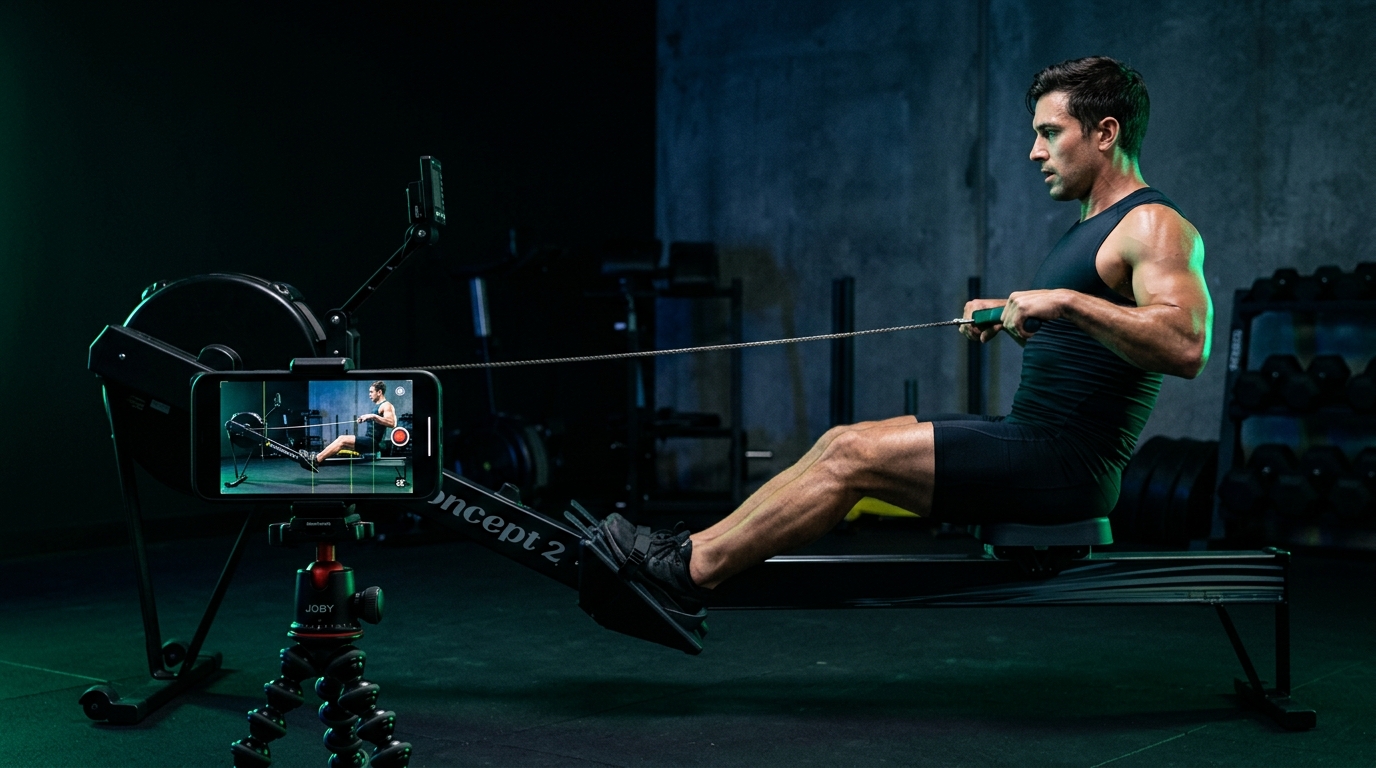
Finish timing. A camera at head height, slightly to the side (15–30 degrees off the rail), captures the finish and the hand-away ([8] Kleshnev 2020, Level 5). The finish timing is the time from the catch to the finish; the hand-away is the moment the handle leaves the body. The head-height angle captures both. A hip-height angle would miss the finish; a directly-side angle would miss the depth of the finish.

Catch posture. A camera at hip height, perpendicular to the rail, captures the layering of legs, body, and arms at the catch ([8] Kleshnev 2020, Level 5). The catch posture is the position of the body at the moment the blade enters the water; the layering is the timing of the leg drive, the body swing, and the arm draw. The hip-height perpendicular angle captures the layering; a head-height angle would miss the leg timing.

Recovery rhythm. A camera at the side, slightly above the rail, captures the recovery — the slide back to the catch ([8] Kleshnev 2020, Level 5). The recovery rhythm is the timing of the body swing, the slide, and the catch preparation. The side angle captures the rhythm; a perpendicular angle would miss the depth of the slide.

Drive force. A camera at the side, with the rail visible, captures the drive force — the leg drive, the body swing, and the arm draw ([8] Kleshnev 2020, Level 5). The drive force is the work done in the drive phase. The side angle captures the force; a perpendicular angle would miss the work.

The review: slow motion, single criterion

The review process is the third half of the answer. A one-question video reviewed in slow motion against a single criterion delivers high-precision KR; a one-question video reviewed at full speed against many criteria delivers low-precision KR.

The [6] Hattie & Timperley 2007 feedback meta-analysis in Review of Educational Research placed the same shape on the empirical side ([6] Hattie & Timperley 2007, Level 1a). High-effect feedback addresses the right level — task, process, self, regulation — and mismatched level is feedback that fails. The one-question video is task-level feedback; the slow-motion review is process-level feedback; the single criterion is the line between "you missed it" and "here is how to fix it".

The [15] Kluger & DeNisi 1996 Feedback Intervention Theory placed the same shape on the policy side ([15] Kluger & DeNisi 1996, Level 5). Feedback improves performance in ~70% of cases and degrades it in ~30%. The 30% degradation rate is the floor; feedback that addresses many criteria at once or arrives without a clear criterion is feedback that exceeds the floor.

The [13] Horn 2008 Advances in Sport Psychology chapter on coaching effectiveness placed the same shape on the operational side ([13] Horn 2008, Level 5). Quality feedback is specific, timely, and actionable. The one-question video reviewed in slow motion is specific (one question), timely (the same session), and actionable (the rower can act on a single criterion).

The privacy question

The privacy question matters as much as the setup and the review. The rower films the rower's own stroke, in the rower's own space, on a device the rower controls. The AI coach may ask for a video clip; the AI coach does not need a permanent record.

The [11] Mageau & Vallerand 2003 motivational model in Journal of Sport Sciences placed the coach–athlete relationship on the perception of competence ([11] Mageau & Vallerand 2003, Level 5). The rower who feels observed and judged by the AI coach is the rower whose perception of competence erodes. The AI coach that asks for a video clip and then stores it indefinitely is the AI coach whose perception erodes.

The [12] Smith & Smoll 1990 Mediated Achievement model in Journal of Sport and Exercise Psychology placed the same shape on the empirical side ([12] Smith & Smoll 1990, Level 5). Coach feedback shapes the athlete's perception of competence; mismatched feedback erodes it. A coach that asks for a video clip and then uses it for purposes the rower did not consent to is a coach whose feedback erodes the rower's perception of competence.

The operational rule: film in your own space, on your own device, and delete what you do not need. The AI coach that asks for a video clip is an AI coach that respects the rower's space; the rower that films the video is a rower that owns the clip. The boundary is the rower's, not the coach's.

The motor-learning frame

The motor-learning literature is the academic anchor for why one-question video beats whole-stroke video.

The [3] Schmidt & Lee 2011 Motor Learning and Performance textbook treats knowledge-of-results (KR) as a variable with frequency, precision, and timing as the policy knobs ([3] Schmidt & Lee 2011, Level 5). A one-question video reviewed in slow motion is low-frequency (one clip), high-precision (slow motion), and timed to the rower's state (the rower chooses when to review). A whole-stroke video is high-frequency (every stroke), low-precision (no slow motion), and not timed to the rower's state (the rower reviews when the AI coach tells them to).

The [4] Wulf 2007 self-controlled-feedback paper added the user's argument back into the loop ([4] Wulf 2007, Level 2b). Learners who choose when to receive feedback learn more than learners who receive it on a fixed schedule. The one-question video gives the rower a choice; the whole-stroke video does not.

The [5] Salmoni et al. 1988 Journal of Motor Behavior review reached the same conclusion from a different angle ([5] Salmoni et al. 1988, Level 5). Too-frequent KR degrades retention; less-frequent KR with the right level improves it.

The [6] Hattie & Timperley 2007 feedback meta-analysis in Review of Educational Research placed the same shape on the empirical side ([6] Hattie & Timperley 2007, Level 1a). High-effect feedback addresses the right level — task, process, self, regulation — and mismatched level is feedback that fails.

The load-monitoring frame

The load-monitoring literature is the second anchor. A video review session is a session; it counts toward the rower's weekly load.

The [7] Foster 2001 session-RPE method in Journal of Strength and Conditioning Research is the operational load metric ([7] Foster 2001, Level 5). Load is sRPE × duration, summed across a rolling window. The video review session has its own sRPE and duration; the rower's weekly load includes the video review.

The [22] Banister & Calvert 1980 fitness-fatigue TRIMP decomposition in Canadian Journal of Applied Sport Sciences is the underlying math ([22] Banister & Calvert 1980, Level 5). Each training impulse contributes a fitness factor and a fatigue factor; the difference is the performance state. A video review session is a low-fitness, low-fatigue impulse; the rower's body absorbs it without fatigue-side cost.

The [18] Halson 2014 training-load monitoring review in Sports Medicine is the methodological anchor ([18] Halson 2014, Level 5). Single markers misfire; the constellation of HR trend, sRPE, sleep, mood, and soreness is the load-bearing signal. The video review session's load is in the lower load zone; the rower's body absorbs it.

The [23] Meeusen et al. 2013 ECSS+ACSM consensus in MSSE placed the overtraining continuum on the same footing ([23] Meeusen et al. 2013, Level 5). A video review session that ignores the constellation is a session that risks moving the rower from no overreach into functional overreach.

Indoor-rowing-specific anchors

The video feedback's setup and review have indoor-rowing-specific implementations the AI coach can read from the PM5, the rower's chat, and the rower's logged markers.

Rate and force curve from the PM5. The [8] Kleshnev 2020 rowing-kinetics chapter is the rate-and-force reference ([8] Kleshnev 2020, Level 5). The [9] Concept2 technique guide is the manufacturer reference ([9] Concept2, Level 5). The [10] Concept2 PM5 documentation gives the operational readout ([10] Concept2, Level 5). The AI coach reads drive time, recovery time, and peak force to verify the rate is being held. When the rower's force curve drops on every other stroke, the AI coach may ask for a video clip — specifically a side angle with the rail visible — to diagnose the drop.

HR trend from the chest strap. The [36] Buchheit 2014 Frontiers in Physiology HR-monitoring review is the methodological anchor ([36] Buchheit 2014, Level 5). When the rower wears a chest strap, the AI coach reads resting HR, HRV, and HR recovery as the freshness signal.

Sleep and mood from the rower's log. The [12] Smith & Smoll 1990 Mediated Achievement model placed mood and soreness on the perception-of-competence side ([12] Smith & Smoll 1990, Level 5). The [18] Halson 2014 training-load monitoring review placed them on the load-monitoring side ([18] Halson 2014, Level 5). The AI coach reads sleep and mood as part of the freshness constellation.

Environmental divergence from the rower's chat. The [30] Leatherwood & Dragoo 2013 airline-travel review, the [31] Nieman 1994 URTI J-curve paper, and the [32] Fulco et al. 2000 altitude review are the environmental-divergence references ([30] Leatherwood & Dragoo 2013, Level 5; [31] Nieman 1994, Level 5; [32] Fulco et al. 2000, Level 5). The AI coach cannot infer travel, illness, or altitude from the PM5 data; the chat is the channel where the rower reports the divergence.

Three concrete scenarios

The peer-reviewed literature converges on three concrete scenarios in which video feedback works — and three in which it does not.

Scenario A (works) — the rower is filming the catch posture for a layering question. The camera is at hip height, perpendicular to the rail, capturing the layering of legs, body, and arms at the catch. The review is in slow motion, against a single criterion: "is the leg drive timed before the body swing?". The answer is yes or no, and the rower can act on it.

Scenario B (works) — the rower is filming the finish for a hand-away question. The camera is at head height, slightly to the side, capturing the finish and the hand-away. The review is in slow motion, against a single criterion: "is the handle fully extended at the finish?". The answer is yes or no, and the rower can act on it.

Scenario C (does not work) — the rower is filming the whole stroke for a single review. The camera is at the side, capturing the entire stroke. The review is at full speed, against many criteria: "is the layering correct? is the finish correct? is the recovery correct?". The rower's working memory cannot hold every cue at full fidelity; the review is low-precision KR; the [15] Kluger & DeNisi 1996 degradation rate is above the floor.

Practical rules for video feedback

The peer-reviewed literature converges on a small set of operational rules for video feedback.

Rule 1 — pick one question before you film. Before the camera turns on, the rower names the question: "is the layering correct?" or "is the finish correct?". The question picks the angle, the criterion, and the review.

Rule 2 — pick the angle that captures the answer. Hip-height perpendicular for layering; head-height slightly off for finish and hand-away; side angle for recovery rhythm; side angle with rail for drive force. The angle is the answer's geometry.

Rule 3 — review in slow motion against a single criterion. Slow motion is high-precision KR; a single criterion is the line between "you missed it" and "here is how to fix it". The review is process-level feedback ([6] Hattie & Timperley 2007, Level 1a).

Rule 4 — let the rower choose when to review. The [4] Wulf 2007 self-controlled-feedback evidence shows that the rower who chooses when to receive feedback learns more than the rower who receives it on a fixed schedule ([4] Wulf 2007, Level 2b). The review is the rower's choice.

Rule 5 — film in your own space, on your own device. The privacy boundary is the rower's. The AI coach may ask, but the rower owns the clip. The clip is deleted when the rower no longer needs it.

Rule 6 — log environmental divergence. Travel, illness, altitude, life stress. The [30] Leatherwood & Dragoo 2013 airline-travel review, the [31] Nieman 1994 URTI J-curve paper, and the [32] Fulco et al. 2000 altitude review are the environmental-divergence references ([30] Leatherwood & Dragoo 2013, Level 5; [31] Nieman 1994, Level 5; [32] Fulco et al. 2000, Level 5). The video review session's calibration respects the divergence.

Rule 7 — when in doubt, ask the coach. The default is to ask the coach which question to film. The coach's question is calibrated to the rower's state; the rower's question may not be.

Limitations and open questions

The motor-learning evidence base is older than the indoor-rowing literature it now informs. The [3] Schmidt & Lee 2011 textbook and the [5] Salmoni 1988 review predate the indoor-rowing literature, and the indoor-rowing application is by analogy, not direct measurement. The honest read for the rower: the principle survives the application shift; the magnitude does not.

The self-controlled-feedback evidence is in motor-learning labs. The [4] Wulf 2007 and [16] Chiviacowsky & Wulf 2002 experiments were conducted in motor-learning labs with simple motor tasks, not in indoor-rowing gyms with multi-modal physiological signals. The indoor-rowing application is by analogy, not direct measurement.

The transferability from elite sport to indoor rowing is by analogy, not direct measurement. The [20] Hagerman 1984 Sports Medicine physiology review and the [21] Ingham et al. 2008 MSSE indoor-rower training study are the rowing-specific anchors ([20] Hagerman 1984, Level 5; [21] Ingham et al. 2008, Level 1b/2b). The honest read for the rower: the principles travel; the prescriptions have to be calibrated to the rower's body over time.

The AI-coaching literature is new. Peer-reviewed evidence for AI-driven session-by-session adaptation in indoor rowing is in early stages. The [3] Schmidt & Lee 2011 textbook, the [4] Wulf 2007 self-controlled-feedback paper, the [18] Halson 2014 review, and the [23] Meeusen 2013 consensus are the closest published analogues. The honest read for the rower: the framework rests on the older literature, and the AI-coaching literature has yet to catch up.

The privacy literature is older than the AI-coaching literature. The [11] Mageau & Vallerand 2003 motivational model and the [12] Smith & Smoll 1990 Mediated Achievement model are the coach–athlete relationship anchors. The privacy boundary is the rower's, not the coach's. The peer-reviewed literature on athlete privacy in AI-driven coaching is still developing.

The summary in one paragraph

Video feedback is most useful when the filming is set up to answer one specific question — finish timing, catch posture, recovery rhythm — and most useless when the filming is set up to capture the whole stroke at once ([1] World Rowing, Level 5; [2] Concept2, Level 5). The [3] Schmidt & Lee 2011 motor-learning textbook and the [5] Salmoni 1988 KR review establish that KR frequency, precision, and timing shape retention; the [4] Wulf 2007 self-controlled-feedback paper shows that the rower who chooses timing learns more ([3] Schmidt & Lee 2011, Level 5; [5] Salmoni et al. 1988, Level 5; [4] Wulf 2007, Level 2b). The [6] Hattie & Timperley 2007 feedback meta-analysis places the right level on the empirical side ([6] Hattie & Timperley 2007, Level 1a). The [15] Kluger & DeNisi 1996 Feedback Intervention Theory shows that feedback improves performance in ~70% of cases and degrades it in ~30% ([15] Kluger & DeNisi 1996, Level 5). The [11] Mageau & Vallerand 2003 motivational model and the [12] Smith & Smoll 1990 Mediated Achievement model place the coach–athlete relationship on the perception of competence ([11] Mageau & Vallerand 2003, Level 5; [12] Smith & Smoll 1990, Level 5). The [13] Horn 2008 coaching-effectiveness framework and the [14] Mason & Holt 2012 coaching-feedback review place the same shape on the operational side ([13] Horn 2008, Level 5; [14] Mason & Holt 2012, Level 5). The [8] Kleshnev 2020 rowing-kinetics chapter, the [9] Concept2 technique guide, and the [10] Concept2 PM5 documentation are the indoor-rowing-specific anchors ([8] Kleshnev 2020, Level 5; [9] Concept2, Level 5; [10] Concept2, Level 5). The [17] ACSM progression-models position stand is the progression anchor ([17] ACSM, Level 5). The [7] Foster 2001 session-RPE method and the [22] Banister & Calvert 1980 TRIMP decomposition are the load anchors ([7] Foster 2001, Level 5; [22] Banister & Calvert 1980, Level 5). The [18] Halson 2014 training-load monitoring review is the methodological anchor ([18] Halson 2014, Level 5). The [19] British Rowing "Go Row Indoor" plan is the governing-body anchor ([19] British Rowing, Level 5). The [20] Hagerman 1984 indoor-rowing physiology review and the [21] Ingham et al. 2008 indoor-rower training study are the rowing-specific anchors. The [23] Meeusen 2013 ECSS+ACSM consensus placed the overtraining continuum on the same footing ([23] Meeusen et al. 2013, Level 5). The [24] Mujika & Padilla 2000 detraining review, the [25] Bosquet 2007 tapering meta-analysis, and the [26] Kiely 2018 critical review are the periodisation anchors. The [27] Sawka 2007 ACSM fluid-replacement position stand, the [28] Burke 2011 carbohydrate-intake review, and the [29] Phillips 2011 protein review are the substrate anchors. The [30] Leatherwood 2013 airline-travel review, the [31] Nieman 1994 URTI J-curve paper, and the [32] Fulco 2000 altitude review are the environmental-divergence references. The [33] Borg 1982 CR-10 scale is the RPE anchor; the [34] Scherr 2013 RPE–lactate correspondence gives the RPE a quantitative floor; the [35] Reed & Pipe 2014 talk-test review gives the ventilation second-channel. The [36] Buchheit 2014 HR-monitoring review is the cardio second-channel.

The right posture is to use the camera as the answer's geometry, the slow motion as the high-precision KR, the single criterion as the line between "you missed it" and "here is how to fix it", and the privacy boundary as the rower's. The one-question video is the input; the rower's body is the variable; the slow-motion review is the answer.

For a deeper exploration of how MyNextRow's AI coach uses load governors to adapt each session, see our AI coaching load governors plain-English guide.

What to do with this article

Read the principle: video feedback works when the filming answers one question, the review is in slow motion against a single criterion, and the privacy boundary is respected.

Read the setup: hip-height perpendicular for layering; head-height slightly off for finish and hand-away; side angle for recovery rhythm; side angle with rail for drive force. The question picks the angle.

Read the review: slow motion; single criterion; one question at a time. The review is process-level feedback; the criterion is the line between "you missed it" and "here is how to fix it".

Read the privacy: film in your own space; film on a device you control; delete what you do not need. The AI coach may ask, but the rower owns the clip.

Read the practical read: pick one question before you film; pick the angle that captures the answer; review in slow motion against a single criterion; let the rower choose when to review; film in your own space, on your own device; log environmental divergence; when in doubt, ask the coach.

Read the research: the [3] Schmidt & Lee 2011 motor-learning textbook, the [5] Salmoni 1988 KR review, the [4] Wulf 2007 self-controlled-feedback paper, the [16] Chiviacowsky & Wulf 2002 confirmation, and the [6] Hattie & Timperley 2007 feedback meta-analysis anchor the motor-learning frame; the [11] Mageau & Vallerand 2003 motivational model and the [12] Smith & Smoll 1990 Mediated Achievement model anchor the coach–athlete relationship side; the [13] Horn 2008 coaching-effectiveness framework and the [14] Mason & Holt 2012 coaching-feedback review anchor the operational side; the [15] Kluger & DeNisi 1996 Feedback Intervention Theory places the empirical anchor on the 30% degradation rate; the [8] Kleshnev 2020 rowing-kinetics chapter, the [9] Concept2 technique guide, and the [10] Concept2 PM5 documentation anchor the indoor-rowing-specific bounds.

When the question is one, the angle is right, the review is slow, and the privacy is respected, the video feedback is the input. The rower's body is the variable. The slow-motion review is the answer.

Video feedback works when the filming answers one question, the review is in slow motion against a single criterion, and the privacy boundary is respected. The one-question video is the input. The rower's body is the variable. The slow-motion review is the answer.

Key points

  • Video feedback works when the filming is set up to answer one specific question, not the whole stroke. (Level 5)
  • Camera at hip height perpendicular to the rail captures layering; head height captures finish and hand-away. (Level 5)
  • Review one movement question at a time, in slow motion, against a single clear criterion. (Level 5)
  • Film your own stroke in your own space on a device you control; delete what you do not need. (Level 5)
  • The motor-learning frame (Schmidt & Lee, Wulf, Salmoni, Hattie & Timperley) explains why one-question-at-a-time beats whole-stroke review. (Level 1a)
  • The privacy frame (your space, your device, your delete) is the boundary condition for filming the rower at home. (Level 5)
  • Use this article to set up the filming; let the coach decide what question to ask. (Level 5)

Sources and further reading

  1. World Rowing — Coaching Education ResourcesGoverning-body education context for teaching rowing skills.
  2. Concept2 — Indoor Rowers TrainingIndoor-rowing practice ideas and monitor-aware training advice.
  3. Schmidt RA, Lee TD. Motor Learning and Performance. 5th ed, Human Kinetics 2011The motor-learning textbook. KR frequency, precision, and timing shape retention.
  4. Wulf G. Self-controlled practice and motor learning. J Mot Behav 2007;39:291–299Learners who choose when to receive feedback learn more than learners who receive it on a fixed schedule.
  5. Salmoni AW, Schmidt RA, Walter CB. Knowledge of results and motor learning. J Mot Behav 1988;20:67–91The KR review. Too-frequent KR degrades retention; less-frequent KR with the right level improves it.
  6. Hattie J, Timperley H. The power of feedback. Rev Educ Res 2007;77:81–112The feedback meta-analysis. High-effect feedback addresses the right level.
  7. Foster C et al. A new approach to monitoring exercise training. J Strength Cond Res 2001;15:109–115The session-RPE method. Load is sRPE × duration; the operational load signal.
  8. Kleshnev V. Kinetics of rowing. In: Rowing: Olympic Handbook of Sports Medicine. Wiley 2020The 2020 rowing-kinetics handbook chapter. Drive-to-recovery ratios, handle speed, force-curve interpretation.
  9. Concept2 — Indoor rowing technique guideThe manufacturer's canonical reference for the four phases of the stroke.
  10. Concept2 — PM5 monitor documentation: drive time, recovery time, peak forceThe PM5 reports drive time, recovery time, drive length, and peak force for every stroke.
  11. Mageau GA, Vallerand RJ. The coach-athlete relationship: a motivational model. JSS 2003;2:119–130The motivational model. Quality feedback depends on perceived coach competence.
  12. Smith RE, Smoll FL. Self-esteem and children's achievements — the coach's role. J Sport Exerc Psychol 1990;12:1–16The Mediated Achievement model. Coach feedback shapes the athlete's perception of competence.
  13. Horn TS. Coaching effectiveness in the sport domain. In: Horn TS ed. Advances in Sport Psychology. 3rd ed, 2008The coaching-effectiveness framework. Quality feedback is specific, timely, and actionable.
  14. Mason A, Holt LE. A review of the literature on coaching feedback. Int J Sports Sci Coach 2012;7:119–128The coaching-feedback review. Effective feedback is specific, timely, and actionable.
  15. Kluger AN, DeNisi A. The effects of feedback interventions on performance. Psychol Bull 1996;119:254–284The Feedback Intervention Theory. Feedback improves performance in ~70% of cases and degrades it in ~30%.
  16. Chiviacowsky S, Wulf G. Self-controlled feedback: does it enhance learning? J Mot Behav 2002;34:267–276The experimental confirmation. Self-controlled feedback groups outperformed yoked groups on retention tests.
  17. ACSM — Position Stand on Progression Models and Injury PreventionReference for progression timing and when to add a new cue versus hold steady.
  18. Halson SL. Monitoring training load to understand fatigue in athletes. Sports Med 2014;44 Suppl 2:139–147Training-load monitoring review. Single markers misfire; the constellation is the load-bearing signal.
  19. British Rowing — Go Row Indoor: First sessionsBeginner plan opens with short, repeatable sessions before introducing hard work.
  20. Hagerman FC. Applied physiology of rowing. Sports Med 1984;1:303–326The indoor-rowing physiology anchor. Elite male rowers hold VO2max ~6.1 ± 0.6 L/min.
  21. Ingham SA et al. Low- versus mixed-intensity rowing training. MSSE 2008;40:579–584The indoor-rower-specific training study. Low- and mixed-intensity programs improved 2K time and VO2peak similarly.
  22. Banister EW, Calvert TW. Planning for future performance. Can J Appl Sport Sci 1980;5:170–176The fitness-fatigue TRIMP decomposition. Each impulse contributes fitness and fatigue.
  23. Meeusen R et al. Prevention and treatment of overtraining: ECSS+ACSM consensus. MSSE 2013;45:186–205ECSS+ACSM consensus. Functional overreaching is recoverable in ~2 weeks; non-functional takes weeks to months.
  24. Mujika I, Padilla S. Detraining: Part I. Med Sci Sports Exerc 2000;30:79–87The detraining timeline. A one-week layoff produces measurable losses in plasma volume and glycogen.
  25. Bosquet L et al. Effects of tapering on performance: a meta-analysis. MSSE 2007;39:1358–1365The tapering meta-analysis. A 41–49% volume taper over 7–14 days maximises performance gains.
  26. Kiely J. Periodization theory: confronting an inconvenient truth. Sports Med 2018;48:753–764The seminal critique. Periodisation's experimental base is thinner than the textbooks claim.
  27. Sawka MN et al. ACSM position stand: exercise and fluid replacement. MSSE 2007;39:377–390The ACSM fluid-replacement position stand. Dehydration degrades capacity on hot days.
  28. Burke LM et al. Carbohydrates for training and competition. JSS 2011;29 Suppl 1:S17–27The carbohydrate-intake review. Under-fuelling on hard days is a hidden drag on the prescribed plan.
  29. Phillips SM, Van Loon LJC. Dietary protein for athletes. JSS 2011;29 Suppl 1:S29–38The protein-for-recovery review. Daily protein intake is a substrate for the plan's adaptation claim.
  30. Leatherwood WE, Dragoo JL. Effect of airline travel on performance. BJSM 2013;47:561–567The airline-travel review. Eastward or westward travel disrupts sleep, hydration, and nutrition.
  31. Nieman DC. Exercise, URTI, and the immune system. MSSE 1994;26:128–139The J-curve URTI paper. Heavy exercise elevates URTI risk in the 1–2 weeks after a marathon-level event.
  32. Fulco CS, Rock PB, Cymerman A. Altitude and athletic performance. Aviat Space Environ Med 2000;71:162–171The altitude review. 'Live high, train low' is the most defensible model.
  33. Borg GA. Psychophysical bases of perceived exertion. Med Sci Sports Exerc 1982;14:377–381The Borg CR-10 scale. The categorical anchor for RPE.
  34. Scherr J et al. Borg's RPE and physiological markers. Eur J Appl Physiol 2013;113:147–1552,560 adults. Borg RPE r = 0.83 with blood lactate; RPE at LT ~10.8.
  35. Reed JL, Pipe AL. The talk test for prescribing and monitoring exercise intensity. Curr Opin Cardiol 2014;29:498–505The talk-test review. Above VT/LT, comfortable speech is not likely possible.
  36. Buchheit M. Monitoring training status with HR measures. Front Physiol 2014;5:73HR-monitoring review. rHR, HRV, HRR each capture a different aspect of readiness.