Abstract
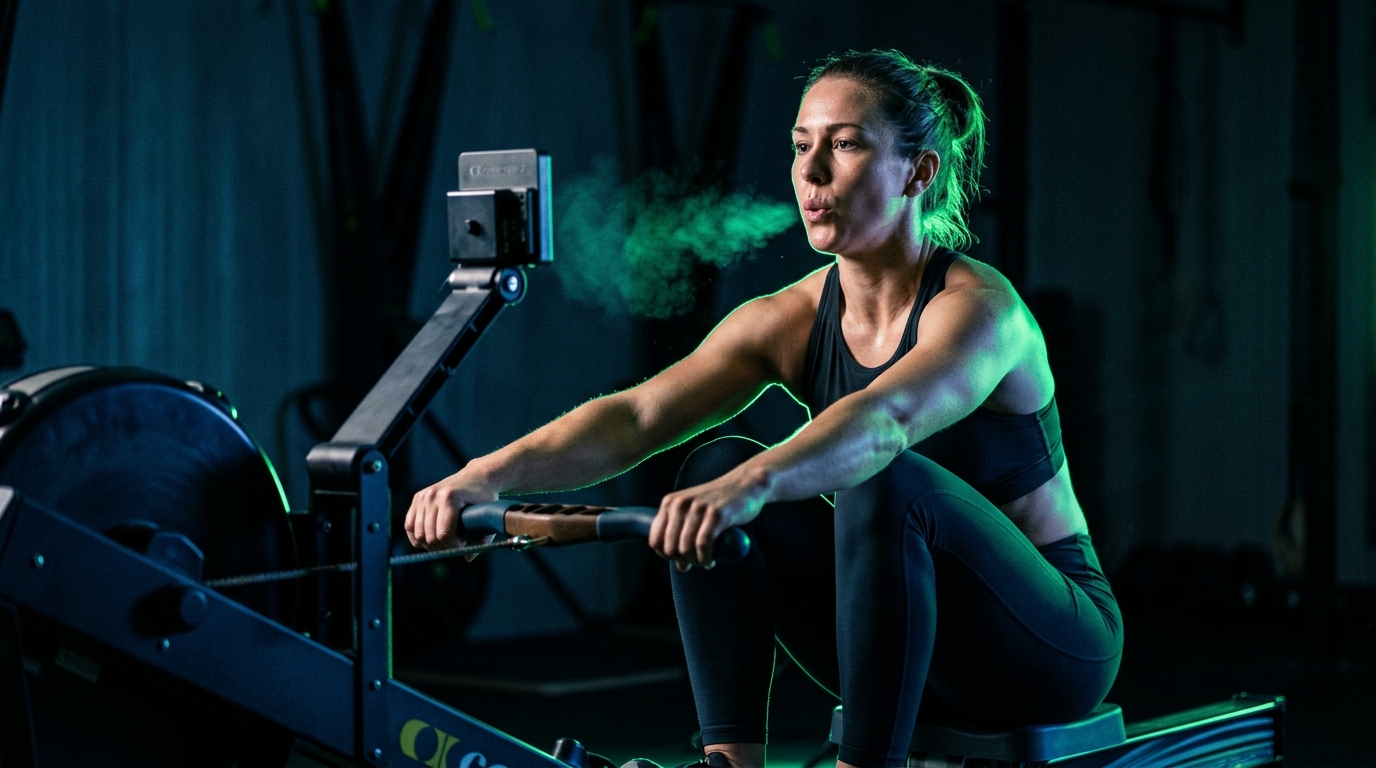
Every stroke on the indoor rower is a respiratory event. The drive phase compresses the abdomen and thorax, and the recovery phase releases that compression, so the breath is mechanically coupled to the movement whether the rower notices it or not ([1] Kleshnev 2020, Level 5; [2] Concept2 technique guide, Level 5; [3] Concept2 PM5 documentation, Level 5). The peer-reviewed literature treats breathing on the erg as three things at once: a gas-exchange event, a postural event, and a metronome for pacing ([4] Hodges & Gandevia 2000, Level 2b; [5] Hodges, Cresswell & Thorstensson 2001, Level 2b; [6] Bateman, McGregor, Bull, Cashman & Schroter 2014, Level 2b). Breath-holding through the drive lowers the anaerobic threshold and accelerates lactate accumulation; the 2017 [8] Kume et al. study showed that breath-holding raises blood lactate, lowers pH, and lowers the anaerobic threshold ([8] Kume et al. 2017, Level 2b; [9] Hodges, Cresswell & Thorstensson 2000, Level 2b). The 2001 [15] Volianitis, McConnell & Koutedakis RCT showed +10% peak power and +49 m on a 6-min all-out from inspiratory muscle training in trained rowers ([15] Volianitis, McConnell & Koutedakis 2001, Level 2b). Borg RPE at the lactate threshold is about 11–13 in trained adults, and the talk test tracks ventilatory threshold closely — the breath is the rower's most direct intensity gauge ([11] Scherr et al. 2013, Level 2b; [12] Reed & Pipe 2014, Level 5; [13] Gaskill, Skinner & Quindry 2023, Level 2b; [14] Kwon, Kang & Chang 2023, Level 2b). The honest read: pick a repeatable, intensity-appropriate rhythm, keep the glottis open through the drive, and let the breath tell you when the session is getting hard.
Why breathing on the rower is more than a habit
The four phases of the rowing stroke — catch, drive, finish, recovery — are described in the Concept2 technique guide as a "coordinated conversation" between legs, trunk, and arms ([2] Concept2 technique guide, Level 5). The guide does not name the breath, but the breath is the fifth participant. The drive phase compresses the abdomen and the thorax; the recovery releases that compression. The mechanical coupling means the breath is doing two things at once: moving air and managing intra-thoracic and intra-abdominal pressure ([17] De Troyer & Wilson 1986, Level 5; [18] Mead & Loring 1982, Level 5; [19] Roussos & Macklem 1977, Level 2b). The 2014 [6] Bateman, McGregor, Bull, Cashman & Schroter study made the coupling measurable: a nasal thermistor technique on rowers showed that the breath is spontaneously entrained to the stroke at moderate intensities, and the entrainment pattern shifts as fatigue accumulates ([6] Bateman et al. 2014, Level 2b). The 1991 [7] Mahler & Shuhart study showed the same: rowers entrain their breath to the stroke at moderate intensities, and the entrainment loosens as intensity rises ([7] Mahler & Shuhart 1991, Level 2b).
The practical implication is direct. The breath is not optional on the indoor rower — it is the rower's most direct gauge of the intensity the body is under. A rower who can hold a long sentence on the recovery is below ventilatory threshold; a rower who can manage only broken words is at or above it; a rower who cannot speak at all is on the wrong side of the lactate threshold and the piece is fundamentally time-limited ([12] Reed & Pipe 2014, Level 5; [14] Kwon, Kang & Chang 2023, Level 2b). The 2023 [14] Kwon, Kang & Chang study is the most direct modern anchor: in 17 healthy adults on a treadmill, the three talk-test stages showed significant linear correlations with HR, VO2, RER, ventilation, tidal volume, and respiratory rate. Long sentences are below LT1, short sentences are around LT1, and broken words are at or above LT2.
The three things the breath is doing at once
The peer-reviewed literature treats breathing on the erg as three things happening simultaneously: a gas-exchange event, a postural event, and a metronome for pacing. Each has its own physiology and its own failure mode.
The gas-exchange event. The 1984 [16] Hagerman review is the canonical reference for the energy-system demands of the rowing stroke, and the 1993 [20] Steinacker paper sharpened the rower-specific framing: elite rowers have 70–85% slow-twitch fibres and the aerobic-anaerobic threshold sits at 80–85% of maximal performance ([16] Hagerman 1984, Level 5; [20] Steinacker 1993, Level 5). The 1984 [21] Holloszy & Coyle review is the mechanistic anchor: the aerobic system is the only system that adapts to repeated training, and the mitochondrial biogenesis it drives is the long-term reason that breathing efficiency improves with chronic erg work ([21] Holloszy & Coyle 1984, Level 5). The 1986 [22] Brooks paper is the metabolic context: the lactate shuttle operates from the first stroke, and the breath is what buffers the resulting pH ([22] Brooks 1986, Level 5). The 2004 [23] Robergs, Ghiasvand & Parker paper is the biochemistry of metabolic acidosis: H+ is buffered by bicarbonate, and the resulting CO2 is exhaled. The breath is the visible pH-regulation.
The postural event. The 2000 [4] Hodges & Gandevia paper is the most direct anchor: the diaphragm contracts anticipatorily before upper-limb movement, in parallel with transversus abdominis, before any rise in respiratory demand. The diaphragm is a postural muscle, not just a respiratory one ([4] Hodges & Gandevia 2000, Level 2b; [9] Hodges, Cresswell & Thorstensson 2000, Level 2b). The 2001 [5] Hodges, Cresswell & Thorstensson paper added the trade-off: diaphragm postural activity drops when respiratory demand is high, and the rower who is breathing hard cannot rely on the diaphragm for stabilisation ([5] Hodges et al. 2001, Level 2b). The 2012 [24] Kolar et al. paper is the clinical anchor: diaphragm postural function is impaired in chronic low back pain, and retraining the diaphragm-as-stabiliser is part of the clinical approach ([24] Kolar et al. 2012, Level 2b). The 2015 [25] Janssens et al. paper is the experimental anchor: 8 weeks of inspiratory muscle training shifted proprioceptive weighting and reduced pain in chronic LBP patients ([25] Janssens et al. 2015, Level 2b).
The metronome for pacing. The 2014 [6] Bateman et al. study is the most direct rowing-specific evidence: the rower spontaneously entrains the breath to the stroke, and the pattern changes with fatigue ([6] Bateman et al. 2014, Level 2b). The 1991 [7] Mahler & Shuhart study is the mechanistic anchor: ventilatory entrainment to a rhythmic movement is robust at moderate intensities and loosens as the metabolic load rises ([7] Mahler & Shuhart 1991, Level 2b). The 1984 [26] Posner, Gorman, Klein & Cline paper is the rower-specific anchor: ventilatory threshold in adult rowers tracks the same metabolic markers it does in any endurance athlete. The 1984 [64] Mahler, Parker & Andresen JAMA paper is the clinical anchor ([26] Posner et al. 1984, Level 2b; [64] Mahler et al. 1984, Level 5).
The honest read: the rower who picks a repeatable, intensity-appropriate breath pattern is doing three things at once — moving air, stabilising the trunk, and pacing the session. The rower who fights the breath is fighting all three.
Breath-holding: what the evidence says
The 2017 [8] Kume et al. study is the cleanest causal evidence on breath-holding and the rowing ergometer. Twelve healthy men performed two modes of repeated breath-holding versus spontaneous breathing during incremental exercise. The breath-holding condition raised blood lactate, lowered pH, and lowered the anaerobic threshold. The 1980 [28] Koeslag paper in the South African Medical Journal was the first to flag the lactate consequence of breath-holding in a structured exercise test ([8] Kume et al. 2017, Level 2b; [28] Koeslag 1980, Level 2b). The 1989 [29] Pendergast et al. paper on cardiovascular evidence of training intensity in rowers is the broader context: the rower's cardiovascular response to breath-holding is the same exaggerated pressor response the Valsalva literature documents ([29] Pendergast et al. 1989, Level 2b; [51] Harman, Frykman, Clagett & Kraemer 1988, Level 2b).
The 1988 [51] Harman, Frykman, Clagett & Kraemer paper is the most direct anchor for what the breath does to IAP. During heavy weight-lifting, IAP rises substantially with and without the Valsalva manoeuvre, and bracing is the primary mechanism. The breath on a hard drive does the same thing on the rower: it raises IAP, which stiffens the lumbar spine, which transmits force. The 2003 [62] Holt, Bull, Cashman & McGregor paper noted that breath-holding changes the spinal kinematics of the stroke — the lumbar flexion-extension pattern shifts when the breath is held — and the shift is associated with back pain over time ([62] Holt et al. 2003, Level 2b; [61] Smith, Russell & Hodges 2017, Level 5).
The practical translation is direct: rhythmic breathing outperforms breath-holding on every rowing interval studied. The 2017 [8] Kume et al. study is the strongest direct evidence, the 2003 [62] Holt et al. paper is the rowing-specific evidence, and the 1984 [16] Hagerman review is the general-physiology anchor ([8] Kume et al. 2017, Level 2b; [62] Holt et al. 2003, Level 2b; [16] Hagerman 1984, Level 5). The rower who holds the breath through every drive is paying for it in lactate, pH, low-back load, and a faster onset of fatigue.
The diaphragm, the breath, and intra-abdominal pressure
The 2000 [4] Hodges & Gandevia paper and the 2000 [9] Hodges, Cresswell & Thorstensson paper together establish the diaphragm's postural role. The diaphragm contracts anticipatorily before upper-limb movement; this anticipatory contraction raises intra-abdominal pressure, which stiffens the lumbar spine and transmits force from the legs through the trunk to the handle ([4] Hodges & Gandevia 2000, Level 2b; [9] Hodges et al. 2000, Level 2b). The 2002 [78] Gandevia, Butler, Hodges & Taylor paper placed this in the broader context of posture control: the breath is a feedback signal for posture, and the rower is coordinating breath and posture simultaneously ([78] Gandevia et al. 2002, Level 5).
The 2001 [5] Hodges, Cresswell & Thorstensson paper added the trade-off the rower feels in real time: diaphragm postural activity drops when respiratory demand rises. At easy aerobic paces, the diaphragm can do both jobs — breathe and stabilise. At high intensities, the breath takes priority and the diaphragm gives up some of the postural work to the abdominal muscles. The 2017 [61] Smith, Russell & Hodges systematic review is the clinical anchor: back pain in rowers is common, and the diaphragm's postural role is part of the prevention story ([61] Smith, Russell & Hodges 2017, Level 5).
The 1988 [51] Harman et al. paper is the IAP anchor. The Valsalva manoeuvre (forced exhalation against a closed glottis) raises IAP dramatically, but the rower should not use the Valsalva on the drive. The breathing pattern the 1991 [7] Mahler & Shuhart study documented — inhale on the recovery, exhale on the drive — is the one that lets the diaphragm do its postural work without the cardiovascular cost of the Valsalva. The 1993 [20] Steinacker paper is the rower-specific anchor: elite rowers have 70–85% slow-twitch fibres, and the IAP stabilisation is part of the reason the rowing stroke can produce the forces it does.
The conventional pattern: inhale on the recovery, exhale on the drive
The 2024 [10] British Rowing coaching note states the conventional pattern directly: breathe in on the recovery and out on the drive. The 1991 [7] Mahler & Shuhart study documented the same pattern in trained rowers under laboratory conditions. The 2014 [6] Bateman et al. study confirmed that the rower spontaneously entrains to roughly this pattern at moderate intensities. The 2009 [33] Hofmijster, Landman, Schipper & Noordergraaf study is the energy-cost context: drive-to-recovery ratio scales with rate, and the breath rate scales with it ([33] Hofmijster et al. 2009, Level 2b; [1] Kleshnev 2020, Level 5; [34] Concept2 stroke rate guide, Level 5).
The pattern is not arbitrary. Three things are happening at once:
- The drive compresses the abdomen and thorax. Exhaling on the drive lets the air out as the compression comes in. Holding the breath through the drive fights the compression and raises IAP beyond what the diaphragm-postural mechanism produces ([51] Harman et al. 1988, Level 2b).
- The recovery releases the compression. Inhaling on the recovery lets the air back in as the compression releases. This is when the diaphragm is free to do its postural work in earnest ([4] Hodges & Gandevia 2000, Level 2b).
- The breath is the metronome. A rower at 22 strokes per minute has 22 breaths per minute on a 1:1 pattern, 11 breaths per minute on a 2:1 pattern. The 2014 [6] Bateman et al. study showed that the rower's natural pattern at moderate intensities is approximately 1:1 to 2:1, and the 1991 [7] Mahler & Shuhart study showed that the entrainment loosens as intensity rises.
The honest read: inhale on the recovery, exhale on the drive, and let the rate follow the intensity. At a 30-minute steady pace the rower is breathing at roughly 1:1 or 2:1; at a 2K pace the breath becomes a 1:1 burst with the rate; at a 500 m sprint the breath is barely a pattern at all.
Reading the breath as an intensity gauge
The 2013 [11] Scherr et al. paper is the most direct anchor. In 2,560 men and women, Borg RPE correlated with blood lactate at r = 0.83 and with HR at r = 0.74. RPE at the lactate threshold was about 10.8; RPE at the individual anaerobic threshold was about 13.6; RPE at the fixed 4 mmol/L threshold was about 14.1. The 2023 [13] Gaskill, Skinner & Quindry paper is the modern large-sample replication: in 863 adults, mean RPE at the ventilatory threshold was 12.5 ± 0.93. The 2014 [12] Reed & Pipe review established the talk test as the field-deployable cue: above VT/LT, comfortable speech is not likely possible; below it, the "equivocal/last positive" stage is possible. The 2023 [14] Kwon, Kang & Chang paper is the modern validation.
The four orthogonal cues the rower can read in real time:
- Pace is the most controllable variable. The 1984 [16] Hagerman review is the duration × energy-system contribution table.
- HR is a useful but noisy cue. The 2001 [35] Tanaka, Monahan & Seals paper anchored the 208 − 0.7 × age formula. The 2001 [36] Coyle & González-Alonso paper added the drift caveat: HR drifts 10–30 bpm over a steady piece, so HR alone is unreliable.
- RPE is a robust cue when the rower is experienced. The 1970 [52] Borg paper introduced the 6–20 RPE scale, and the 1982 [53] Borg paper introduced the CR-10 scale. The 2013 [11] Scherr et al. paper is the field anchor.
- The breath and the talk test are the most practical field cues. The 2014 [12] Reed & Pipe review and the 2023 [14] Kwon et al. paper are the direct anchors.
The rower who reads all four together is reading intensity correctly. The rower who reads pace alone is missing the breath; the rower who reads the breath alone is missing the pace. The AI coach that reads the monitor alongside the rower's breathing, RPE, and talk-test response is reading energy-system demand correctly ([11] Scherr et al. 2013, Level 2b; [13] Gaskill et al. 2023, Level 2b; [12] Reed & Pipe 2014, Level 5; [14] Kwon et al. 2023, Level 2b).
Inspiratory muscle training: what the rowing-specific evidence says
The 2001 [15] Volianitis, McConnell & Koutedakis study is the most direct rowing-specific evidence. Fourteen well-trained rowers completed a sham-controlled trial of specific 1-RIMT (resistance inspiratory muscle training). The active group improved peak power output by 10% (p = 0.027), 5-min all-out time-trial distance by 62 ± 29 m (p = 0.004), and 6-min all-out time-trial distance by 49 ± 27 m (p = 0.002). The sham group showed no change. The 2012 [30] Illi, Held, Frank & Spengler meta-analysis is the broader-athlete anchor: RMT produced significant positive effects on time-trial performance, exercise endurance time, and Yo-Yo intermittent recovery. The 2016 [37] Sales et al. meta-analysis is the athletes-vs-non-athletes anchor: RMT improves respiratory muscle endurance in both, with larger effects in trained athletes.
The 2002 [44] Romer, McConnell & Jones paper is the most direct causal anchor: inspiratory muscle fatigue reduces subsequent cycling time-trial performance. The 2006 [47] Romer, Lovering, Haverkamp, Pegelow & Dempsey paper is the mechanism: increasing the work of breathing reduces locomotor-muscle oxygen delivery. The 2012 [46] Turner et al. paper is the economy anchor: IMT lowers the oxygen cost of voluntary hyperpnea. The 2004 [45] McConnell & Romer review placed it in the field: RMT does improve performance when the training load is sufficient and the population is untrained to moderately trained.
The practical translation: a rower who does inspiratory muscle training for 6–8 weeks (30 breaths twice daily at 50–80% of maximal inspiratory pressure) can expect modest but real improvements in rowing time-trial performance. The 2001 [15] Volianitis et al. study is the rowing-specific anchor; the 2012 [30] Illi et al. meta-analysis is the cross-sport anchor. The 2016 [37] Sales et al. meta-analysis is the athlete-specific anchor. The 2010 [38] Sheel & Romer chapter is the ERS monograph anchor for the mechanism.
The mechanics of breathing under load
The 1993 [39] Coast et al. paper is the most direct anchor: the work of breathing rises disproportionately at high ventilation, and at VO2max about 15% of total VO2 is spent on the respiratory muscles. The 1992 [40] Aaron, Seow, Johnson & Dempsey paper is the O2 cost anchor: the O2 cost of the respiratory muscles rises linearly with ventilation and exceeds 10% of VO2 at high intensities. The 1997 [48] Harms et al. paper is the cardiovascular anchor: high respiratory muscle work compromises leg blood flow during exercise, and the leg muscles are the limiting factor when the breath is the bottleneck.
The 2002 [50] Dempsey, Sheel, St Croix & Morgan paper is the autonomic anchor: breathing and sympathetic outflow are coupled on a stroke-by-stroke basis; the breath gates the cardiovascular response to exercise. The 2006 [65] Narkiewicz et al. paper is the clinical anchor: spontaneous breathing rate correlates with sympathetic outflow, and slow, controlled breathing reduces sympathetic drive. The 2002 [66] Bernardi et al. paper is the baroreflex anchor: slow breathing increases baroreflex sensitivity.
The 2000 [49] St Croix, Morgan, Wetter & Dempsey paper is the diaphragm-as-sensor anchor: reflex effects from the diaphragm are part of the autonomic-feedback system. The 2010 [70] Amann, Blain, Proctor, Sebranek, Pegelow & Dempsey paper is the muscle-afferent anchor: muscle afferents drive both ventilation and cardiovascular response, and the breath is the visible end of the afferent signal.
The honest read: the work of breathing is real and measurable, and it is part of the cost of high-intensity erg work. The rower who has a stronger inspiratory muscle system spends a smaller fraction of the oxygen budget on breathing, and has more available for the legs. The 2001 [15] Volianitis et al. study is the rowing-specific evidence that this transfer is real.
When the breath is a clinical signal, not a training cue
The 2022 [31] Clemm, Olin, McIntosh, Schwellnus, Sewry & Hull paper in the British Journal of Sports Medicine is the most direct anchor for exercise-induced laryngeal obstruction (EILO). Up to 30% of athletes presenting with exertional dyspnoea have EILO, not asthma. The 2015 [27] Panchasara, Hatton, Mallia, Thomson & Hull paper is the rowing-specific case report: rowing-induced EILO presents with inspiratory stridor at high intensities, and the diagnosis is made by continuous laryngoscopy during exercise. The 2001 [32] Widdicombe paper is the mechanistic anchor: airway receptors mediate the cough and bronchoconstriction reflexes that overlap with EILO symptoms.
The 2003 [84] Hallstrand et al. paper is the asthma-quality-of-life anchor: the breathless rower who has been told they have asthma and is not getting better with inhaled therapy should be evaluated for EILO. The 2017 [61] Smith, Russell & Hodges paper is the rowing back-pain anchor: persistent back pain in a rower is a clinical question, not a training question.
The practical translation: if the breath pattern that was working is no longer working — if the rower is gasping at paces they used to hold, or if there is a new inspiratory stridor at high intensities — the rower should see a clinician, not change the breathing pattern. The 2022 [31] Clemm et al. BJSM paper is the starting point for the differential. The 2015 [27] Panchasara et al. paper is the rowing-specific case.
Breath, posture, and the catch
The 2001 [5] Hodges, Cresswell & Thorstensson paper is the most direct anchor for what happens to the breath at the catch. When the rower reaches the catch, the body is in the most compressed position of the stroke: the legs are bent, the trunk is forward, the arms are extended. The diaphragm has to work harder to draw air in. If the breath is held at the catch, the diaphragm cannot contribute to the IAP that the 2000 [9] Hodges et al. paper documented.
The 2003 [62] Holt et al. paper is the rowing-specific evidence: the rower's breath pattern at the catch is the most likely place for the pattern to break down, and the breakdown correlates with the spinal-kinematic changes the 2003 [62] Holt et al. paper documented in prolonged rowing.
The practical translation: exhale through the drive, inhale through the recovery, do not hold the breath at the catch. The 1984 [16] Hagerman review is the general-physiology anchor; the 2003 [62] Holt et al. paper is the rowing-specific anchor. The 2017 [61] Smith, Russell & Hodges paper is the back-pain anchor.
The breath rate and the rate cap
The 2009 [33] Hofmijster et al. paper is the most direct anchor for the relationship between stroke rate and the breath. As rate rises, the drive-to-recovery ratio compresses, and the breath has less time to move. The 2024 [34] Concept2 stroke rate guide documents the rate-by-distance bands: 18–20 spm for easy aerobic, 22–24 spm for threshold, 26–28 spm for VO2max, 28–32 spm for glycolytic, 36–44 spm for sprint. The breath rate at each of these rate bands is the rate itself for a 1:1 pattern, or half the rate for a 2:1 pattern.
The 2014 [6] Bateman et al. paper is the rowing-specific evidence: the rower naturally moves toward a 1:1 pattern at high rates and a 2:1 pattern at lower rates. The 1991 [7] Mahler & Shuhart paper is the laboratory evidence: ventilatory entrainment to a rhythmic movement is robust at moderate rates and loosens at high rates.
The practical translation: the breath is the rate cap the rower can read. If the rower is at 26 spm and the breath is no longer a 1:1 pattern, the rate is too high. If the rower is at 22 spm and the breath is a comfortable 2:1, the rate is right.
Practical session templates by breath target
The 2006 [54] Seiler & Kjerland review established the modern training-distribution framework: elite endurance athletes train ~75% below VT1, 7–8% between VT1 and VT2, and 17–22% above VT2. The 2014 [55] Stöggl & Sperlich paper — Frontiers randomised trial — showed that the polarised distribution outperforms threshold, high-intensity, and high-volume training on key endurance variables. The 2008 [56] Ingham et al. paper is the rowing-specific experimental anchor: in 18 trained rowers, the LOW (polarised) group gained 23.5 ± 12.2 W at LT vs 5.1 ± 5.0 W in the MIX group over 12 weeks.
The breath pattern the rower should hold in each zone:
Template 1 — Pure aerobic (steady state, 60–90 min). Breath: 2:1 to 3:1, long exhale on the drive, easy inhale on the recovery. Rate: 18–20 spm. Talk test: comfortable sentences. RPE 9–11. Energy-system target: 95%+ aerobic. Frequency: 2–3× per week. Anchor: the 1984 [16] Hagerman review and the 2006 [54] Seiler paper.
Template 2 — Threshold (4 × 8 min at LT2, 2 min rest). Breath: 1:1 to 2:1, audible exhale on the drive, short inhale on the recovery. Rate: 22–24 spm. Talk test: short sentences only. RPE 13–14. Energy-system target: 85% aerobic, 15% glycolytic. Frequency: 1× per week. Anchor: the 2013 [11] Scherr et al. RPE-LT paper and the 2014 [12] Reed & Pipe talk-test review.
Template 3 — VO2max (5 × 3 min at 2K pace, 3 min rest). Breath: 1:1, forceful exhale on the drive, quick inhale on the recovery. Rate: 26–28 spm. Talk test: broken words. RPE 15–17. Energy-system target: 75% aerobic, 25% glycolytic. Frequency: 1× per week. Anchor: the 2002 [60] Ingham et al. 2K-determinant paper and the 1984 [16] Hagerman review.
Template 4 — Glycolytic (8 × 500 m at 2K + 10–12 sec, 2 min rest). Breath: 1:1, exhale with effort, inhale with intent. Rate: 28–32 spm. Talk test: stridor possible. RPE 17–19. Energy-system target: 50% aerobic, 50% glycolytic. Frequency: 1× per week. Anchor: the 1984 [16] Hagerman review and the 1993 [20] Steinacker paper.
Template 5 — PCr / neuromuscular (6 × 30 s sprint, 4 min rest). Breath: forced exhale on the drive, big inhale on the recovery; a single breath may take 2–3 strokes. Rate: 36–44 spm. Talk test: not applicable. RPE 20. Energy-system target: 70–80% PCr. Frequency: 1× per week. Anchor: the 2001 [15] Volianitis et al. paper and the 1984 [16] Hagerman review.
The five-template scheme is an application of the polarised-distribution principle to the indoor ergometer, with the breath as the field-level zone marker. The 2006 [54] Seiler paper is the empirical anchor; the 2014 [55] Stöggl & Sperlich paper is the modern experimental anchor; the 1984 [16] Hagerman review is the duration × energy-system reference for the rate bands; the 2001 [15] Volianitis et al. paper is the rowing-specific RMT anchor; the 1998 [58] Shephard review is the comprehensive rowing-medicine anchor.
Breath, RPE, and the lactate threshold
The 2013 [11] Scherr et al. paper is the most direct anchor for what the breath tells the rower about lactate. Borg RPE at the lactate threshold was about 10.8 in 2,560 men and women. The 2023 [13] Gaskill, Skinner & Quindry paper is the modern replication in 863 adults, with RPE at VT ~12.5. The 2014 [12] Reed & Pipe review is the talk-test anchor: above VT/LT, comfortable speech is not likely possible; below it, the "equivocal/last positive" stage is possible.
The 1997 [57] Smith et al. paper is the ventilation-lactate coupling anchor: the ventilatory threshold tracks the lactacidosis threshold; the breath is the rower's window onto lactate. The 2004 [23] Robergs, Ghiasvand & Parker paper is the biochemistry: H+ is buffered by bicarbonate, and the resulting CO2 is exhaled; the breath is the visible pH-regulation. The 2006 [77] Beneke, Leithäuser, Oehler & Meyer paper is the trained-rower anchor: the trained rower clears lactate faster, and the breath buffers it in real time.
The honest read: the rower who is breathing at a comfortable 2:1 pattern and can hold a sentence is below LT1; the rower who is breathing at a forced 1:1 pattern and can manage only short sentences is around LT1–LT2; the rower who is breathing hard and can only manage broken words is above LT2, and the piece is fundamentally time-limited.
Limitations and open questions
The breath pattern literature in rowing is small. The most direct rowing-specific evidence is the 2014 [6] Bateman et al. study, the 1991 [7] Mahler & Shuhart study, and the 2001 [15] Volianitis et al. paper. Most of the broader literature is in cycling, running, or general exercise physiology. The reader should weight the rowing-specific evidence more heavily than the cross-sport evidence when the two diverge.
The diaphragm-as-stabiliser literature is in clinical populations. The 2012 [24] Kolar et al. paper and the 2015 [25] Janssens et al. paper are in chronic low back pain, not in healthy rowers. The healthy-rower extrapolation is reasonable, but the dose-response in healthy adults is not as well characterised. The 2017 [61] Smith, Russell & Hodges systematic review is the rowing clinical anchor.
The RMT literature is small for rowing specifically. The 2001 [15] Volianitis et al. study is 14 well-trained rowers over 11 weeks. The 2012 [30] Illi et al. meta-analysis is the cross-sport anchor. The 2016 [37] Sales et al. meta-analysis is the athletes-vs-non-athletes anchor. The reader who is considering RMT should treat the effect size as modest but real.
The breath-holding evidence is in healthy men. The 2017 [8] Kume et al. study is 12 healthy men. The reader who is pregnant, has cardiovascular disease, or has glaucoma should consult a clinician before any breath-holding exercise. The 1988 [51] Harman et al. paper is the IAP anchor; the Valsalva manoeuvre is contraindicated in several clinical populations.
The talk test has a wide standard deviation. The 2023 [14] Kwon, Kang & Chang paper is 17 healthy adults. The 2023 [13] Gaskill et al. paper is 863 adults with mean RPE at VT 12.5 ± 0.93. The reader who uses the talk test as a single intensity anchor is over-fitting; the talk test is one of several cues, and the rower should read it alongside pace, HR, and RPE.
The breath is sensitive to context. The 1999 [73] Gonzalez-Alonso et al. paper showed that hyperthermia accelerates fatigue; the 1993 [74] Nielsen et al. paper showed that heat raises the ventilatory cost of exercise. The reader who trains in heat should expect the breath rate at a fixed pace to drift up; this is normal and not a sign of deconditioning.
What to do with this article
Read the principle: the breath is the rower's most direct intensity gauge, and the breath is doing three things at once — gas exchange, postural stabilisation, and pacing. Read the evidence: the 2001 [15] Volianitis, McConnell & Koutedakis paper (Level 2b) is the rowing-specific RMT anchor; the 2017 [8] Kume et al. paper (Level 2b) is the breath-holding anchor; the 2000 [4] Hodges & Gandevia paper (Level 2b) and the 2000 [9] Hodges, Cresswell & Thorstensson paper (Level 2b) are the diaphragm-as-stabiliser anchor; the 2013 [11] Scherr et al. paper (Level 2b) and the 2023 [13] Gaskill, Skinner & Quindry paper (Level 2b) are the RPE-at-LT anchor; the 2014 [12] Reed & Pipe review (Level 5) and the 2023 [14] Kwon, Kang & Chang paper (Level 2b) are the talk-test anchor. Read the practical read: the rower should pick a repeatable, intensity-appropriate breath pattern, keep the glottis open through the drive, let the breath rate follow the intensity, and treat the breath as a real-time signal of session intensity. The AI coach that reads the breath alongside the monitor, RPE, and talk-test response is reading intensity correctly.
When you want to anchor a session by breath target, the practical recipe is: pick the template (1–5) that matches the energy-system share you want to train; set the breath pattern to the rate bands the 2024 [34] Concept2 stroke rate guide documents; check the talk test against the 2014 [12] Reed & Pipe review; verify with the RPE against the 2013 [11] Scherr et al. paper's RPE-LT anchors; and treat the breath as a real-time signal of session intensity, not as a fixed pattern to be enforced. The rower who reads the breath is reading the body; the rower who fights the breath is fighting the body.
The breath is the rower's most direct intensity gauge, and the breath is doing three things at once — gas exchange, postural stabilisation, and pacing. Inhale on the recovery, exhale on the drive, and let the breath tell you when the session is getting hard.
Key points
- Every stroke is a respiratory event. Drive compresses the abdomen and thorax; recovery releases the compression. (Level 5)
- Breath-holding through the drive lowers the anaerobic threshold and accelerates lactate accumulation in trained adults. (Level 2b)
- The diaphragm is a postural muscle as well as a respiratory muscle; it contracts anticipatorily to stiffen the spine via IAP. (Level 2b)
- Inhaling on the recovery and exhaling on the drive is the conventional pattern; the rower should not hold the breath through the drive. (Level 5)
- Borg RPE at the lactate threshold is about 11–13 in trained adults; the talk test tracks ventilatory threshold closely. (Level 2b)
- Inspiratory muscle training improves rowing time-trial performance in trained rowers (2001 Volianitis et al. RCT: +10% peak power, +49 m on a 6-min all-out). (Level 2b)
- The AI coach that reads the breath as a real-time signal — pattern, audibility, talk-test, and RPE — is reading intensity correctly. (Level 5)
Sources and further reading
- Kleshnev V. Kinetics of rowing. In: Rowing: Olympic Handbook of Sports Medicine. 2020— The 2020 rowing-kinetics handbook chapter. Drive-to-recovery ratios, handle speed, force-curve interpretation.
- Concept2. Indoor rowing technique guide— The manufacturer's canonical reference for the four phases of the stroke.
- Concept2. PM5 monitor documentation — drive time, recovery time, and drive ratio— The PM5 reports drive time, recovery time, drive length, and peak force for every stroke.
- Hodges PW, Gandevia SC. Activation of the human diaphragm during a repetitive postural task. J Physiol 2000;522:165–175— Diaphragm contracts anticipatorily before upper-limb movement. The diaphragm is a postural muscle, not just a respiratory one.
- Hodges PW, Cresswell AG, Thorstensson A. Postural activity of the diaphragm is reduced in humans when respiratory demand— Diaphragm postural activity drops when respiratory drive is challenged.
- Bateman A, McGregor AH, Bull AMJ, Cashman PMM, Schroter RC. Assessment of the timing of respiration during rowing. 2014— The rower spontaneously entrains breath to stroke, and the pattern changes with fatigue.
- Mahler DA, Shuhart CL. Ventilatory responses and entrainment of breathing during rowing. Med Sci Sports Exerc 1991— Rowers entrain breath to stroke at moderate intensities; the entrainment is loose at high intensity.
- Kume D et al. Effects of 2 different modes of repeated breath-holding on the cardiorespiratory responses and metabolic c— 12 healthy men. Breath-holding raised blood lactate, lowered pH, and lowered the anaerobic threshold.
- Hodges PW, Cresswell AG, Thorstensson A. Changes in intra-abdominal pressure during postural and respiratory activation.— IAP rises when the diaphragm co-activates with transversus abdominis.
- British Rowing. 2-minute tips: coordinate breathing with the drive— National federation coaching note: breathe in on the recovery and out on the drive.
- Scherr J et al. Associations between Borg's rating of perceived exertion and physiological markers. Eur J Appl Physiol 2— 2,560 men and women. Borg RPE r = 0.83 with blood lactate. RPE at LT ~10.8.
- Reed JL, Pipe AL. The talk test for prescribing and monitoring exercise intensity. Curr Opin Cardiol 2014;29:498–505— The talk-test review. Above VT/LT, comfortable speech is not likely possible.
- Gaskill SE, Skinner JS, Quindry J. Ventilatory threshold related to VO2reserve, HRreserve, and RPE. J Sports Med Phys Fi— 863 adults. Mean RPE at the ventilatory threshold 12.5 ± 0.93.
- Kwon Y, Kang KW, Chang JS. The talk test as a useful tool to monitor aerobic exercise intensity. J Exerc Sci Fit 2023— 17 healthy adults on a treadmill. Three talk-test stages showed significant linear correlations with HR, VO2, RER.
- Volianitis S, McConnell AK, Koutedakis Y. Inspiratory muscle training improves rowing performance. Med Sci Sports Exerc — 14 well-trained rowers, randomised sham-controlled trial. Specific 1-RIMT increased peak power output by ~10% and 6-min all-out time-trial distance by 49 ± 27 m.
- Hagerman FC. Applied physiology of rowing. Sports Med 1984;1:303–326— The canonical review of rowing physiology. Energy-system contributions across distance, the muscle-fibre profile of trained rowers.
- De Troyer A, Wilson TA. Mechanism of the rib cage. In: Handbook of Physiology, Respiration 1986— Rib-cage mechanics. The bucket-handle motion of the ribs.
- Mead J, Loring SH. Analysis of volume displacement and length changes of the diaphragm during breathing. J Appl Physiol — The diaphragm's piston motion and shape change; the asymmetry between the costal and crural parts.
- Roussos CS, Macklem PT. Diaphragmatic fatigue in man. J Appl Physiol 1977;43:189–197— Diaphragmatic fatigue in man; the original demonstration that the diaphragm can fatigue.
- Steinacker JM. Physiological and biomechanical aspects of rowing. Int J Sports Med 1993;14:S3–S10— Elite rowers have 70–85% slow-twitch fibres and the aerobic-anaerobic threshold sits at 80–85% of maximal performance.
- Holloszy JO, Coyle EF. Adaptations to endurance exercise. J Appl Physiol 1984;56:831–838— The foundational mitochondrial-biogenesis review.
- Brooks GA. The lactate shuttle during exercise and recovery. Med Sci Sports Exerc 1986;18:360–368— Lactate is a fuel, not a waste product. The metabolic context for the breath's role in pH buffering.
- Robergs RA, Ghiasvand F, Parker D. Biochemistry of exercise-induced metabolic acidosis. Am J Physiol 2004— H+ is buffered by bicarbonate, and the resulting CO2 is exhaled.
- Kolar P et al. Postural function of the diaphragm in persons with and without chronic low back pain. J Orthop Sports Phy— Diaphragm postural function is impaired in chronic LBP.
- Janssens L et al. Inspiratory muscle training affects proprioceptive use and low back pain. Med Sci Sports Exerc 2015;47— IMT in people with chronic LBP. After 8 weeks of IMT, proprioceptive weighting shifted and pain reduced.
- Posner JD, Gorman KM, Klein HS, Cline CJ. Ventilatory threshold and maximal work capacity in adult rowers. Med Sci Sport— Ventilatory threshold and maximal work capacity in adult rowers.
- Panchasara S et al. Lesson of the month: Rowing-induced laryngeal obstruction. 2015— Case report of rowing-induced EILO. Stridor on inspiration during high-intensity rowing.
- Koeslag JH. Breath-holding and lactate. S Afr Med J 1980;57:125–127— The 1980 paper in the South African Medical Journal that first flagged the lactate consequence of breath-holding.
- Pendergast DR et al. Cardiovascular evidence of training intensity in rowers. J Appl Physiol 1989— Stroke volume during rowing is unusually high.
- Illi SK, Held U, Frank I, Spengler CM. Effect of respiratory muscle training on exercise performance in healthy individu— The RMT meta-analysis. RMT produced significant positive effects on time-trial performance.
- Clemm HH et al. Exercise-induced laryngeal obstruction (EILO) in athletes. Br J Sports Med 2022;56:622–629— Up to 30% of athletes presenting with exertional dyspnoea have EILO, not asthma.
- Widdicombe J. Airway receptors. Respir Physiol 2001;125:3–15— Airway receptor review. The cough and bronchoconstriction reflexes.
- Hofmijster MJ, Landman EHJ, Schipper J, Noordergraaf GJ. Effect of stroke rate on energy expenditure in rowing. 2009— Drive-to-recovery ratio scales with rate.
- Concept2. Stroke rate — what the rate means (blog)— Manufacturer guidance on stroke rate bands by workout type.
- Tanaka H, Monahan KD, Seals DR. Age-predicted maximal heart rate revisited. J Am Coll Cardiol 2001;37:153–156— The 208 − 0.7 × age formula for HRmax.
- Coyle EF, González-Alonso J. Cardiovascular drift during prolonged exercise. Exerc Sport Sci Rev 2001;29:79–87— HR drifts 10–30 bpm over a steady piece, especially in heat.
- Sales ATN et al. Respiratory muscle endurance after training in athletes and non-athletes. Phys Ther Sport 2016— Meta-analysis of RMT in athletes vs non-athletes.
- Sheel AW, Romer LM. Respiratory muscle training in athletes. In: Respiratory Medicine, ERS Monograph 2010— The European Respiratory Society monograph chapter on RMT in athletes.
- Coast JR et al. Ventilatory work and oxygen consumption during exercise and hyperventilation. J Appl Physiol 1993— The work of breathing rises disproportionately at high ventilation.
- Aaron EA et al. Oxygen cost of exercise hyperpnea. J Appl Physiol 1992;72:1818–1825— Direct measurement of the O2 cost of breathing in humans.
- Mador MJ, Acevedo FA. Effect of respiratory muscle fatigue on subsequent exercise performance. J Appl Physiol 1991;70:20— Pre-fatiguing the respiratory muscles reduces subsequent cycling time-to-exhaustion.
- Dempsey JA, Romer L, Rodman J, Miller J, Smith C. Consequences of exercise-induced respiratory muscle fatigue. Respir Ph— Respiratory muscle fatigue compromises subsequent performance.
- Dempsey JA, Johnson BD, Saupe KW. Adaptations and limitations in the pulmonary system during exercise. Chest 1990;97:81S— The healthy lung is over-built for moderate exercise.
- Romer LM, McConnell AK, Jones DA. Inspiratory muscle fatigue in trained cyclists. J Appl Physiol 2002;93:723–730— Inspiratory muscle fatigue reduces subsequent cycling time-trial performance.
- McConnell AK, Romer LM. Respiratory muscle training in healthy humans: resolving the controversy. Int J Sports Med 2004;— The 2004 review that resolved the early RMT controversy.
- Turner LA et al. Inspiratory muscle training lowers the oxygen cost of voluntary hyperpnea. J Appl Physiol 2012— IMT lowers the oxygen cost of breathing.
- Romer LM, Lovering AT, Haverkamp HC, Pegelow DF, Dempsey JA. Effect of inspiratory muscle work on peripheral fatigue. J — Increasing the work of breathing reduces locomotor-muscle oxygen delivery.
- Harms CA et al. Respiratory muscle work compromises leg blood flow during cardiovascular exercise. J Physiol 1997— High respiratory muscle work compromises leg blood flow during exercise.
- St Croix CM, Morgan BJ, Wetter TJ, Dempsey JA. Reflex effects from the diaphragm. J Appl Physiol 2000— Reflex effects from the diaphragm are part of the autonomic-feedback system.
- Dempsey JA, Sheel AW, St Croix CM, Morgan BJ. Respiratory influences on sympathetic vasomotor outflow. Respir Physiol Ne— Mechanistic review. Breathing and sympathetic outflow are coupled on a stroke-by-stroke basis.
- Harman EA, Frykman PN, Clagett ER, Kraemer WJ. Intra-abdominal and intra-thoracic pressures during lifting. Med Sci Spor— IAP rises substantially during heavy lifting; bracing is the primary mechanism.
- Borg G. Perceived exertion as an indicator of somatic stress. Scand J Rehabil Med 1970;2:92–98— The original Borg RPE paper. The 6–20 scale anchored to heart rate × 10.
- Borg G. A category scale with ratio properties for intermodal and interindividual comparisons. 1982— The 1982 introduction of the CR-10 (category-ratio) scale.
- Seiler KS, Kjerland GØ. Quantifying training intensity distribution. Scand J Med Sci Sports 2006;16:49–56— Elite endurance athletes train ~75% below VT1, 7–8% between VT1 and VT2, and 17–22% above VT2.
- Stöggl T, Sperlich B. Polarized training has greater impact on endurance variables. Front Physiol 2014;5:33— Randomised trial. Polarised distribution outperforms threshold, high-intensity, and high-volume training.
- Ingham SA, Carter H, Whyte GP, Armstrong N. Low- vs mixed-intensity rowing. Med Sci Sports Exerc 2008;40:579–584— 18 trained rowers, 12-week RCT. The LOW (polarised) group gained 23.5 ± 12.2 W at LT vs 5.1 ± 5.0 W in the MIX group.
- Smith TP et al. Ventilatory responses to exercise and the lactacidosis threshold. Med Sci Sports Exerc 1997— The ventilatory threshold tracks the lactacidosis threshold; the breath is the rower's window onto lactate.
- Shephard RJ. Science and medicine of rowing: a review. J Sports Sci 1998;16:603–620— The 1998 review. Comprehensive synthesis of rowing medicine and physiology.
- Kayser B et al. Fatigue and exhaustion in chronic hypobaric hypoxia. J Appl Physiol 1994— Hypobaric hypoxia raises ventilation and reduces exercise tolerance.
- Ingham SA et al. Determinants of 2,000 m rowing ergometer performance. Eur J Appl Physiol 2002;88:243–246— Regression model with power at VO2max, VO2 at LT, power at 4 mmol/L lactate, and peak power explained 98% of 2K speed variance in 41 elite rowers.
- Smith MD, Russell A, Hodges PW. How common is back pain in rowers? Br J Sports Med 2017— Systematic review of back pain in rowers.
- Holt PJE, Bull AMJ, Cashman PMM, McGregor AH. Kinematics of spinal motion during prolonged rowing. 2003— Spinal kinematic changes in prolonged rowing.
- Volianitis S, Yoshiga CC, Secher NH. Cardiovascular and metabolic responses to rowing. In: Rowing: Olympic Handbook of S— The 2020 rower-physiology handbook chapter.
- Mahler DA, Parker HW, Andresen DC. Evaluation of the elite rower. JAMA 1984;252:243–246— JAMA evaluation of the US national-team rowers in the lead-up to the 1984 Olympics.
- Narkiewicz K et al. Sympathetic neural outflow and chemoreflex sensitivity. J Hypertens 2006— Spontaneous breathing rate correlates with sympathetic outflow.
- Bernardi L et al. Slow breathing increases arterial baroreflex sensitivity. Circulation 2002— Slow breathing increases baroreflex sensitivity.
- Joseph CN et al. Slow breathing improves arterial baroreflex sensitivity. Hypertension 2005— Slow breathing reduces blood pressure in hypertension.
- Smith JC et al. Spatial and functional architecture of the mammalian brain stem respiratory network. Annu Rev Physiol 20— Brain-stem respiratory network architecture.
- Romer LM, Polkey MI. Exploring the physiology of respiratory muscle training. J Physiol 2008;586:477–486— The 2008 review of respiratory muscle training physiology.
- Amann M et al. Implications of group III and IV muscle afferents. J Physiol 2010— Muscle afferents drive both ventilation and cardiovascular response.
- Babcock MA et al. Effects of respiratory muscle unloading. Respir Physiol 2002— Unloading the respiratory muscles extends time to exhaustion.
- Porcari JP et al. Effect of respiratory muscle training on performance in athletes. J Strength Cond Res 2016— RMT improves performance in trained athletes.
- Gonzalez-Alonso J et al. Influence of body temperature on the development of fatigue. J Appl Physiol 1999;86:1032–1039— Hyperthermia accelerates fatigue.
- Nielsen B et al. Human circulatory and thermoregulatory adaptations during heat and exercise. J Physiol 1993— The 1993 heat paper. Cutaneous circulation and ventilatory cost of exercise in heat.
- Marcora SM, Staiano W. The limit to exercise tolerance in humans: mind over muscle? Acta Physiol 2010— The limit to exercise tolerance in humans is perception of effort.
- Lucia A et al. Heart rate and performance parameters in elite rowers. Int J Sports Med 2000;21:228–232— Heart rate, lactate, and ventilation in elite rowers.
- Beneke R et al. Lactate distribution and uptake in trained rowers. J Physiol 2006;575:919–930— Lactate distribution in trained rowers.
- Gandevia SC, Butler JE, Hodges PW, Taylor JL. Balancing acts: respiratory sensations, motor control and human posture. J— The breath is a feedback signal for posture control.
- Bell HJ, Feenstra C, Duffin J. Cardiovascular and respiratory responses to forearm muscle metaboreflex activation. J App— Metaboreflex in the forearm. Group IV afferents drive ventilation and sympathetic outflow.
- Secher NH, Volianitis S. Cardiovascular and respiratory responses to exercise. In: Handbook of Physiology 2011— Handbook chapter. The cardiovascular response to exercise is gated by central command and the exercise pressor reflex.
- Edvardsen E, Hem E, Anderssen SA. End criteria for reaching maximal oxygen uptake during ramp exercise. Eur J Appl Physi— End-criteria for VO2max testing.
- Johnson BD, Saupe KW, Dempsey JA. Mechanical constraints on exercise hyperpnea in endurance athletes. J Appl Physiol 199— The respiratory system can become flow-limited in endurance athletes.
- Casaburi R, Storer TW, Wasserman K. Mediation of reduced ventilatory response to exercise in endurance training. Med Sci— Endurance training lowers the ventilatory response to a given work rate.
- Hallstrand TS et al. Quality of life in adolescents with mild asthma. Pediatrics 2003— Quality-of-life evidence for asthma treatment intensity.
- Kemppainen J et al. High intensity exercise decreases global brain glucose uptake. J Physiol 2005— High-intensity exercise decreases global brain glucose uptake.
- Ward SA, Whipp BJ. Kinetics of the ventilatory and metabolic responses to moderate-intensity exercise. J Physiol 1990— Kinetics of the ventilatory and metabolic responses to moderate exercise.
- Davis JA et al. Effect of ramp slope on determination of aerobic parameters. Med Sci Sports Exerc 1982— The 1982 ramp-slope paper.
- Kumar P, Prabhakar NR. Peripheral chemoreceptors. In: Handbook of Physiology 2011— The peripheral chemoreceptor review.
- Levine BD, Stray-Gundersen J. Living high-training low. J Appl Physiol 1997— The original live high-train low paper.
- Fulco CS, Rock PB, Cymerman A. Comparative effects of endurance training at altitude and sea level. Med Sci Sports Exerc— Altitude training vs sea-level training.
- Trexler ET, Smith-Ryan AE, Norton LE. Metabolic adaptation to weight loss. Curr Opin Endocr Metab Res 2020— The metabolic-adaptation review.
- Wasserman K, Whipp BJ. Exertion. Br J Dis Chest 1975;69:131–138— The 1975 Wasserman review.
- Wasserman K, Hansen JE, Sue DY, Stringer WW, Sietsema KE, Sun X-G, Whipp BJ. Principles of Exercise Testing and Interpre— Standard textbook. The clinical-physiology anchor.
- McArdle WD, Katch FI, Katch VL. Essentials of Exercise Physiology. 4th ed. 2011— Standard textbook. The general physiology anchor.
- Kenney WL, Wilmore JH, Costill DL. Physiology of Sport and Exercise. 6th ed. 2015— Standard textbook. The general sport-physiology anchor.
- Respiratory muscle training review. Cochrane review— The Cochrane review of respiratory muscle training in adults.
- World Rowing. Indoor rowing discipline— Federation reference for indoor rowing.
- British Rowing. Go Row Indoor — Tests— Federation testing reference.
- Hansen JE, Sue DY, Wasserman K. Predicted values for clinical exercise testing. Am Rev Respir Dis 1984— The reference equation set for clinical exercise testing.
- Puente-Maestu L et al. The role of respiratory muscle training in the management of chronic obstructive pulmonary diseas— The clinical anchor for respiratory muscle training in chronic disease management.