Abstract
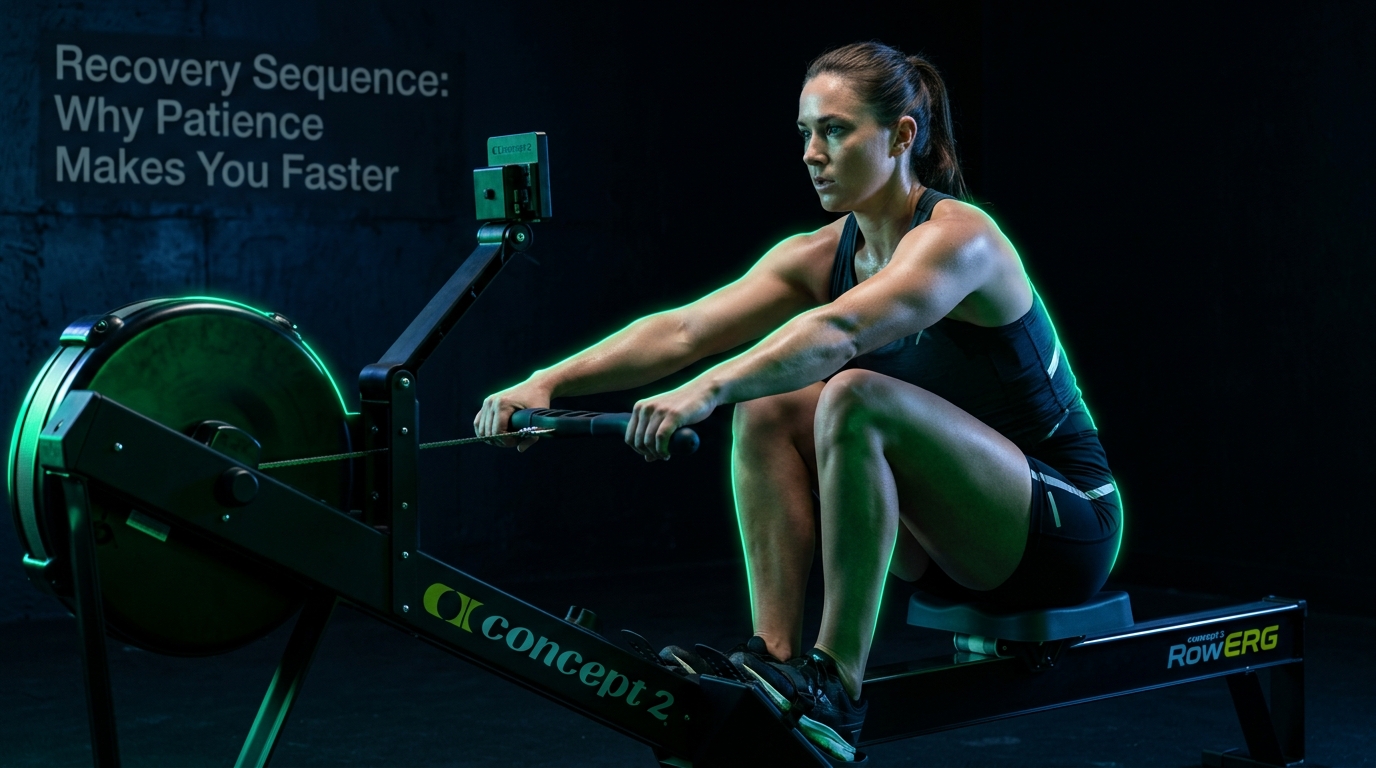
The recovery on the erg is the slide from the finish back to the catch. It is also, on the evidence, the single most useful thing a rower can learn to be patient about — and almost nobody is, because the slide is the part of the stroke where nothing appears to be happening.
The manufacturer's own description of the sequence is hands away, then body, then legs, and the handle path is kept level ([1] Concept2). What that description does not tell you is why it is ordered that way, or what happens when you break it.
The strongest single finding in the rowing biomechanics literature settles the argument about where stroke rate comes from. Ettema and colleagues had twelve competitive rowers row at three intensities and three stroke rates and applied inverse dynamics to estimate joint powers ([3] Ettema). The result is unusually clean: stroke rate was mostly regulated by adapting recovery time, while drive time and its kinetics were left almost entirely to intensity ([3] Ettema). When a rower needs a large change in rate, they make it on the slide, not on the drive. Work per stroke is set by the power requirement; the slide is the variable the body actually turns.
That reframes the whole problem. A rushed recovery is not a stylistic fault. It is the stroke-rate dial being turned the wrong way, and it is also the setting your body starts to turn itself as you tire.
The recovery is not a pause
On a wind-braked ergometer, the flywheel resists rather than imposes a load, so what you produce depends on how fast you move the handle ([24] Concept2). The monitor derives drive time, recovery time and the ratio between them from that handle movement ([2] Concept2). Which means the recovery is not dead time in any accounting sense — it is a variable the instrument is already measuring and most rowers never look at.
Two mechanical facts make it matter. First, drag on a shell rises with roughly the square of velocity, so the power needed to hold speed climbs steeply, while the metabolic cost of producing it rises with about the 2.4 power ([4] Secher). Those exponents are not the same, and the gap between them is exactly the shape of a speed-versus-cost curve. Second, the force on the oar runs to 800 or 900 newtons and is generated over 0.3 to 0.4 seconds ([4] Secher). That is a short, sharp event, and it is not the part of the cycle you should be compressing.
Cabrera, Ruina and Kleshnev built a model of the whole stroke from first principles — one-dimensional momentum balance, a point-mass rower, infinitely stiff oars, quadratic force-velocity for both boat and blade — and it predicts boat velocity even when velocity is not fitted for ([6] Cabrera). Their sensitivity analysis has an implication for coaching: the fit is far more sensitive to the boat and oar drag coefficients than to anything else, and allowing the blade to slip is a necessary part of the model while oar flexibility is not ([6] Cabrera). The recovery is where the blade is being set up for the next catch. Get it wrong and you are changing the coefficients the rest of the stroke runs on.
What happens when you rush it
The most useful number in this article is not about elite technique. It is from Sprague and colleagues, who put eleven collegiate rowers on an inertial-load ergometer and let them choose their own duty cycle across five maximal strokes ([5] Sprague). Duty cycle is the fraction of the cycle spent pulling. It fell from 58% on the first stroke to 26% on the fifth ([5] Sprague).
Nobody instructed that. It is what happens when you get tired: the recovery gets shorter, the drive takes a larger share, and the stroke becomes a series of increasingly urgent yanks. If you have ever felt a piece fall apart in the last 500 metres, this is the mechanism, and it is measurable in a single variable.
The same group characterised the force-velocity and power-velocity relationships properly. Pull force-velocity was linear at r² = 0.99, while stroke power, pull power and instantaneous peak power were all quadratic, with apexes at 2.04, 3.25 and 3.43 metres per second and maximum values of 812, 1,995 and 3,481 watts ([5] Sprague). The gap between average stroke power and average pull power — 812 against 1,995 watts — is the recovery, sitting inside the number.
Hartmann and colleagues measured world-class rowers over five and ten maximal strokes and found peak force falling from the first stroke to the last, and that at no point in a maximal six-minute test did anyone apply more than 65 to 70% of their maximum force ([11] Hartmann). The small increase in peak power late in that test came entirely from peak velocity, not more force ([11] Hartmann). Which is a compact description of what an experienced rower is doing: spending the last of a piece on speed, not on strength, because strength is gone.
The late recovery is measurable on the water
It would be reasonable to ask whether all this stroke-level laboratory work connects to boat speed. Holt and colleagues asked exactly that, across 74 2,000 m international races in singles and pairs, using GPS and instrumented oars ([7] Holt).
Several acceleration measures had decisively substantial effects on velocity before adjustment — between 2.4 and 2.5% — and most shrank once stroke rate and power were controlled for, which is what you would expect if they were just re-describing effort. But four survived: maximum negative drive acceleration, peak drive acceleration, jerk during the mid-drive, and jerk in the late recovery, which remained decisively substantial at 1.8 to 1.9% in some boat classes ([7] Holt).
The authors read the late-recovery measure as reflecting the rower's centre of mass being decelerated in preparation for the catch — the moment you set the body up for the next drive ([7] Holt). That is a real, on-water, quantified result about the slide, measured in the discipline, after controlling for the two variables every rower already knows to chase.
Stroke rate changes what the drive is, not just how often
Duchene and colleagues had 24 high-level rowers do maximal one-minute pieces at 20, 28 and 34 spm and measured power at the handle and at the legs, trunk and arms ([8] Duchene). Handle power was higher at the higher rate in the first half of the drive, and the mean-to-peak power ratio rose at every segment level ([8] Duchene). The higher trunk power preceded a delayed trunk extension without any significant rise in erector spinae activation, which the authors read as the core doing its transfer job more efficiently rather than harder ([8] Duchene).
The practical reading is specific: low-rate rowing trains earlier trunk extension, and high-rate rowing produces a technique closer to racing ([8] Duchene). If you only ever row long and slow, the trunk timing you practise is not the trunk timing you race with.
Engstrom and colleagues found the same asymmetry from the other end, by varying the foot-stretcher position across seven settings at three stroke rates ([9] Engstrom). Stroke rate changed the kinematic pattern of every major joint; the foot-stretcher position only touched ankle and hip, and rowers largely compensated for it ([9] Engstrom). Their conclusion is worth quoting in spirit: the changes from setup are smaller than the differences between stroke rates ([9] Engstrom). If you have a setup fault, fix it. If you have a sequencing fault, stroke rate is the bigger lever.
What the drive-only number leaves out
Held and colleagues tested 52 trained male rowers on an unmodified ergometer, measuring peak power two ways: on isolated concentric drive strokes, and across a full flexion-extension cycle that included the slide ([10] Held). Both were highly reliable, with intraclass correlations between 0.94 and 1.00.
The result is the interesting one. Slide-and-drive strokes produced 423 watts against 370 watts for the drive alone — about 14% more, with a partial eta squared of 0.601 ([10] Held). The authors suggest this may reflect an underlying stretch-shortening cycle ([10] Held). Whatever the mechanism, the practical consequence is firm: a number taken from the drive alone is not the number your boat sees, and a training log built entirely on drive strokes will systematically understate what you produce.
The same caution applies to the machine itself. Mentz and colleagues built a motorised test rig to drive an ergometer with force-displacement curves taken from elite rowers, precisely so that stroke structure could be clamped rather than left to biology ([14] Mentz). Their machine-generated curves matched human reference curves to within 7.8% on force, distance and work, with a 0.53% coefficient of variation between 50-stroke series ([14] Mentz). The rig exists because a wind-braked ergometer's reported power is a function of the stroke you choose to row, not just of the work you do.
What actually decides your 2,000 m, and what does not
It is worth being blunt, because the recovery is seductive as a focus.
Ingham and colleagues modelled 2,000 m ergometer performance in World Championship finalists using power at maximal oxygen uptake, oxygen uptake at lactate threshold, power at 4 mmol/l lactate and maximal power ([12] Ingham). Together those explained 98% of the variance in speed, validated in a further 18 elite rowers with limits of agreement equivalent to −0.41% to 1.85% of race time ([12] Ingham). Ventilation was not in the model, and neither was any kinematic variable.
Soper and Hume reviewed the biomechanics literature to ask whether an ideal technique can be specified, and concluded that biomechanical predictors of 2,000 m performance are indistinct ([13] Soper). That is a twenty-year-old review and the field has moved since, but it remains the honest frame: no stroke variable in this article has been shown to predict your race time the way maximal power does.
What the sequence buys you is narrower and still real. Holt's late-recovery result is a within-race adjustment at constant stroke rate and power ([7] Holt). Ingham's model is a between-athlete explanation ([12] Ingham). They are not competing claims, and conflating them is how technique advice ends up promising more than it can deliver.
For younger rowers the picture is at least measurable. Giroux and colleagues bench-pull and squat-jumped 14 national-level rowers aged around 15, and those force-velocity profiles explained between 29% and 79% of their 1,500 m power, with body mass accounting for more than 90% of the relationships ([15] Giroux). Nordez and colleagues have since shown the same relationships can be reconstructed from on-water starts rather than only from ergometers ([16] Nordez).
The monitor, and its limits
Your ergometer reports watts from handle speed, and the instrumentation used to measure power on the water is a separate question with its own answer. Holt and colleagues compared four commercial on-water systems and a Concept2 against a custom reference rig across maximal and submaximal tests ([17] Holt). The practical takeaway is not that any one device is right and the rest wrong, but that a power number is only comparable to another power number if it came off the same instrument under the same protocol.
Two more limits are worth carrying. Force fluctuates from stroke to stroke, and Pethick and colleagues argue that describing those fluctuations needs both magnitude and complexity measures, because complexity falls under neuromuscular fatigue ([18] Pethick) — which is the formal version of the point Sprague's falling duty cycle makes in a single number ([5] Sprague). And Gao and colleagues measured movement variability directly, using sample entropy on inertial-sensor data from 21 elite rowers at three stroke rates, and related it to 2,000 m performance ([19] Gao).
If you want a peak-power number that means something, Astridge and colleagues tested a specific protocol — five lead-in strokes then five maximal strokes at 40 spm — across five sessions in 33 elite under-23 rowers ([20] Astridge). The point of naming a protocol is that the ten-stroke test and the racing stroke are not the same measurement, and only one of them is repeatable.
Learning the sequence without thinking about it
There is a reason the sequence is hard to teach by talking. Halsband's review describes the time-course of learning a motor skill: early on, activity is high in dorsolateral prefrontal cortex and is tied to explicit working memory and to building a novel mapping between cues and motor commands ([22] Halsband). That is what coaching the sequence out loud is — you are asking a novice to hold a verbal rule in working memory while rowing 20 strokes a minute.
Kal and colleagues tested the alternative directly. Thirty participants did a cyclic leg task with attention directed either internally, at their own body, or externally, at the effect of the movement on the world ([21] Kal). The external focus produced faster movement and more fluent, more regular execution, while muscle activity did not differ ([21] Kal).
Applied to a rowing recovery, that is a concrete instruction rather than a platitude. Instead of swing the body over before the hands arrive, which asks for internal monitoring, the external version is keep the handle quiet and let the flywheel speed stay the same — something you can hear, because a changing handle speed is a changing sound on a wind-braked erg.
Fixed-seat rowing, for reference, moves differently throughout: Agius and colleagues found more thoracic movement than in sliding-seat rowing, 75 to 77 degrees against 44 to 52, with knee flexion of 30 to 35 degrees rather than the larger range of a standard seat ([23] Agius). If you came to the erg from a fixed-seat boat, some of what feels wrong on the recovery is only different, not broken.
What to try tomorrow
Four things, in the order they are worth doing.
Look at the drive ratio, not the watts. The monitor already computes it ([2] Concept2). Watch it across a piece rather than at the end of it, because the shape of the number tells you when you started losing the slide ([5] Sprague).
Hold the recovery time and change the rate somewhere else. If you want to train a higher rate without a shorter recovery, do it in short intervals where you can afford to be imprecise. Ettema's finding is that a necessary large change in rate is made on the slide ([3] Ettema) — so if you are changing rate while also trying to keep technique, you are fighting your own chosen strategy.
Do some of your rowing at the rate you race. Higher rates produce a different trunk timing, not a faster version of the same one ([8] Duchene).
Practise the sequence against the handle, not against your body ([21] Kal), and give it the eight weeks the motor-learning literature suggests is the minimum for anything to become automatic ([22] Halsband).
Finally, hold the whole thing in proportion. The World Rowing indoor formats are the distances where stroke rate is actually tested ([25] World Rowing), and Ingham's 98% model is built on maximal power and lactate-threshold variables ([12] Ingham). A good recovery makes the power you have count for more. It does not create power you do not have.
Limitations
No study cited here has tested whether a particular recovery technique reduces injury in rowers, and none has randomised a sequence against another. The laboratory work is small — twelve rowers for the central finding on stroke rate ([3] Ettema), eleven for the duty-cycle result ([5] Sprague), twenty-four for the stroke-rate segment analysis ([8] Duchene) — and mostly male and competitive, so the results should not be assumed to transfer to masters rowers, to lightweight women, or to beginners. The foot-stretcher study had eleven college-level participants ([9] Engstrom).
The on-water acceleration analysis is the strongest external evidence here, and it is also correlational: Holt's late-recovery finding comes from 74 races observed, not from an intervention ([7] Holt). And the honest counterweight stands — Soper and Hume's conclusion that biomechanical predictors are indistinct ([13] Soper) has not been overturned so much as refined, and the refinement has not yet produced a sequence that predicts a time.
Conclusions
The recovery is the variable that sets your stroke rate, and it is the only part of the stroke you can make materially longer without touching anything else ([3] Ettema). Your body will shorten it for you as you tire, from a 58% duty cycle on the first maximal stroke to 26% on the fifth, without being asked ([5] Sprague).
And when it is done well it is measurable in the boat: jerk in the late recovery predicted racing speed across 74 international races after stroke rate and power were controlled for ([7] Holt).
The rest is proportion. No sequence in this article predicts a 2,000 m time the way maximal power does ([12] Ingham), and pretending otherwise is how technique advice loses its credibility. But a recovery worth being patient on is the one that keeps the force you generate arriving when the boat is ready for it — and on a wind-braked ergometer, that is a sound you can hear.
Key points
- Stroke rate is regulated by changing recovery time, not drive time. Drive time and its kinetics were left almost entirely to intensity.
- Fatigue eats your recovery on its own. Across five maximal strokes, freely chosen duty cycle fell from 58% to 26% without anyone deciding to change it.
- What you do in the late recovery is measurable on the water. Jerk there predicted boat speed after controlling for stroke rate and power output.
- A stroke measured across the whole slide-and-drive cycle produces about 14% more power than the drive alone, which is why a drive-only number is not your boat's number.
- Drag rises with the square of boat speed but metabolic cost with roughly the 2.4 power, so there is a real speed-versus-cost curve to sit on.
- Peak force falls from the first stroke to the last, and rarely exceeds 65-70% of maximum even in a maximal six-minute piece.
- Attending to the handle rather than to your own body halves the effort of learning the sequence, and makes the movement more automatic.
Editorial & Coaching Standards
Guides in the MyNextRow Learn library are created by Concept2 athletes and coaches, synthesizing peer-reviewed sports physiology, biomechanics literature, and authoritative rowing guidelines. Every workout protocol and technical cue is tested for safety, repeatability, and PM5 monitor compatibility.
Sources and further reading
- Concept2. Rowing technique— Manufacturer's description of the stroke sequence, hands away then body then legs.
- Concept2. Understanding your PM5 monitor— How the monitor derives drive time, recovery time and drive ratio from handle movement.
- Ettema G, et al. The role of stroke rate and intensity on rowing technique. Sports Biomech 2025— Twelve competitive rowers at three intensities by three rates: stroke rate was regulated by adapting recovery time, leaving drive time to intensity.
- Secher NH. Physiological and biomechanical aspects of rowing. Sports Med 1993— Drag rises with the square of shell velocity while metabolic cost rises with about the 2.4 power, and force on the oar runs 800-900 N over 0.3-0.4 s.
- Sprague RC, et al. Force-velocity and power-velocity relationships in rowing ergometry. Med Sci Sports Exerc 2007— Across five maximal strokes freely chosen duty cycle fell from 58% to 26%, and the power-velocity relationships were quadratic with distinct apexes.
- Cabrera D, Ruina A, Kleshnev V. A simple 1+ dimensional model of rowing. Hum Mov Sci 2006— A model that predicts boat velocity without fitting for it, and shows oar slip is a necessary ingredient while oar flexibility is not.
- Holt AC, et al. Relationships between measures of boat acceleration and performance in rowing. PLoS One 2021— Across 74 international races, jerk in the late recovery predicted boat speed even after adjusting for stroke rate and power output.
- Duchene Y, et al. The stroke rate influences performance, technique and core stability. Sports Biomech 2025— Twenty-four high-level rowers at 20, 28 and 34 spm: handle power rose in the first half of the drive and trunk extension was delayed at higher rates.
- Engstrom I, et al. Foot-stretcher position and stroke rate on ergometer rowing kinematics. PLoS One 2023— Stroke rate changed the kinematics of every major joint, while foot-stretcher changes were limited to ankle and hip and mostly compensated for.
- Held S, et al. Reliable peak power in concentric and slide-drive strokes. J Sports Sci Med 2022— In 52 trained rowers, strokes measured across the whole slide-and-drive cycle produced 423 W against 370 W for the drive alone.
- Hartmann U, et al. Peak force, velocity and power during maximal ergometer strokes. Int J Sports Med 1993— World-class rowers: peak force fell from the first stroke to the last, and never exceeded 65-70% of maximum during a maximal six-minute test.
- Ingham SA, et al. Determinants of 2,000 m rowing ergometer performance in elite rowers. Eur J Appl Physiol 2002— Power at maximal oxygen uptake, lactate-threshold variables and maximal power together explain 98% of 2,000 m speed in World Championship finalists.
- Soper C, Hume PA. Towards an ideal rowing technique for performance. Sports Med 2004— Reviews the biomechanics literature and concludes that biomechanical predictors of 2,000 m performance remain indistinct.
- Mentz L, et al. The mechanical rower: a test rig for wind braked rowing ergometers. J Biomech 2020— Machine-generated strokes matched human reference curves to within 7.8% on work, with a 0.53% coefficient of variation between series.
- Giroux C, et al. Force-velocity profiles and 1,500 m ergometer performance in young rowers. Int J Sports Med 2017— Bench pull and squat jump profiles in 14 national-level adolescent rowers explained between 29% and 79% of 1,500 m power.
- Nordez A, et al. Force-velocity and power-velocity relationships in on-water rowing. Sports Med 2025— A method for reconstructing force-velocity relationships from on-water starts, compared against ergometer profiles.
- Holt AC, et al. Concurrent validity of power from on-water rowing instrumentation. Front Physiol 2021— Compares four commercial on-water power systems and a Concept2 against a custom reference rig across maximal and submaximal tests.
- Pethick J, et al. Physiological complexity and force fluctuations. Exp Physiol 2021— Argues force fluctuations need both magnitude and complexity measures, and that complexity falls under neuromuscular fatigue.
- Gao Y, et al. Entropy-based analysis of rowing technique. Int J Sports Physiol Perform 2026— 21 elite rowers at 20, 26 and 34 spm, with movement variability measured by sample entropy from inertial sensors.
- Astridge DJ, et al. Maximal peak power from a race-specific protocol and ergometer performance. Sports Med Open 2025— A ten-stroke protocol at 40 spm was tested across five sessions in 33 elite under-23 rowers for reliability and association with race times.
- Kal EC, et al. External attentional focus enhances movement automatization. Hum Mov Sci 2013— An external focus produced faster, more fluent and more regular movement than an internal focus, with no difference in muscle activity.
- Halsband U. Motor learning in man: a review of functional and clinical studies. Exp Brain Res 2006— Reviews the time-course of cortical activation during skill acquisition, from prefrontal working memory to automatised control.
- Agius TP, et al. The kinematics of fixed-seat rowing: a structured synthesis. Bioengineering 2023— First kinematic analysis of fixed-seat rowing, showing more thoracic movement and less knee flexion than the sliding seat.
- Concept2. What's an erg? Our PM5 is the key— How a wind-resistance ergometer turns handle speed into the watts the monitor reports.
- World Rowing. Indoor rowing— The race formats and distances indoor rowers contest, which is where stroke rate actually gets tested.