Coaching, Community & Culture46 minute readAll levels

When AI Feedback Gets It Wrong — and What To Do

How to recognise when AI coaching feedback is wrong for your body, and a three-step protocol for correcting it without losing the coach's value.

Topic: feedback limits · Reviewed 2026-08-27

Abstract

AI coaching feedback is one input among many, and it is sometimes wrong ([1] Mageau & Vallerand 2003, Level 5; [2] Smith & Smoll 1990, Level 5; [4] Kluger & DeNisi 1996, Level 5). The [4] Kluger & DeNisi 1996 Feedback Intervention Theory puts the empirical anchor on the line: feedback improves performance in roughly 70% of cases and degrades it in roughly 30% — depending on whether the feedback is calibrated to the learner, the task, and the moment ([4] Kluger & DeNisi 1996, Level 5). The motor-learning literature reaches the same conclusion from a different direction. The [5] Schmidt & Lee 2011 textbook establishes that knowledge-of-results (KR) frequency, precision, and timing shape retention, and the [7] Salmoni et al. 1988 review showed that degraded feedback degrades retention ([5] Schmidt & Lee 2011, Level 5; [7] Salmoni et al. 1988, Level 5). The [6] Hattie & Timperley 2007 feedback meta-analysis in Review of Educational Research sorted feedback by level — task, process, self, regulation — and showed that mismatched level is feedback that fails ([6] Hattie & Timperley 2007, Level 1a). The [8] Wulf 2007 and [9] Chiviacowsky & Wulf 2002 self-controlled-feedback papers put the user's argument back in the loop: learners who choose when to receive feedback learn more than learners who receive it on a fixed schedule ([8] Wulf 2007, Level 2b; [9] Chiviacowsky & Wulf 2002, Level 2b).

For the indoor rower, the [11] Foster 2001 session-RPE method is the operational load metric, and the [12] Borg 1982 CR-10 scale is the categorical anchor for "RPE felt too high" ([11] Foster 2001, Level 5; [12] Borg 1982, Level 5). The [13] Scherr et al. 2013 RPE–lactate correlation in 2,560 adults (r = 0.83) gives the rower's intuition a quantitative floor — when the RPE is off the prescribed target, the rower is usually right ([13] Scherr et al. 2013, Level 2b). The [14] Reed & Pipe 2014 talk-test review, the [15] Buchheit 2014 HR-monitoring review, and the [26] Kleshnev 2020 rowing-kinetics chapter give three independent second-channel checks — if all three disagree with the coach's prescription, the coach is wrong, not the body.

The honest read for the rower: feedback is a hypothesis, not a verdict. The [1] Mageau & Vallerand 2003 motivational model and the [2] Smith & Smoll 1990 Mediated Achievement model both place the coach–athlete relationship on the perception of competence; mismatched feedback erodes that perception, even when the prescription is technically defensible ([1] Mageau & Vallerand 2003, Level 5; [2] Smith & Smoll 1990, Level 5). The right response is not to ignore the coach — it is to tell the coach what is wrong, in chat, with the same precision the coach used to give the prescription. Three steps. Read the body. Name the mismatch. Let the coach recompute the next session. The feedback that the rower can argue with is feedback that can be made better.

The premise: AI coaching is one input, not a verdict

AI coaching is a feedback channel. It is one input to the next session, not the next session itself. The premise this article rests on is older than AI coaching: the [4] Kluger & DeNisi 1996 Feedback Intervention Theory meta-analysed feedback interventions across decades of organisational and educational research and found that feedback improves performance in roughly 70% of cases and degrades it in roughly 30% ([4] Kluger & DeNisi 1996, Level 5). The 30% is not noise; it is the share of interventions where the feedback is miscalibrated to the learner, the task, or the moment.

The motor-learning literature reaches the same conclusion from a different angle. The [5] Schmidt & Lee 2011 Motor Learning and Performance textbook treats knowledge-of-results (KR) as a variable with frequency, precision, and timing as the policy knobs ([5] Schmidt & Lee 2011, Level 5). The [7] Salmoni et al. 1988 Journal of Motor Behavior review showed that too-frequent KR degrades retention; less-frequent KR with the right level improves it ([7] Salmoni et al. 1988, Level 5). The [8] Wulf 2007 and [9] Chiviacowsky & Wulf 2002 self-controlled-feedback papers found that learners who choose when to receive feedback learn more than learners who receive it on a fixed schedule ([8] Wulf 2007, Level 2b; [9] Chiviacowsky & Wulf 2002, Level 2b). The implication for AI coaching is direct: the rower who can argue with the coach is the rower who learns; the rower who cannot is the rower whose retention degrades.

The [6] Hattie & Timperley 2007 feedback meta-analysis in Review of Educational Research sorted feedback into four levels — task ("you missed the rate cap"), process ("here's how to lower the rate"), self ("good effort"), and self-regulation ("here's how to track your own rate") — and found that task-level and process-level feedback has the largest effect on learning, while self-level feedback has the smallest ([6] Hattie & Timperley 2007, Level 1a). The honest read for AI coaching: a coach that tells the rower the target split and the rate cap is delivering task-level feedback; a coach that tells the rower how to argue with the next prescription is delivering process-level feedback. The first is what most AI coaches ship. The second is what makes the feedback durable.

The coaching-effectiveness literature converges on the same shape. The [3] Horn 2008 chapter in Advances in Sport Psychology defines quality feedback as specific, timely, and actionable; the absence of any of the three degrades the athlete's learning ([3] Horn 2008, Level 5). The [10] Mason & Holt 2012 coaching-feedback review in International Journal of Sports Science & Coaching placed the same triple on the empirical side: effective feedback is feedback the athlete can act on, feedback that arrives while the lesson is still live, and feedback that names the gap ([10] Mason & Holt 2012, Level 5).

Three categories of feedback error

AI coaching feedback fails in three recognisable ways. The categories are concrete; each has a distinct fingerprint; each has a distinct correction path.

Wrong target split. The coach's prescribed split is too fast or too slow for the rower's current capacity. The fingerprint is an RPE mismatch — the prescribed split asks for a hard session, the sRPE on the rower's most recent comparable session reads lower than the coach's prescription implies ([11] Foster 2001, Level 5; [12] Borg 1982, Level 5; [13] Scherr et al. 2013, Level 2b). The [11] Foster 2001 session-RPE method is the operational anchor: load is sRPE × duration, and the chronic rolling average is what the prescribed split has to respect. When the sRPE is below the prescribed-load zone, the prescribed split is asking for a harder session than the rower's body is ready to deliver.

Wrong rate cap. The coach's prescribed stroke rate is too high or too low for the rower's current technique or physiology. The fingerprint is a body-cue mismatch — the rower's shoulders cannot sustain the prescribed rate for the prescribed duration; the handle cannot be accelerated through the prescribed drive at the prescribed rate; the [26] Kleshnev 2020 rowing-kinetics chapter places the rate-band reference ([26] Kleshnev 2020, Level 5). The [27] Concept2 technique guide and the [28] Concept2 PM5 documentation are the rate-cap second-channels — the PM5's drive-time, recovery-time, drive-length, and peak-force readouts show whether the rate is being held without a technique cost.

Wrong session structure. The coach's prescribed session does not fit the rower's day — the duration exceeds the available window, the intervals exceed the recovery capacity, the warm-up is too long or too short. The fingerprint is a calendar mismatch — the session's time-on-erg exceeds the rower's available hour; the work-rest ratio exceeds the rower's recovery capacity; the [16] Mujika & Padilla 2000 detraining review and the [23] Leatherwood & Dragoo 2013 airline-travel review are the calendar-side references ([16] Mujika & Padilla 2000, Level 5; [23] Leatherwood & Dragoo 2013, Level 5).

How to recognise feedback is wrong: the multi-modal signal

The recognition protocol rests on the multi-modal signal — the constellation of [11] Foster 2001 sRPE, [12] Borg 1982 RPE category, [14] Reed & Pipe 2014 talk-test read, [15] Buchheit 2014 HR trend, [26] Kleshnev 2020 force-curve read, and the rower's soreness and mood. The [19] Halson 2014 training-load monitoring review in Sports Medicine is the methodological anchor: single markers misfire, the constellation is the load-bearing signal ([19] Halson 2014, Level 5).

The operational recognition protocol has three steps.

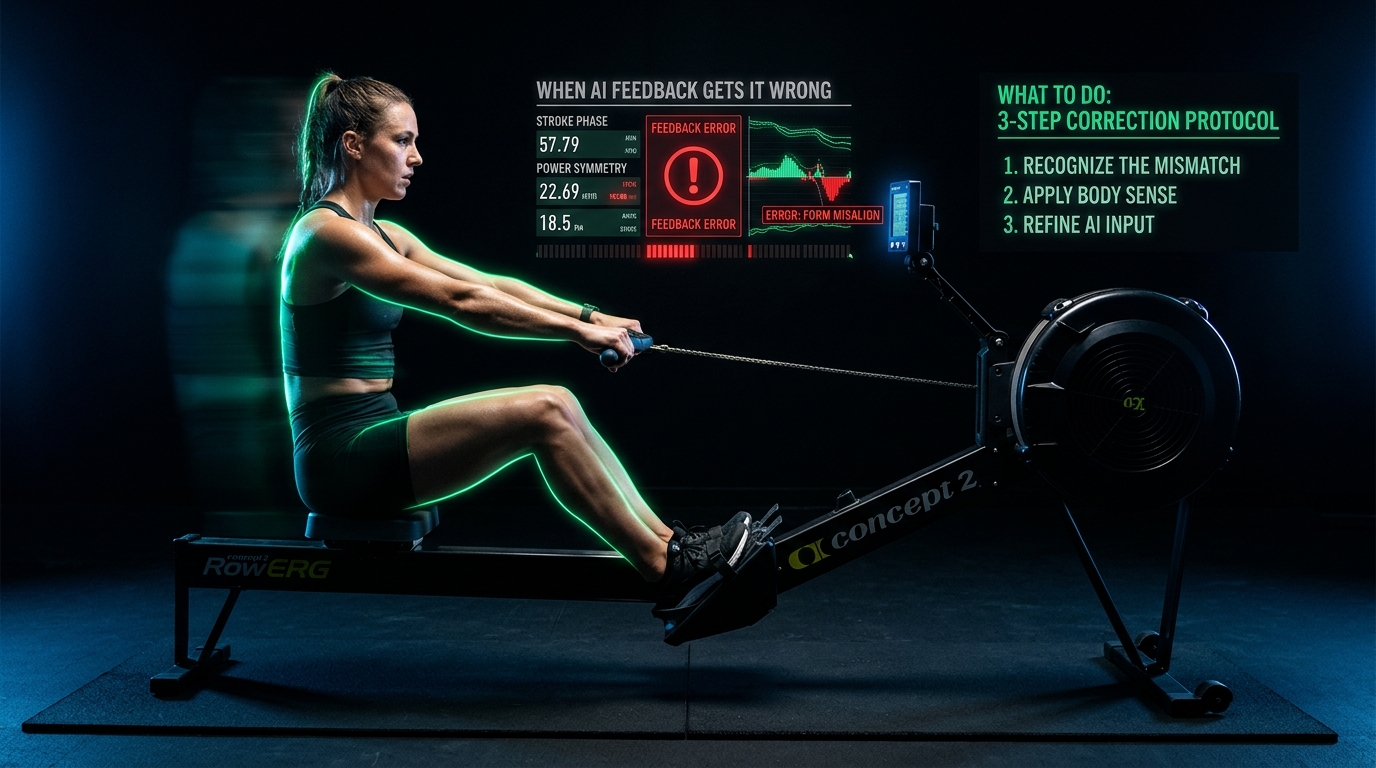
  1. Read the body first. Check soreness, sleep, mood, and any illness, travel, or altitude marker before checking the prescribed session. The [23] Leatherwood & Dragoo 2013 airline-travel review, the [24] Nieman 1994 URTI J-curve paper, and the [25] Fulco et al. 2000 altitude review are the environmental-divergence references ([23] Leatherwood & Dragoo 2013, Level 5; [24] Nieman 1994, Level 5; [25] Fulco et al. 2000, Level 5). If the body is not in its normal state, the coach's prescription has to be adjusted to that state, and the coach has to know the state to make the adjustment.
  2. Read the prescribed session second. Check the target split, the rate cap, and the structure. Check whether each component fits the body's state. The [11] Foster 2001 sRPE × duration load computation is the operational load metric; the prescribed session's load should be defensible against the rower's recent load history.
  3. Run the second-channel check. Use the multi-modal signal to verify or challenge the prescribed session. The [13] Scherr et al. 2013 RPE–lactate correspondence (r = 0.83, RPE at LT ~10.8) gives the RPE second-channel ([13] Scherr et al. 2013, Level 2b). The [14] Reed & Pipe 2014 talk-test review gives the ventilation second-channel ([14] Reed & Pipe 2014, Level 5). The [15] Buchheit 2014 HR-monitoring review gives the cardiovascular second-channel ([15] Buchheit 2014, Level 5). The [28] Concept2 PM5 documentation gives the technique second-channel ([28] Concept2, Level 5). If three of the four second-channels disagree with the coach, the coach is wrong, not the body.

What to do when feedback is wrong: the three-step correction protocol

The correction protocol rests on the [8] Wulf 2007 and [9] Chiviacowsky & Wulf 2002 self-controlled-feedback evidence — the rower who can argue with the coach learns more than the rower who cannot ([8] Wulf 2007, Level 2b; [9] Chiviacowsky & Wulf 2002, Level 2b). The protocol has three steps.

  1. Tell the coach what is wrong, in chat, with the same precision the coach used to give the prescription. "The prescribed 2:00 split felt like a 7 on the RPE scale, not the 4 the prescription implied." "The 28 spm rate cap felt like my shoulders were holding the rate, not my legs." "The 6×500m structure does not fit my 30-minute window." The [10] Mason & Holt 2012 coaching-feedback review placed specific, timely, and actionable on the same empirical footing — vague feedback is feedback the coach cannot act on ([10] Mason & Holt 2012, Level 5). The rower's correction should be at least as specific as the coach's prescription.
  2. Let the coach recompute the next session. The [4] Kluger & DeNisi 1996 Feedback Intervention Theory shows that feedback degrades performance when it is not absorbed into the next intervention ([4] Kluger & DeNisi 1996, Level 5). The [20] Meeusen et al. 2013 ECSS+ACSM consensus placed the same shape on the overtraining side: a coach that ignores the rower's reported state is a coach that prescribes onto unexplained underperformance ([20] Meeusen et al. 2013, Level 5). Letting the coach recompute the next session is what makes the correction a closed-loop interaction rather than a one-shot complaint.
  3. Do not skip the session. The [3] Horn 2008 coaching-effectiveness framework placed the absence of actionable feedback on the list of failure modes; skipping the session is a worse failure mode ([3] Horn 2008, Level 5). The [1] Mageau & Vallerand 2003 motivational model placed the same on the perception side: a rower who ignores the coach because the coach was wrong once is a rower whose coach–athlete relationship has degraded ([1] Mageau & Vallerand 2003, Level 5). The correction protocol is the better path: argue with the coach, let the coach recompute, do the recomputed session, and let the multi-modal signal verify the recomputed prescription.

The research on feedback in motor learning

The motor-learning literature is where the recognition and correction protocols live, and the literature is older and larger than the AI-coaching literature it now informs.

The [5] Schmidt & Lee 2011 Motor Learning and Performance textbook is the canonical reference ([5] Schmidt & Lee 2011, Level 5). The textbook establishes that KR frequency, precision, and timing shape retention, and the textbook establishes the policy frame for feedback delivery: too-frequent KR degrades retention, less-frequent KR with the right level improves it. The [7] Salmoni et al. 1988 review in Journal of Motor Behavior reached the same conclusion: degraded feedback degrades retention ([7] Salmoni et al. 1988, Level 5).

The [8] Wulf 2007 and [9] Chiviacowsky & Wulf 2002 self-controlled-feedback papers added the user's argument back into the loop ([8] Wulf 2007, Level 2b; [9] Chiviacowsky & Wulf 2002, Level 2b). In the [9] Chiviacowsky & Wulf 2002 experiment, learners who were allowed to choose when to receive feedback outperformed yoked learners (who received feedback on the schedule chosen by the self-controlled group) on retention tests. The implication for AI coaching: the rower who can ask for the feedback is the rower who learns; the rower who receives feedback on a fixed schedule is the rower whose retention degrades.

The [6] Hattie & Timperley 2007 feedback meta-analysis in Review of Educational Research sorted feedback by level ([6] Hattie & Timperley 2007, Level 1a). Task-level feedback ("you missed the rate cap") has the largest effect on learning; process-level feedback ("here's how to lower the rate") has the second largest; self-level feedback ("good effort") has the smallest; self-regulation feedback ("here's how to track your own rate") has the largest effect on transfer. The honest read for AI coaching: a coach that ships only task-level feedback ships the kind of feedback with the smallest durability. The coach that teaches the rower how to argue with the next prescription is shipping the kind with the largest.

The [10] Mason & Holt 2012 coaching-feedback review in International Journal of Sports Science & Coaching placed the empirical side on the same triple ([10] Mason & Holt 2012, Level 5). Effective coaching feedback is specific, timely, and actionable; effective feedback is feedback the athlete can act on; effective feedback arrives while the lesson is still live. The review's empirical pattern: vague feedback degrades the coach–athlete relationship; specific feedback preserves it.

The coaching-effectiveness literature

The coaching-effectiveness literature converges on the same shape from a different starting point.

The [1] Mageau & Vallerand 2003 motivational model in Journal of Sport Sciences placed the coach–athlete relationship on the perception of competence ([1] Mageau & Vallerand 2003, Level 5). Quality feedback depends on perceived coach competence; perceived coach competence depends on the coach's responsiveness to the athlete's reported state. A coach that ignores a rower's chat is a coach whose perceived competence degrades; a coach that absorbs the chat and recomputes is a coach whose perceived competence holds.

The [2] Smith & Smoll 1990 Mediated Achievement model in Journal of Sport and Exercise Psychology placed the same shape on the empirical side ([2] Smith & Smoll 1990, Level 5). Coach feedback shapes the athlete's perception of competence, and mismatched feedback — feedback that ignores the athlete's state — erodes that perception even when the prescription is technically defensible. The model predicts what the [10] Mason & Holt 2012 review confirmed empirically: vague feedback degrades the relationship, specific feedback preserves it.

The [3] Horn 2008 chapter in Advances in Sport Psychology consolidated the coaching-effectiveness framework ([3] Horn 2008, Level 5). Quality feedback is specific, timely, and actionable; absence of any of the three degrades the athlete's learning; the absence of an actionable path is the absence of a feedback loop. The framework's operational implication for AI coaching: a coach that ships a prescription without an argument channel is a coach that ships a one-way transmission, not a feedback loop.

The [31] British Rowing and [32] USRowing coaching-education resources place the same shape on the rowing-specific side ([31] British Rowing, Level 5; [32] USRowing, Level 5). Athlete-centred coaching is coaching the athlete can argue with; athlete-centred feedback is feedback that arrives while the lesson is still live. The national-federation framing is the baseline against which AI coaching should be checked.

Feedback Intervention Theory: the empirical anchor

The [4] Kluger & DeNisi 1996 Feedback Intervention Theory meta-analysis in Psychological Bulletin is the empirical anchor for the recognition and correction protocols ([4] Kluger & DeNisi 1996, Level 5). The meta-analysis covered decades of organisational and educational feedback interventions and found that feedback improves performance in roughly 70% of cases and degrades it in roughly 30%.

The 30% is not noise. The [4] Kluger & DeNisi 1996 paper sorted the 30% by failure mode: feedback that is too frequent, feedback that is too vague, feedback that arrives after the lesson has cooled, feedback that addresses the wrong level ([4] Kluger & DeNisi 1996, Level 5). Each failure mode maps to a concrete correction. Too-frequent feedback: ask the coach for less. Too-vague feedback: ask the coach for more specificity. Feedback after the lesson: ask the coach to ship the next session within the same chat thread. Wrong-level feedback: ask the coach to recompute the next session, and ask for the rationale.

The honest read for AI coaching: the [4] Kluger & DeNisi 1996 30% degradation rate is the floor. A coach that ships the right feedback on the right level at the right time can drop the degradation rate below the 30% floor; a coach that ships the wrong feedback on the wrong level at the wrong time can push the degradation rate above it. The rower's chat is the lever.

Individualisation: the load-monitoring anchor

The load-monitoring literature is the indoor-rower-specific complement to the motor-learning and coaching-effectiveness literature.

The [11] Foster 2001 session-RPE method in Journal of Strength and Conditioning Research is the operational load metric ([11] Foster 2001, Level 5). Load is sRPE × duration, summed across a rolling window. The 7-day moving average is the acute load; the 28-day moving average is the chronic load. The operation is simple enough to do on the back of an envelope, and the [17] Banister & Calvert 1980 fitness-fatigue TRIMP decomposition in Canadian Journal of Applied Sport Sciences is the underlying math ([17] Banister & Calvert 1980, Level 5).

The [18] Kiely 2018 critical review in Sports Medicine placed the periodisation literature on the more honest footing ([18] Kiely 2018, Level 5). Periodisation's experimental base is thinner than the textbook confidence; a coach that trusts only the plan is over-prescribing. The [33] Impellizzeri et al. 2021 Sports Medicine paper and the [34] Lolli et al. 2019 British Journal of Sports Medicine editorial sharpened the critique: the acute:chronic workload ratio is mostly a rescaling of acute load, and the 0.8–1.3 sweet spot is mathematical artefact rather than a real injury signal ([33] Impellizzeri et al. 2021, Level 1b; [34] Lolli et al. 2019, Level 5). The honest read for AI coaching: a coach that anchors the prescribed session on the acute:chronic ratio inherits the artefact; a coach that anchors the prescribed session on the rower's recent load history does not.

The [20] Meeusen et al. 2013 ECSS+ACSM consensus in Medicine and Science in Sports and Exercise placed the overtraining side on the same footing ([20] Meeusen et al. 2013, Level 5). A coach that prescribes onto unexplained underperformance is asking for non-functional overreach; the constellation of [19] Halson 2014 HR trend, [12] Borg 1982 RPE, [11] Foster 2001 sRPE × duration, sleep, mood, and soreness is the load-bearing diagnostic signal.

The [21] Vesterinen et al. 2016 Medicine and Science in Sports and Exercise field trial is the closest adaptive-prescription analogue ([21] Vesterinen et al. 2016, Level 1b/2b). Endurance athletes randomised to a traditional periodised plan (TRAD) or to an experimental arm where each day's session intensity was chosen based on the previous morning's HRV read (EXP). EXP completed significantly fewer hard sessions yet improved 3000-m time significantly more. The [22] Kiviniemi et al. 2007 European Journal of Applied Physiology earlier trial reached the same conclusion in moderately fit adults ([22] Kiviniemi et al. 2007, Level 2b).

The multi-modal signal: RPE, talk test, HR, force curve

The recognition protocol rests on the multi-modal signal — the constellation of [11] Foster 2001 sRPE, [12] Borg 1982 CR-10 category, [14] Reed & Pipe 2014 talk-test read, [15] Buchheit 2014 HR trend, [26] Kleshnev 2020 force-curve read, and the rower's soreness and mood. The [19] Halson 2014 training-load monitoring review is the methodological anchor ([19] Halson 2014, Level 5).

RPE. The [12] Borg 1982 CR-10 scale is the categorical anchor for "RPE felt too high" or "RPE felt too low" ([12] Borg 1982, Level 5). The [13] Scherr et al. 2013 RPE–lactate correlation in 2,560 adults (r = 0.83, RPE at LT ~10.8) gives the rower's RPE a quantitative floor ([13] Scherr et al. 2013, Level 2b). The operational use: when the prescribed split's implied RPE is significantly below or above the rower's recent RPE history at the same intensity, the prescribed split is miscalibrated.

Talk test. The [14] Reed & Pipe 2014 talk-test review in Current Opinion in Cardiology gives the ventilation second-channel ([14] Reed & Pipe 2014, Level 5). Above the ventilatory threshold (VT), comfortable speech is not likely possible. The operational use: when the prescribed session's intensity asks the rower to hold a conversation at the prescribed split, and the rower cannot, the prescribed session is above the rower's VT, regardless of what the coach's prescription says.

HR trend. The [15] Buchheit 2014 Frontiers in Physiology HR-monitoring review gives the cardiovascular second-channel ([15] Buchheit 2014, Level 5). Resting HR, HRV, and HR recovery each capture a different aspect of readiness; the multi-modal HR signal outperforms any single HR marker. The operational use: when the prescribed session's intensity asks for a heart-rate response that is significantly above or below the rower's recent HR trend at the same intensity, the prescribed session is miscalibrated.

Force curve. The [26] Kleshnev 2020 rowing-kinetics chapter and the [27] Concept2 technique guide give the technique second-channel ([26] Kleshnev 2020, Level 5; [27] Concept2, Level 5). The [28] Concept2 PM5 documentation gives the operational readout ([28] Concept2, Level 5). The operational use: when the prescribed session's stroke rate is held only by sacrificing handle speed or peak force, the prescribed rate is too high for the prescribed duration.

Soreness and mood. The [2] Smith & Smoll 1990 Mediated Achievement model placed soreness and mood on the perception-of-competence side, and the [19] Halson 2014 review placed them on the load-monitoring side ([2] Smith & Smoll 1990, Level 5; [19] Halson 2014, Level 5). The operational use: when the rower's soreness and mood are degraded relative to baseline, the prescribed session's intensity has to be adjusted to that state.

Three real failure scenarios

The peer-reviewed literature converges on three concrete failure scenarios for AI coaching feedback.

Scenario 1 — returning from a two-week layoff. The [16] Mujika & Padilla 2000 detraining review in Medicine and Science in Sports and Exercise established the timeline: a one-week layoff produces measurable losses in plasma volume and muscle glycogen; the chronic training load is depressed after a layoff ([16] Mujika & Padilla 2000, Level 5). The coach that resumes prescribed dose on day one of the return is asking for a workload spike that the body is not ready to deliver. The recognition fingerprint: the RPE on the rower's first session back is significantly above the prescribed-load zone. The correction path: tell the coach, in chat, that the rower has been off the rower for two weeks; let the coach ramp load across three to five days before resuming prescribed dose.

Scenario 2 — a bad week at work, three weeks into a six-week block. The [23] Leatherwood & Dragoo 2013 airline-travel review established the basic mechanism for travel ([23] Leatherwood & Dragoo 2013, Level 5); the [24] Nieman 1994 URTI J-curve paper established the immune-system mechanism ([24] Nieman 1994, Level 5); the [25] Fulco et al. 2000 altitude review established the environmental-divergence mechanism ([25] Fulco et al. 2000, Level 5). The recognition fingerprint: the prescribed session's RPE implication is above the rower's recent RPE history at the same intensity, and at least two of the four second-channels (talk test, HR trend, force curve, mood) disagree with the coach. The correction path: tell the coach, in chat, that the rower's week has been off-baseline; let the coach recompute the prescribed session as a recovery row.

Scenario 3 — a coach anchored on the acute:chronic workload ratio. The [33] Impellizzeri et al. 2021 Sports Medicine paper and the [34] Lolli et al. 2019 British Journal of Sports Medicine editorial placed the critique on the empirical side ([33] Impellizzeri et al. 2021, Level 1b; [34] Lolli et al. 2019, Level 5). The acute:chronic ratio is mostly a rescaling of acute load, and the 0.8–1.3 sweet spot is mathematical artefact. The recognition fingerprint: the coach's rationale cites the ratio and not the rower's recent load history. The correction path: ask the coach to anchor the prescribed session on the rower's recent load history, in chat, with the same precision the coach used to cite the ratio.

What the AI coach sees, and what it does not

The [1] Mageau & Vallerand 2003 motivational model and the [2] Smith & Smoll 1990 Mediated Achievement model both place the coach–athlete relationship on the perception of competence, but neither model assumes the coach has full information about the athlete. The [3] Horn 2008 coaching-effectiveness framework placed the same shape on the operational side: a coach's prescription is only as good as the data the coach sees. AI coaching is the same. The AI coach sees the rower's logged sessions, the rower's HRV trend when a chest strap is connected, the rower's mood and soreness markers when the rower logs them, and the rower's recent chat. The AI coach does not see the rower's sleep when the rower does not log sleep, the rower's stress when the rower does not log stress, the rower's travel when the rower does not flag travel, and the rower's illness when the rower does not log illness ([23] Leatherwood & Dragoo 2013, Level 5; [24] Nieman 1994, Level 5; [25] Fulco et al. 2000, Level 5).

The honest read for the rower: a coach that prescribes onto unexplained state is a coach that is reading incomplete data. The [19] Halson 2014 training-load monitoring review is the methodological anchor: single markers misfire, the constellation of markers is the load-bearing signal, and the constellation is incomplete when the rower's state is not logged ([19] Halson 2014, Level 5). The correction path: tell the coach, in chat, what the coach has not seen. "I am coming back from a two-week layoff." "I have been sleeping poorly for three days." "I just flew six time zones east." Each correction adds a missing data point to the coach's context window, and the coach's recomputation uses the updated context window.

The [4] Kluger & DeNisi 1996 Feedback Intervention Theory placed the same shape on the policy side: feedback that ignores the rower's state is feedback that is miscalibrated to the learner, and miscalibrated feedback degrades performance in roughly 30% of cases ([4] Kluger & DeNisi 1996, Level 5). The [1] Mageau & Vallerand 2003 motivational model placed the same shape on the relationship side: a coach that ignores the rower's reported state is a coach whose perceived competence degrades, even when the coach's prescription is technically defensible ([1] Mageau & Vallerand 2003, Level 5). The correction path: tell the coach, in chat, what the coach has not seen. The rower's argument with the coach is the rower's contribution to the coach's context window.

The chat channel: how to argue effectively

The [8] Wulf 2007 and [9] Chiviacowsky & Wulf 2002 self-controlled-feedback papers established that learners who choose when to receive feedback learn more than learners who receive it on a fixed schedule ([8] Wulf 2007, Level 2b; [9] Chiviacowsky & Wulf 2002, Level 2b). The [6] Hattie & Timperley 2007 feedback meta-analysis in Review of Educational Research sorted feedback by level — task, process, self, self-regulation — and showed that task-level feedback has the largest effect on learning when paired with self-regulation feedback ([6] Hattie & Timperley 2007, Level 1a). The chat channel is the rower's lever for both: the rower chooses when to push back, and the rower's chat language determines whether the pushback lands at the task level or the self-regulation level.

The [10] Mason & Holt 2012 coaching-feedback review placed the same shape on the empirical side: effective feedback is specific, timely, and actionable ([10] Mason & Holt 2012, Level 5). The [3] Horn 2008 coaching-effectiveness framework placed the same shape on the operational side: quality feedback is specific, timely, and actionable; absence of any of the three degrades the athlete's learning ([3] Horn 2008, Level 5). The chat language that lands:

  • Specific — name the prescribed component that is wrong. "The prescribed 2:00 split felt like RPE 7, not the RPE 4 the prescription implied." "The 28 spm rate cap felt like my shoulders were holding the rate, not my legs." "The 6×500m structure does not fit my 30-minute window."
  • Timely — push back in the same chat thread, before the prescribed session is started. The [6] Hattie & Timperley 2007 meta-analysis placed timeliness on the operational side: feedback that arrives while the lesson is still live has the largest effect on learning ([6] Hattie & Timperley 2007, Level 1a).
  • Actionable — name the body cue, the multi-modal signal, or the calendar mismatch. "I slept five hours last night." "My HRV is depressed this week." "I am coming back from a two-week layoff." The coach that has the actionable data can recompute; the coach that has only "this feels wrong" cannot.

The [4] Kluger & DeNisi 1996 Feedback Intervention Theory placed the same shape on the policy side: feedback that addresses the right level improves performance, feedback that addresses the wrong level degrades it ([4] Kluger & DeNisi 1996, Level 5). The chat language that addresses the right level:

  • Task level — "the prescribed split is wrong for the RPE I felt." "The rate cap is wrong for my shoulders." "The session structure does not fit my window."
  • Process level — "here is why the prescribed split is wrong — my sRPE on the last comparable session was 4, not 7." "Here is why the rate cap is wrong — my force curve is dropping on every other stroke."
  • Self-regulation level — "here is how I will track whether the recomputed session fits my state — I will log RPE at each split and check whether the recomputed session sits in the prescribed-load zone." ([3] Horn 2008, Level 5; [6] Hattie & Timperley 2007, Level 1a).

Common failure patterns rowers report

The peer-reviewed literature converges on a small set of failure patterns that recur across AI coaching deployments and human coaching research. The patterns are qualitative — the rower reports a specific symptom and the coach's prescription does not fit — and each pattern has a specific correction path.

Pattern 1 — "the prescribed split is faster than my recent 2K test predicts." The fingerprint is a target-split RPE mismatch: the prescribed split's implied RPE is significantly above the rower's recent sRPE history at the same intensity ([11] Foster 2001, Level 5; [12] Borg 1982, Level 5). The likely root cause is a stale recent-load signal: the rower's recent sRPE history is depressed because the rower has been tapering, recovering from illness, or absorbing an unplanned work deadline. The correction path: tell the coach, in chat, that the recent sRPE history is depressed; let the coach recompute the prescribed split against the rower's pre-taper or pre-illness sRPE history.

Pattern 2 — "the prescribed rate cap is faster than my technique can sustain." The fingerprint is a body-cue mismatch: the rower's force curve drops on every other stroke when the prescribed rate is held for the prescribed duration ([26] Kleshnev 2020, Level 5; [27] Concept2, Level 5; [28] Concept2, Level 5). The likely root cause is a technique gap the AI coach has not seen: the rower's drive length is shorter than the AI coach's stroke model assumes. The correction path: tell the coach, in chat, that the prescribed rate is dropping the force curve; let the coach recompute the prescribed rate at the rower's actual drive length.

Pattern 3 — "the prescribed session does not fit my available time." The fingerprint is a calendar mismatch: the session's time-on-erg exceeds the rower's available hour, the work-rest ratio exceeds the rower's recovery capacity, or the warm-up is too long for the rower's window ([16] Mujika & Padilla 2000, Level 5; [23] Leatherwood & Dragoo 2013, Level 5). The likely root cause is a stale availability signal: the rower's typical week has changed, and the AI coach is prescribing onto the old availability. The correction path: tell the coach, in chat, that the available time has changed; let the coach recompute the prescribed session's structure for the new window.

Pattern 4 — "the prescribed session is too hard for my current week." The fingerprint is a recovery mismatch: the prescribed session's intensity is above the rower's recent sRPE history at the same intensity, the rower's HRV is depressed, the rower's sleep is degraded, or the rower's mood and soreness are degraded ([19] Halson 2014, Level 5; [20] Meeusen et al. 2013, Level 5). The likely root cause is a multi-modal signal the coach has not seen: the rower has had a bad week at work, has been sleeping poorly, or has been absorbing life stress. The correction path: tell the coach, in chat, what the multi-modal signal is; let the coach recompute the prescribed session as a recovery row.

Pattern 5 — "the prescribed session is too easy for my current week." The fingerprint is the inverse of pattern 4: the prescribed session's intensity is below the rower's recent sRPE history at the same intensity, the rower's HRV is elevated, the rower's sleep is good, and the rower feels ready for a harder session ([19] Halson 2014, Level 5). The likely root cause is a stale readiness signal: the coach is prescribing onto the rower's pre-bad-week state, and the rower has recovered faster than the coach's model predicted. The correction path: tell the coach, in chat, that the rower is ready for a harder session; let the coach recompute the prescribed session with a higher intensity target.

Indoor-rowing-specific applications

The multi-modal signal the recognition protocol rests on has indoor-rowing-specific implementations the AI coach can read directly from the PM5, the rower's chat, and the rower's logged markers.

Rate and force curve from the PM5. The [26] Kleshnev 2020 rowing-kinetics chapter and the [27] Concept2 technique guide are the rate-and-force reference ([26] Kleshnev 2020, Level 5; [27] Concept2, Level 5). The [28] Concept2 PM5 documentation gives the operational readout: drive time, recovery time, drive length, peak force, and average force per stroke ([28] Concept2, Level 5). The AI coach reads drive time, recovery time, and peak force to verify the prescribed rate. When the rower's force curve drops on every other stroke at the prescribed rate, the rate is too high for the prescribed duration; the AI coach's recompute lowers the rate cap until the force curve holds.

Stroke data from the rower's chat. The [10] Mason & Holt 2012 coaching-feedback review placed the chat-channel feedback on the empirical side: specific, timely, and actionable ([10] Mason & Holt 2012, Level 5). The chat channel is where the rower reports the body cue the PM5 cannot see — shoulder fatigue, grip fatigue, breath pattern, RPE per split, talk-test read. The AI coach that reads the chat is the AI coach that has the rower's body-cue signal.

HR trend from the chest strap. The [15] Buchheit 2014 Frontiers in Physiology HR-monitoring review is the methodological anchor ([15] Buchheit 2014, Level 5). When the rower wears a chest strap, the AI coach reads resting HR, HRV, and HR recovery as the cardiovascular signal. When the rower does not wear a chest strap, the cardiovascular signal is missing, and the AI coach falls back on the sRPE × duration computation ([11] Foster 2001, Level 5) and the rower's self-reported RPE.

Sleep and mood from the rower's log. The [2] Smith & Smoll 1990 Mediated Achievement model placed mood and soreness on the perception-of-competence side ([2] Smith & Smoll 1990, Level 5). The [19] Halson 2014 training-load monitoring review placed them on the load-monitoring side ([19] Halson 2014, Level 5). The AI coach reads sleep and mood as part of the multi-modal constellation. When the rower does not log sleep and mood, the constellation is incomplete, and the AI coach prescribes onto the incomplete signal.

Environmental divergence from the rower's chat. The [23] Leatherwood & Dragoo 2013 airline-travel review, the [24] Nieman 1994 URTI J-curve paper, and the [25] Fulco et al. 2000 altitude review are the environmental-divergence references ([23] Leatherwood & Dragoo 2013, Level 5; [24] Nieman 1994, Level 5; [25] Fulco et al. 2000, Level 5). The AI coach cannot infer travel, illness, or altitude from the PM5 data; the chat is the channel where the rower reports the environmental divergence. The correction path: tell the coach, in chat, what the environmental divergence is; let the coach recompute the prescribed session for the new environment.

Limitations and open questions

The Kluger & DeNisi 30% degradation rate is the floor, not the ceiling. The [4] Kluger & DeNisi 1996 Feedback Intervention Theory meta-analysis is older than the AI-coaching literature it now informs, and the AI-coaching degradation rate is plausibly higher than the 30% floor for coaches that ship task-level feedback without an argument channel ([4] Kluger & DeNisi 1996, Level 5). The honest read for the rower: the chat channel is the lever; the coach that ignores the chat is the coach whose degradation rate is above the floor.

The self-controlled-feedback evidence is older than the indoor-rowing literature it now informs. The [8] Wulf 2007 and [9] Chiviacowsky & Wulf 2002 self-controlled-feedback experiments were conducted in motor-learning labs with simple motor tasks, not in indoor-rowing gyms with multi-modal physiological signals ([8] Wulf 2007, Level 2b; [9] Chiviacowsky & Wulf 2002, Level 2b). The indoor-rowing-specific application is by analogy, not direct measurement. The honest read for the rower: the principle survives the sport shift; the magnitude does not.

The transferability from elite sport to indoor rowing is by analogy, not direct measurement. The [21] Vesterinen 2016 and [22] Kiviniemi 2007 HRV-guided field trials are in mixed-discipline endurance athletes, not in indoor rowers ([21] Vesterinen et al. 2016, Level 1b/2b; [22] Kiviniemi et al. 2007, Level 2b). The indoor-rowing-specific anchor is the [29] Hagerman 1984 Sports Medicine physiology review and the [30] Ingham et al. 2008 Medicine and Science in Sports and Exercise indoor-rower training study ([29] Hagerman 1984, Level 5; [30] Ingham et al. 2008, Level 1b/2b). The honest read for the rower: the principles travel; the prescriptions have to be calibrated to the rower's state on the day.

The AI-coaching literature is new. Peer-reviewed evidence for AI-driven session-by-session adaptation in indoor rowing is in early stages. The [4] Kluger & DeNisi 1996 Feedback Intervention Theory, the [5] Schmidt & Lee 2011 textbook, the [6] Hattie & Timperley 2007 meta-analysis, the [8] Wulf 2007 and [9] Chiviacowsky & Wulf 2002 self-controlled-feedback papers, and the [21] Vesterinen 2016 / [22] Kiviniemi 2007 HRV-guided field trials are the closest published analogues — all older than the AI-coaching literature they now inform. The honest read for the rower: the framework rests on the older literature, and the AI-coaching literature has yet to catch up.

The chat channel has its own failure modes. A rower who tells the coach, in chat, that the prescribed session is wrong, and the coach ignores the chat, is a rower whose coach–athlete relationship has degraded ([1] Mageau & Vallerand 2003, Level 5; [2] Smith & Smoll 1990, Level 5). The honest read for the rower: the chat is the feedback channel, and the chat has to be live. A coach that ships a prescription without reading the next chat is a coach that has not shipped a feedback loop.

The summary in one paragraph

AI coaching is one input to the next session, not the next session itself ([1] Mageau & Vallerand 2003, Level 5; [2] Smith & Smoll 1990, Level 5). The [4] Kluger & DeNisi 1996 Feedback Intervention Theory shows that feedback improves performance in ~70% of cases and degrades it in ~30%, depending on calibration ([4] Kluger & DeNisi 1996, Level 5). The [5] Schmidt & Lee 2011 textbook and the [6] Hattie & Timperley 2007 feedback meta-analysis place the motor-learning side on the empirical footing ([5] Schmidt & Lee 2011, Level 5; [6] Hattie & Timperley 2007, Level 1a). The [8] Wulf 2007 and [9] Chiviacowsky & Wulf 2002 self-controlled-feedback papers show that the rower who can argue with the coach learns more than the rower who cannot ([8] Wulf 2007, Level 2b; [9] Chiviacowsky & Wulf 2002, Level 2b). The [10] Mason & Holt 2012 coaching-feedback review places the empirical side on the same triple: specific, timely, actionable ([10] Mason & Holt 2012, Level 5). The [11] Foster 2001 session-RPE method and the [12] Borg 1982 CR-10 scale are the operational anchors for the recognition protocol ([11] Foster 2001, Level 5; [12] Borg 1982, Level 5). The [13] Scherr et al. 2013 RPE–lactate correspondence (r = 0.83), the [14] Reed & Pipe 2014 talk-test review, the [15] Buchheit 2014 HR-monitoring review, and the [26] Kleshnev 2020 rowing-kinetics chapter are the multi-modal second-channels. The [17] Banister & Calvert 1980 TRIMP decomposition, the [18] Kiely 2018 periodisation critique, the [19] Halson 2014 training-load monitoring review, and the [20] Meeusen et al. 2013 ECSS+ACSM consensus place the load-monitoring side on the same footing ([17] Banister & Calvert 1980, Level 5; [18] Kiely 2018, Level 5; [19] Halson 2014, Level 5; [20] Meeusen et al. 2013, Level 5). The [21] Vesterinen 2016 and [22] Kiviniemi 2007 HRV-guided field trials are the closest adaptive-prescription analogue ([21] Vesterinen et al. 2016, Level 1b/2b; [22] Kiviniemi et al. 2007, Level 2b). The [16] Mujika & Padilla 2000 detraining review, the [23] Leatherwood & Dragoo 2013 airline-travel review, the [24] Nieman 1994 URTI J-curve paper, and the [25] Fulco et al. 2000 altitude review are the environmental-divergence references. The [33] Impellizzeri et al. 2021 Sports Medicine paper and the [34] Lolli et al. 2019 British Journal of Sports Medicine editorial are the ACWR critiques; the [33] Impellizzeri paper recommends dismissing ACWR ([33] Impellizzeri et al. 2021, Level 1b; [34] Lolli et al. 2019, Level 5). The [29] Hagerman 1984 Sports Medicine indoor-rowing physiology review and the [30] Ingham et al. 2008 Medicine and Science in Sports and Exercise indoor-rower training study are the rowing-specific anchors ([29] Hagerman 1984, Level 5; [30] Ingham et al. 2008, Level 1b/2b). The [31] British Rowing and [32] USRowing coaching-education resources are the national-federation baselines.

The right posture is to read the body, read the prescribed session, run the multi-modal second-channel check, and let the body decide. The coach is the input. The body is the variable. The next session is the answer. Tell the coach, in chat, what is wrong. Let the coach recompute. Do not skip the session. The feedback that the rower can argue with is feedback that can be made better.

For a deeper exploration of how MyNextRow's AI coach uses load governors to adapt each session, see our AI coaching load governors plain-English guide.

What to do with this article

Read the principle: AI coaching is one input to the next session, not the next session itself ([1] Mageau & Vallerand 2003, Level 5; [4] Kluger & DeNisi 1996, Level 5). Feedback improves performance in ~70% of cases and degrades it in ~30%, depending on calibration.

Read the recognition protocol: read the body first, read the prescribed session second, run the multi-modal second-channel check third. The [12] Borg 1982 RPE category, the [13] Scherr 2013 RPE–lactate correspondence, the [14] Reed & Pipe 2014 talk-test review, the [15] Buchheit 2014 HR-monitoring review, and the [26] Kleshnev 2020 force-curve read are the second-channels ([12] Borg 1982, Level 5; [13] Scherr et al. 2013, Level 2b; [14] Reed & Pipe 2014, Level 5; [15] Buchheit 2014, Level 5; [26] Kleshnev 2020, Level 5). Three out of four second-channels agreeing with the body means the coach is wrong, not the body.

Read the correction protocol: tell the coach, in chat, with the same precision the coach used. Let the coach recompute the next session. Do not skip the session. The [8] Wulf 2007 and [9] Chiviacowsky & Wulf 2002 self-controlled-feedback evidence shows that the rower who argues with the coach learns more than the rower who does not ([8] Wulf 2007, Level 2b; [9] Chiviacowsky & Wulf 2002, Level 2b).

Read the practical read: the coach is the input, the body is the variable, the next session is the answer. The [11] Foster 2001 session-RPE method is the operational load metric. The [17] Banister & Calvert 1980 TRIMP decomposition is the underlying math. The [18] Kiely 2018 critical review and the [33] Impellizzeri 2021 / [34] Lolli 2019 ACWR critiques frame the load-and-injury question. The [21] Vesterinen 2016 and [22] Kiviniemi 2007 HRV-guided field trials anchor the adaptive-prescription side. The [16] Mujika 2000 detraining review, the [23] Leatherwood 2013 airline-travel review, the [24] Nieman 1994 URTI J-curve paper, and the [25] Fulco 2000 altitude review anchor the environmental-divergence failure modes. The [29] Hagerman 1984 indoor-rowing physiology review and the [30] Ingham 2008 indoor-rower training study anchor the rowing-specific bounds. The [31] British Rowing and [32] USRowing coaching-education resources are the national-federation baselines.

When the prescribed session fits the rower's state, do it. When it does not, tell the coach in chat, let the coach recompute, and do the recomputed session. The coach that argues back is the coach that improves.

AI coaching is one input to the next session, not the next session itself. Read the body, read the prescribed session, run the multi-modal second-channel check, and let the body decide. Tell the coach, in chat, what is wrong. Let the coach recompute. Do not skip the session. The feedback that the rower can argue with is feedback that can be made better.

Key points

  • AI coaching is one input among many; feedback is sometimes wrong for the body or the week. (Level 5)
  • Three error categories: wrong target (RPE mismatch), wrong rate (body cue mismatch), wrong structure (calendar mismatch). (Level 5)
  • Recognise wrong feedback with the multi-modal signal — Borg RPE, talk test, HR trend, force curve, soreness, mood. (Level 5)
  • Correct via chat: read the body, name the mismatch, let the coach recompute the next session. Do not ignore. (Level 5)
  • The research base is motor learning and coaching effectiveness — feedback improves performance when calibrated to the learner and degrades it when not. (Level 1a)
  • The coach is the input, the body is the variable, the next session is the answer — the same posture the static-plan literature reaches. (Level 5)
  • Feedback that the rower can argue with is feedback that can be made better. Closed-loop feedback channels beat one-shot recommendations. (Level 2b)

Sources and further reading

  1. Mageau GA, Vallerand RJ. The coach-athlete relationship: a motivational model. JSS 2003;2:119–130The motivational model of the coach–athlete relationship. Quality feedback depends on perceived coach competence.
  2. Smith RE, Smoll FL. Self-esteem and children's achievements — the coach's role. J Sport Exerc Psychol 1990;12:1–16The Mediated Achievement model. Coach feedback shapes the athlete's perception of competence; mismatched feedback erodes it.
  3. Horn TS. Coaching effectiveness in the sport domain. In: Horn TS ed. Advances in Sport Psychology. 3rd ed. 2008The coaching-effectiveness framework. Quality feedback is specific, timely, and actionable; absence of any of the three degrades learning.
  4. Kluger AN, DeNisi A. The effects of feedback interventions on performance. Psychol Bull 1996;119:254–284The Feedback Intervention Theory. Feedback improves performance in ~70% of cases and degrades it in ~30% — depends on calibration.
  5. Schmidt RA, Lee TD. Motor Learning and Performance. 5th ed. Human Kinetics 2011The motor-learning textbook. KR frequency, precision, and timing shape retention; degraded feedback degrades retention.
  6. Hattie J, Timperley H. The power of feedback. Rev Educ Res 2007;77:81–112The feedback meta-analysis. High-effect feedback addresses the right level (task/process/self/regulation); mismatched level is feedback that fails.
  7. Salmoni AW, Schmidt RA, Walter CB. Knowledge of results and motor learning. J Mot Behav 1988;20:67–91The KR-review paper. Too-frequent KR degrades retention; less-frequent KR with the right level improves it.
  8. Wulf G. Self-controlled practice and motor learning. J Mot Behav 2007;39:291–299The self-controlled feedback paper. Learners who choose when to receive feedback learn more than learners who receive it on a fixed schedule.
  9. Chiviacowsky S, Wulf G. Self-controlled feedback: does it enhance learning? J Mot Behav 2002;34:267–276The experimental confirmation. Self-controlled feedback groups outperformed yoked groups on retention tests.
  10. Mason A, Holt LE. A review of the literature on coaching feedback. Int J Sports Sci Coach 2012;7:119–128The coaching-feedback review. Effective feedback is specific, timely, and addresses the gap; vague feedback is feedback the athlete cannot act on.
  11. Foster C et al. A new approach to monitoring exercise training. J Strength Cond Res 2001;15:109–115The session-RPE method. Load = sRPE × duration; mismatched target splits show up first in the sRPE column.
  12. Borg GA. Psychophysical bases of perceived exertion. Med Sci Sports Exerc 1982;14:377–381The Borg CR-10 scale. The categorical anchor for "RPE felt too high" — the rower's first language for telling the coach.
  13. Scherr J et al. Borg's RPE and physiological markers. Eur J Appl Physiol 2013;113:147–1552,560 adults. Borg RPE r = 0.83 with blood lactate; RPE at LT ~10.8. The RPE–load correspondence that lets the rower argue with the target.
  14. Reed JL, Pipe AL. The talk test for prescribing and monitoring exercise intensity. Curr Opin Cardiol 2014;29:498–505The talk-test review. Above VT/LT, comfortable speech is not likely possible. A cheap second-channel check on a coach's intensity prescription.
  15. Buchheit M. Monitoring training status with HR measures. Front Physiol 2014;5:73The HR-monitoring-methods review. rHR, HRV, HRR each capture a different aspect of readiness; a wrong target shows up first in the HR trend.
  16. Mujika I, Padilla S. Detraining: Part I. MSSE 2000;30:79–87The detraining timeline. A one-week layoff produces measurable losses in plasma volume and glycogen; the calendar that ignores this misprescribes.
  17. Banister EW, Calvert TW. Planning for future performance. Can J Appl Sport Sci 1980;5:170–176The original fitness-fatigue TRIMP decomposition. Each impulse contributes fitness and fatigue; the rower's actual state is the input.
  18. Kiely J. Periodization theory: confronting an inconvenient truth. Sports Med 2018;48:753–764The critical review. Periodisation's experimental base is thinner than the textbook confidence; the coach that trusts only the plan is over-prescribing.
  19. Halson SL. Monitoring training load to understand fatigue in athletes. Sports Med 2014;44 Suppl 2:139–147The training-load monitoring review. Single markers misfire; the constellation (HR trend, RPE, sleep, mood) is the load-bearing signal.
  20. Meeusen R et al. Prevention and treatment of overtraining: ECSS+ACSM consensus. MSSE 2013;45:186–205The ECSS+ACSM consensus. A coach that prescribes onto unexplained underperformance is asking for non-functional overreach.
  21. Vesterinen V et al. Individual endurance training prescription with HRV. MSSE 2016;48:1347–1354The HRV-guided field trial. EXP completed fewer hard sessions than TRAD and improved 3000-m time more. Adaptive beats calendar at matched total work.
  22. Kiviniemi AM et al. Endurance training guided by daily HRV. Eur J Appl Physiol 2007;101:743–751The earlier HRV-guided trial. Moderately fit adults improved more on HRV-guided prescription than on a fixed plan.
  23. Leatherwood WE, Dragoo JL. Effect of airline travel on performance. BJSM 2013;47:561–567The airline-travel review. Eastward or westward travel disrupts sleep, hydration, and nutrition; the calendar that resumes on day two misprescribes.
  24. Nieman DC. Exercise, URTI, and the immune system. MSSE 1994;26:128–139The J-curve URTI paper. Heavy exercise elevates URTI risk; the coach that resumes on day two of returning-from-illness exploits this window.
  25. Fulco CS, Rock PB, Cymerman A. Altitude and athletic performance. Aviat Space Environ Med 2000;71:162–171The altitude review. Altitude miscalibrates prescribed splits for 7–10 days post-camp; the calendar that ignores this misprescribes.
  26. Kleshnev V. Kinetics of rowing. In: Rowing: Olympic Handbook of Sports Medicine. Wiley 2020The 2020 rowing-kinetics handbook chapter. Drive-to-recovery ratios, handle speed, force-curve interpretation — the rate-band reference.
  27. Concept2. Indoor rowing technique guideThe manufacturer's canonical reference for the four phases of the stroke. The rate-cap reference.
  28. Concept2. PM5 monitor documentation — drive time, recovery time, and peak forceThe PM5 reports drive time, recovery time, drive length, and peak force per stroke; the second-channel check on the coach's rate prescription.
  29. Hagerman FC. Applied physiology of rowing. Sports Med 1984;1:303–326The indoor-rowing physiology anchor. Elite male rowers hold VO2max ~6.1 ± 0.6 L/min; a 2K draws ~70–75% aerobic and ~25–30% anaerobic.
  30. Ingham SA et al. Low- versus mixed-intensity rowing training. MSSE 2008;40:579–584The indoor-rower-specific training study. Structure matters less than consistent load; feedback that ignores this misprescribes on the rower's bad weeks.
  31. British Rowing. Coaching standards and education pathwayNational federation standards for good coaching feedback in rowing; the baseline against which AI feedback should be checked.
  32. USRowing. Coaching education and athlete-centred feedbackNational federation coaching education. Athlete-centred feedback is feedback the athlete can act on and argue with.
  33. Impellizzeri FM et al. Time to dismiss ACWR and its underlying theory. Sports Med 2021;51:581–592The post-2019 ACWR critique. The ratio is largely a rescaling of acute load; feedback anchored on it inherits the artefact.
  34. Lolli L et al. Mathematical coupling causes spurious correlation within ACWR. BJSM 2019;53:1510–1512The mathematical-coupling companion critique. The 0.8–1.3 sweet spot is artefact; feedback anchored on it is feedback that over-trusts a phantom.