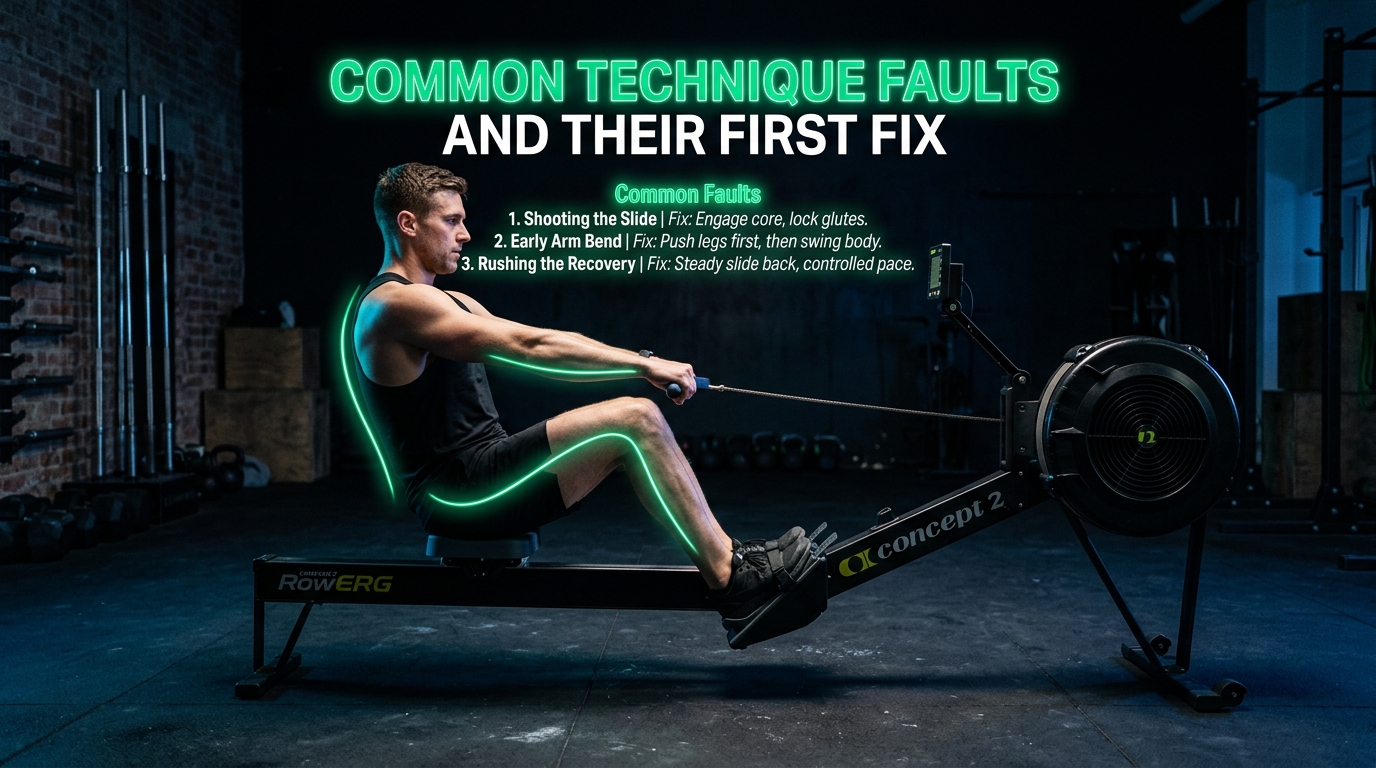
There is a moment at the end of a piece where a rower decides what kind of problem they have just had. It is a bad moment to decide in, because tired people are poor at causal reasoning and the stroke is not the only thing that can explain what just happened.
The context
Fault correction advice tends to arrive as a list of shapes: don't collapse at the catch, finish tall, keep the handle level. Some of that is right. The problem is that the list treats the stroke as the only suspect.
The biomechanics literature points somewhere more useful. Engstrom and colleagues measured how foot-stretcher position and stroke rate change ergometer kinematics [1]. Caldwell and colleagues instrumented rowers across a trial and found lumbar flexion increased as the piece went on, alongside rising erector spinae activity and a falling median frequency — the signature of those muscles tiring [2]. Cardoso and colleagues compared two machine geometries and found the thorax angle at the finish differs by roughly eight degrees between them [3].
None of those three papers is about a rower doing something wrong. All three describe a rower doing something correctly and still producing something that looks like a fault, because the machine moved, or the trunk fatigued, or the hardware imposes a shape.
That distinction decides what you do next, and it is the reason a generic fault list underperforms: most of what it tells you to change is not the thing that changed.
The four checks
The manufacturer's own technique material and the federation coaching material both work from a list of things that go wrong [11] [12]. That is a reasonable starting point, but both are written for a machine set up the way the manufacturer intended and a rower who has not changed anything. Run the four checks first and the list usually gets shorter.
1. The foot stretcher. This goes first because checking it is free, not because we have measured it to be the most common cause — nobody has. Engstrom found that foot-stretcher height and angle change how the legs move through the stroke [1]. A rower who has shortened their slide by dropping the heels at the top has changed the catch, and the drive that follows is the drive that fits the new geometry. Reset the stretcher to the manufacturer's recommendation, row six easy strokes, and see whether the fault is still there. Sometimes it will not be, and sometimes it will, which is the point of spending the minute.
2. The rate. Ask when it appeared. Caldwell's trial measured flexion rising across the piece as the trunk muscles fatigued [2], and the systematic review found fatigue increases lumbar flexion at the catch, more so on an ergometer than on the water [8]. A back that is fine at 30 seconds and rounded at 1900 m is most likely a piece that outlasted the trunk rather than a cue you got wrong. Treat it as a pacing problem first: shorten the piece, or slow the rate, and see whether the shape returns. If the rounding is there from the first stroke, or if it comes with pain, it is no longer a pacing question and is worth taking to a clinician.
3. The machine. Cardoso's sixteen rowers produced a thorax angle at the finish of 27.5° ± 7.6° on a Concept2 against 19.4° ± 4.5° on an angular ergometer built to match the boat [3]. If your "fault" is an over-open finish, you may be correcting for the machine. Note the spread — the groups overlap, so this is a reason to measure yourself, not a licence to assume.
4. The count. How often does it happen? The movement-competency literature assesses a stroke as a competency, which means it is judged on whether the rower reproduces it across strokes rather than on whether a single instance matches a reference shape [4]. When coaches were asked what they actually evaluate, their answers clustered around consistency and movement quality rather than angles [5]. If a fault appears once in twenty strokes, you do not yet know whether you have a fault.
A worked example
A rower finishes a 2k and decides the finish is collapsing — the handle comes in and the chest opens, and it felt worse than it used to. The obvious read is a sequencing fault and the obvious fix is a finish cue.
Run the checks instead.
Stretcher. It was moved two weeks ago, after a shoe change. Reset it. The finish looks the same, so this was not it.
Rate. The fault appears from about 1500 m. Caldwell's trial found lumbar flexion rising across a piece as the trunk muscles fatigued [2], and the review found fatigue adds catch flexion, worse on the erg than the boat [8]. So this is not a finish problem at all — the trunk is running out before the finish does.
Machine. The chest is opening wide. Cardoso's figure for a Concept2 at the finish is 27.5° against 19.4° for a boat-shaped machine [3], so part of what is being seen is the hardware.
Count. Watch it across twenty strokes at rate 20. It happens in most of them late, and in none of them early.
The conclusion is not a finish cue. It is that the piece was paced beyond the trunk's ceiling and the rower was reading a fatigue signature as a technique problem. The fix is the pacing. A finish cue added now would have been coached into a stroke that was never the problem.
When it really is technique
Having cleared the four, some faults survive, and those are worth taking seriously. Soper and Hume describe the deviations that genuinely cost a rower, and they are overwhelmingly about sequence — the trunk arriving at the wrong time, the arms taking work the legs should have done [6]. Baudouin and Hawkins' review frames the stroke as a set of trade-offs where improving one variable costs you something downstream [7], which is why a cue that helps at one rate can hurt at another.
Secher's review is useful for the same reason: it describes the stroke as one coordinated sequence through legs, trunk and arms rather than separable phases [9]. A sequencing fault that is consistent stroke to stroke is a useful clue — it is what a genuine sequencing problem tends to look like. It is not a rule, though. A fatigue-driven change and a technique fault can sit on top of each other, and a fault that only appears when you are tired is still a fault.
Yamashita and colleagues found trunk muscle activity during ergometer rowing differs between rowers with and without a history of low back pain [10], so if a fault is specifically about the trunk under load, it is worth treating as clinical rather than cosmetic.
The trade-offs
Two honest limits.
The first is that the four checks above are cheap but not conclusive. They will clear a fault that was never yours and leave you with a real one. What they do is stop you re-coaching a stroke that the setup was already wrong for, which is the more expensive mistake because it takes a technique change to make and then a technique change to undo.
The second is that "is this really a fault?" is a judgement, and the evidence does not automate it. Consistency is a better criterion than shape because it is measurable [4] [5], and it is still a judgement. Treat a fault you can only see once as a hypothesis.
What to do tomorrow
Next time something goes wrong, write down four things before you row again: the rate, how long into the piece it happened, whether it happened at all before the last third, and when you last moved the foot stretcher.
Then check them in order. Reset the stretcher, row six easy strokes at a rate you would call slow, and watch the specific fault rather than your general impression. If it is gone, you just avoided a technique change you did not need. If it is still there in every stroke at a rate you can hold, that is a sequencing fault and it deserves the attention.
Most faults are not in the stroke. They are in the setup, the rate, the machine, or the last 500 metres — and all four are cheaper to check than to fix.
Key points
- Before changing technique, check four things in order: the foot stretcher, the rate, the machine, and how late in the piece the fault appeared.
- Foot-stretcher position changes ergometer kinematics directly, so a "technique change" may be a setup that moved.
- A linear Concept2 produces a measurably more open finish than a boat-shaped machine — about 27.5° against 19.4°. Some finishes are the machine's.
- Lumbar flexion rises measurably across a trial as the erector spinae fatigue. A fault that appears at 1900 m may be a pacing problem noticed late.
- Competency is judged on whether a movement repeats, not on whether one instance looks right.
- Coaches evaluate consistency and movement quality rather than angles.
- Start with the checks that are free to run, because they cost nothing and they change what you are looking at.
Editorial & Coaching Standards
Guides in the MyNextRow Learn library are created by Concept2 athletes and coaches, synthesizing peer-reviewed sports physiology, biomechanics literature, and authoritative rowing guidelines. Every workout protocol and technical cue is tested for safety, repeatability, and PM5 monitor compatibility.
Sources and further reading
- Engstrom I et al. Foot-stretcher position and stroke rate… PLoS One 2023;18(5):e0285676— Foot-stretcher position and rate change ergometer kinematics; the check that comes before technique.
- Caldwell JS et al. Repetitive motion, lumbar flexion and erector… Clin Biomech 2003;18(8):704-711— Lumbar flexion increased across a rowing trial as erector spinae activity fatigued.
- Cardoso R et al. Angular vs straight linear rowing ergometers… Sensors 2024;24(17):5686— Sixteen international rowers on both machine types; thorax angle at the finish differs by about eight degrees.
- Legge N et al. Movement competency in rowing: the key… Front Sports Act Living 2025;7:1601563— Frames technique as a movement competency assessed on consistency, not on a reference shape.
- Baumann E, Schmid MJ. Insights from expert coaches on te… Front Sports Act Living 2024;6:1448797— What rowing coaches actually evaluate when judging technique.
- Soper C, Hume PA. Towards an ideal rowing technique… Sports Med 2004;34(12):825-848— Canonical biomechanical account; which deviations genuinely cost the rower.
- Baudouin A, Hawkins D. A biomechanical review of factors… Br J Sports Med 2002;36(6):396-402— Review of the biomechanical determinants of ergometer performance.
- Nugent FJ et al. Rowing-related low back pain and biomechanics… Br J Sports Med 2021— Systematic review; the kinematics that distinguish rowers with a low-back-pain history.
- Secher NH. Physiological and biomechanical aspects of rowing… Sports Med 1993;15(1):24-42— Rowing physiology and biomechanics review; the coordination the sequence has to serve.
- Yamashita M et al. Trunk muscle activities during ergometer row… J Sports Sci Med 2023;22(2):338-344— Trunk muscle behaviour during ergometer rowing in rowers with and without low back pain.
- Concept2 — Rowing Technique— Manufacturer technique guidance; the faults a machine is designed to produce or prevent.
- British Rowing — Online Coaching— National federation coaching material; the coaching-side framing of correction.