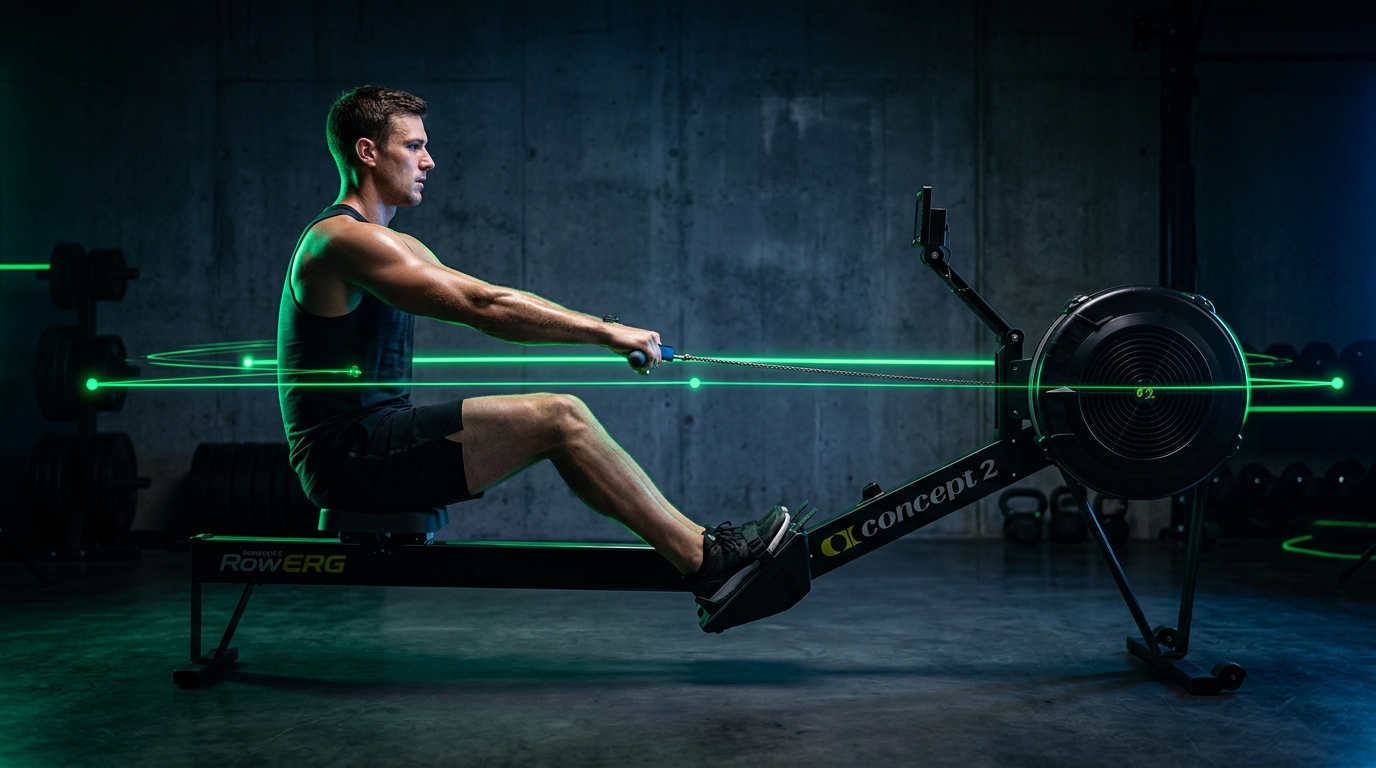
The handle path is the line the handle draws through the drive and the recovery. It is usually described as a technique standard: keep it straight, keep it level, do not lift the handle at the finish. That framing is the source of most of the confusion around it, because it asks you to hold something that is already being held for you.
The context
You have probably been told to fix your handle path. Usually this arrives as a correction after a bad piece, and it rarely tells you what to actually change. The advice circles around keeping the handle level through the drive and the recovery, avoiding lifting it over the knees on the way back, and not dropping it toward the shins at the front. The manufacturer's own technique material describes it in much the same terms [1], and practitioner biomechanics writing has long framed the trajectory as a cue to be coached [3].
None of that is wrong, but it describes the symptom rather than the mechanism, and it leaves you with nothing to adjust. It also implies that a good handle path is a skill you either have or have not acquired. The awkward part of that story is that people who row for years without ever thinking about handle path tend to have a good one anyway, which should tell you the line is not being maintained by attention.
The core idea
The handle is attached to a chain, and that chain runs back to a sprocket on the flywheel housing. A German patent on a rowing-ergometer training aid documents the consequence plainly: because the chain is under tension, it runs between the sprocket and the handle along a straight line, and the handle is located on that line [2]. The handle cannot be anywhere else. The straight path is a property of the machine's geometry, not an achievement of yours.
That leaves exactly one thing to decide, and you decide it before the drive starts: the angle of the line. The handle at the catch is some distance from the flywheel, and the line from that point back to the sprocket is set by that distance and by the height of the handle at that moment. Move the catch closer to the flywheel and the line steepens. Move it away and the line flattens. There is no way to change the line during the stroke without moving the catch, and the catch has already happened by the time you are pulling.
So handle path is not a discipline you practise. It is a readout of your catch position. When a coach asks you to fix your handle path, the useful translation is: your catch is in the wrong place.
This also explains the one thing the traditional advice gets right, which is that the line should not be broken. The chain will keep the handle roughly on the line no matter what you do, but nothing stops you from moving the handle up or down relative to it. That is what lifting the handle over the knees on the recovery actually is: not a new path, but a vertical displacement away from the line you started on. The same goes for dropping the handle toward the shins.
None of this is a separate skill layered on top of sequencing. The rowing-physiology literature is consistent that the stroke is a coordinated sequence through legs, trunk and arms rather than a pull [4], and a handle that has been dragged vertically somewhere in the middle of that sequence is a symptom of the sequence breaking, not its cause.
The how-to
Work through this once at a deliberately low rate, around 14 to 16 strokes a minute, so that each part of the stroke is separable.
-
Set the catch where you want the line to sit, not where you can reach furthest. Over-reaching for slide length moves the catch toward the flywheel and steepens the line, and the steeper line is the one you will have to fight at the finish. Stop compressing when your shins are close to vertical. The depth you get there is the depth you keep.
-
Finish on the same line, and notice that you do not have to try. Bring the handle in to the body without lifting it. Because the line is already there, the natural finish lands on it. The thing to resist is the urge to pull the handle up and back at the same time, which is what produces the hump you can see in the recovery of most tired rowers.
-
Let the recovery be slower than the drive. The recovery is unhurried and unpowered by definition, so there is no reason to rush it. A rushed recovery is the most common source of vertical handle movement, and it happens well before anyone is tired.
-
Pick one external target and keep it there. Put a mark low on the wall opposite the machine, or use the bottom edge of the monitor. Aim the handle at it on the recovery. Relying on how the movement feels is much weaker than a target you can see: work on external focus reports that attending to the effect of a movement, rather than to the body producing it, improves both performance and learning [7], and the sensation of a level handle is not something most people can reliably detect in the first place.
-
Raise the rate last, and only after the line is boringly consistent at a slow one. Higher rates compress the available time, and drive length is the first thing to go when time compresses. Rate also changes the economics of the stroke underneath you: as it rises, the share of power going to the rower and to losses grows while the share contributing to boat velocity shrinks [6]. That measurement is about power, not about your handle path, and it cannot diagnose one — but it does mean the rate is doing something to the stroke that the line alone will not show you. Treat a line that degrades as you speed up as a reason to drop the rate and re-check, rather than as a diagnosis to interpret.
The same study makes the first point measurable rather than advisory. Rowers who modified a machine to vary foot-stretcher height and angle showed that this equipment setting does change ergometer kinematics [5]. That effect was confined to the ankle and the hip, and the rowers largely absorbed it: the researchers found those changes generally smaller than the differences stroke rate produces on its own. So the foot stretcher is one dial among several that set where your catch lands, and it is not even the biggest one. If the line drifts when you go faster, the rate is the first thing to look at rather than the setup.
The trade-offs
Two honest limits are worth naming.
The first is that this advice is about the erg, not the water. On the water the handle describes an arc, because the oar is a rigid lever and the handle is at the end of it, and the arc lengthens as the blade approaches the catch. The straight line is a property of the chain-and-sprocket machine, and a linear ergometer cannot reproduce that arc. Comparative work on angular and linear ergometers finds similar cardiorespiratory responses but clearly different kinematics, with the angular machine producing a finish closer to the on-water layback [8], so the two machines are genuinely not interchangeable. Rowers moving between boat and erg have to translate between a different handle trajectory each way, and treating the two as the same skill causes more confusion than it solves.
The second is that a straight, consistent line is not by itself evidence of efficient rowing. It is a necessary condition, not a sufficient one. You can hold a clean line at a low intensity and still row a technically poor stroke, and the article most people need is about sequencing rather than geometry. What the line gives you is a reliable signal: when it stays straight, the catch is right, and you can stop guessing about that part of the stroke and start looking elsewhere.
What to do tomorrow
Pick one piece, drop the rate to something you would not normally choose, and row ten strokes watching only the handle. Check two things: that the handle arrives over your shins at the front without dropping below the line, and that it does not lift on the way back. That is ten minutes, and it will tell you more about your catch than any amount of thinking about the drive.
If the handle drops at the front, shorten your compression. If it lifts on the back, slow the recovery down rather than trying to correct the lift. If both are fine and the piece still feels wrong, the problem is probably not handle path at all.
The straight line is not yours to maintain — it is what the chain does. What you choose is the catch, and the catch chooses the line.
Key points
- The straight handle path is a consequence of the chain being under tension, not a standard you have to hold.
- The angle of the line is fixed at the catch, by the catch's distance from the flywheel. Change the catch and you change the path.
- Most of what gets called bad handle path is the handle leaving that line vertically, usually as the finish is rushed or the recovery is hurried.
- Over-reaching for slide length pulls the catch toward the flywheel and steepens the line, which is why it shows up in the drive, not at the catch.
- Foot-stretcher height and angle change ergometer kinematics, but mainly at the ankle and the hip, so setup shifts where the catch lands without being the whole stroke.
- A spot low on the wall or the monitor's edge gives you an external target for the finish and recovery, which internal cues alone will not supply.
Editorial & Coaching Standards
Guides in the MyNextRow Learn library are created by Concept2 athletes and coaches, synthesizing peer-reviewed sports physiology, biomechanics literature, and authoritative rowing guidelines. Every workout protocol and technical cue is tested for safety, repeatability, and PM5 monitor compatibility.
Sources and further reading
- Concept2 — Rowing Technique— Manufacturer technique guidance; the operational anchor for catch position and the finish.
- Patent DE10164117A1 — rowing ergometer handle guidance display— Not a Concept2 patent (the assignee is an individual). Cited only for the geometric fact it states: the chain runs between sprocket and handle along a straight line, so the handle is constrained to that line.
- Kleshnev V. Rowing biomechanics newsletter. biorow.com— Practitioner biomechanics newsletter; the coaching translation of the handle trajectory into cues.
- Secher NH. Physiological and biomechanical aspects of rowing. Sports Med 1993;15:24-42— Rowing physiology review; the case that stroke work is a coordinated sequence rather than an arm pull.
- Engstrom I et al. Foot-stretcher position and stroke rate on ergometer rowing kinematics. PLoS One 2023— Directly tests the premise of this article: foot-stretcher height and angle do change ergometer kinematics, but the effect was confined to the ankle and the hip and was largely absorbed by the rowers.
- Hofmijster MJ et al. Effect of stroke rate on the distribution… J Sports Sci 2007;25(4):403-411— Rate redistributes power inside the stroke: the share going to the rower and to losses rises while the share contributing to boat velocity falls.
- Wulf G. Attentional focus and motor learning. Int J Sport Psychol 2007— External-focus review; the rationale for the visual reference in the how-to.
- Cardoso R et al. Assessment of angular and straight linear rowing ergometers. Sensors 2024;24(17):5686— Peer-reviewed comparison of handle trajectories; distinguishes the RowErg linear path from the angular path a sculling oar takes on the water.