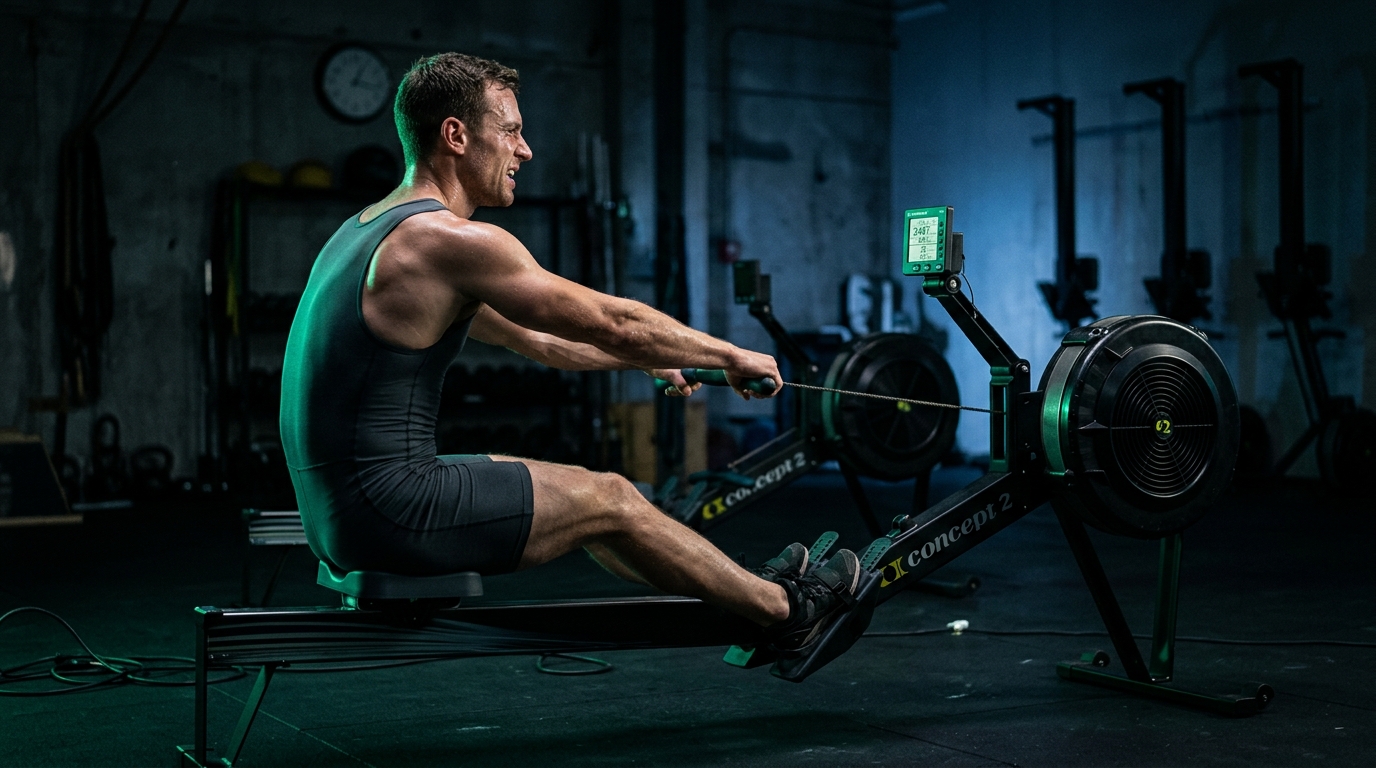
Every 5K has an opening, and most rowers take it hard. The conventional shape has a name — a degressive start — and a reputation: fast out, settle, sprint. In rowing's own vocabulary it is a habit. One French trial that measured the physiology of the opening describes it as what "during 2000 m races, the first 1500 m are usually and empirically often conducted in a degr way" ([6] Boillet 2022). Usually. Empirically often. That is a description of what happens, not a finding about what works.
This article makes one argument about that opening: it is inherited rather than earned. It is a convention that arrived before you did. It travels with you from one distance to the next, it is shaped as much by who else is in the race as by what you intended, and under controlled conditions it has bought no extra aerobic energy — it has raised strain sooner, and the rowers ranked it last.
One scope note, because it caps everything. Almost every pacing measurement in rowing comes from the 2,000 m — the Olympic distance, the piece a study can afford to run. A 5K is a much longer piece than that, so nothing below is a measurement of 5K pacing. It is an argument from shorter efforts, from championship races and from the machine maker's advice, with conditions attached. For what a 5K result measures, see our 5K result endurance drift guide.
The core idea
Start with the biggest dataset on the question: Garland took split times from every heavyweight race at the 2000 Olympic Games and the 2001 and 2002 World Championships, added the British Indoor Rowing Championships, and kept the 948 of 1,612 profiles with evidence of a fastest-possible effort ([1] Garland 2005).
The interesting part is not the shape of the fast start. It is what that shape fails to separate. There were no differences in pacing profile between winners and losers, and none between men and women ([1] Garland 2005). Every crew opened the same way, whoever they were.
Garland's null is about the shape. A later analysis asks another. Mentzoni and Losnegard took the 500 m splits from 106 championship A-finals — the Worlds of 2017 to 2019 and Europeans of 2017 to 2021 — and compared the medallists with the crews they beat, 636 in all. The medallists' splits varied less than everyone else's, a coefficient of variation of 1.72% against 2.00%, and the authors were careful: a more even strategy "could imply" an advantage rather than proving one ([2] Mentzoni 2021). So if the shape of the opening does not separate the fast rowers from the rest, consistency might — and consistency is trainable.
The same dataset carries a detail that matters more for you than the shape. On-water and ergometer trials showed a competitively meaningful difference in the first 500 m sector ([1] Garland 2005). The fast start you inherited is surface-specific — the one your training taught you, on the water or on the machine. They are not the same shape, and the machine is the one you will be tested on.
Pacing is a skill, not a preference, and that makes the opening a habit rather than a decision. A systematic review of 64 studies found that pacing behaviour develops from childhood, improves its fit to task demands with experience, and that fit includes environment factors such as opponents ([3] Menting 2022). With experience, attention frees up for tasks like incorporating opponents, and the goal shifts from completing to optimising ([3] Menting 2022).
That is the start-order effect in one sentence: a field opens hard because there are other boats in it, and the strength of your opening is set by the people around you as much as by your plan. On the machine there is nobody to incorporate, cover or pass. The only thing shaping your opening is you, and whatever you have been repeating for months.
The feeling is the trap: Concept2's own 5K plan warns that going too hard in the first part of a race "just feels SO easy then" ([9] Concept2 2024).
The habit travels with the rower. Thirty-three under-23 international rowers produced the same shape of pacing profile in a maximal 2,000 m trial as in an unprescribed 1,500 m trial, and the conclusion is blunt: "International rowers currently rely on familiar 2000-m pacing patterns when racing over 1500 m" ([4] Astridge 2026). Power targets for the first 1,000 m, derived from critical-speed modelling, did not influence performance either — the unprescribed, even and fast-start trials produced the same mean power, and every one allowed a sprint finish ([4] Astridge 2026). A plan is not a lever. What you repeat is.
Even the shape changes with the round you are in. Across seven World Championships from 2001 to 2009, the 500 m quarters of 2,000 m heats were better described by a linear trend with a positive slope — the splits got progressively slower — while the same crews in the finals were better described by a quadratic, parabolic one ([5] Muehlbauer 2011). The authors suggest the missing final sprint in the heats may be to conserve energy for the rounds to come ([5] Muehlbauer 2011). The fast start is not one shape: it is what a final looks like.
Thirteen French rowers — four women, nine men, national and ex-international — rowed the first 1,500 m of a simulated 2,000 m under three imposed power strategies: degressive, stable and progressive, with handle force, oxygen uptake, heart rate and blood lactate measured throughout ([6] Boillet 2022).
The headline was a null, and it is load-bearing: no significant differences in aerobic energy contribution between the three strategies ([6] Boillet 2022). The fast start did not buy more aerobic energy. Whatever it is doing, it is not a better supply of aerobic ATP — the usual physiological story.
The cost was measured in the same trial. Final blood lactate and perceived effort were similar across all three, but the rise in both came sooner in the degressive condition, so time at high strain was longer ([6] Boillet 2022). Same work, higher strain, arriving earlier. And the detail that should give a fast starter pause: asked which protocol they preferred, the rowers ranked the degressive strategy last ([6] Boillet 2022). Everyone does it, and when they stop to choose deliberately, they do not choose it.
A second rowing trial points the other way, so it belongs here, not in a footnote. Fifteen male rowers, 15.37 ± 1.34 years old, completed three 2,000 m ergometer races with the first 1,000 m manipulated ([7] Dimakopoulou 2018). The self-selected profile — parabolic, and in practice a fast start — produced the shorter finishing time and the higher stroke rate. The imposed even profile, set at the same mean velocity, was slower. The imposed negative profile was slower still, and was set four per cent slower overall, so it was a different race, not a different shape ([7] Dimakopoulou 2018). Read honestly, that trial does not say the fast start is good. It says that imposing a shape on these rowers cost them time — over 2,000 m, in fifteen adolescent males. It is a genuine result, and the one most often left out.
One design here changes behaviour and measures the result, and it is not rowing. Thirty-four cross-country skiers raced 7.5 km on snow with self-selected pacing; on the strength of their first two minutes they were split into a fast-start group and a conservative group, seventeen each. On the second day the fast starters were told to reduce their opening to their own lap average from the day before, and the controls to keep theirs ([8] Losnegard 2022).
The fast starters improved more than the controls, at an effect size of 0.87. Their opening slowed by 7.7%, heart rate fell from 83% to 81% of maximum, perceived effort dropped from 5 to 4 on a ten-point scale, and they finished 1.9% faster. The controls changed nothing ([8] Losnegard 2022).
That is skiing, on snow, over 7.5 km, in people about seventeen years old — not a rowing result. But it is the only design here that asks your question: if I start too fast, would I be better off stopping? The answer was yes, and what did it was strain arriving later, not speed sooner.
The how-to
Decide the shape before you are on the machine. Concept2's own 5K plan is blunt about it: "Before doing a Time Trial or Race, it is important to have a Race Plan", built from the paces you have actually been rowing, and the plan is either a constant pace or a negative split — starting one or two seconds slower than target and finishing faster ([9] Concept2 2024). Write the first 500 m down before you start.
Run the three shapes over one distance. Boillet's design is the template: three pieces of the same length, one shape each, and long enough that you can feel the strain arriving — the trial used the first 1,500 m of a 2,000 m precisely to catch the state you are in with 500 m to go ([6] Boillet 2022).
Record where the effort arrives, not only the time. The degressive condition's signature was strain arriving early ([6] Boillet 2022). You can approximate that without a blood test: rate each 500 m out of ten and look at where the number starts to climb. Then ask which shape you would have chosen on purpose. The trial's rowers ranked the degressive strategy last when asked ([6] Boillet 2022), which makes this the cheapest check on whether a result was earned or survived.
Change nothing else between the pieces. Concept2's guidance on the machine is that intensity on an ergometer is created by the rower, that it is power rather than cadence that makes the workout, and that a damper of three to five with a rate of 24 to 30 is the sane place to work ([11] Concept2 2013).
Borrow the distance, not the 2K. Concept2's own menu of ways to a 5K is explicit about the gap: for the 2,500 m pieces, "This distance pushes you a bit farther than 2k, so ease up on your race pace", and for the 500 m repeats, aim for a pace "a bit slower than your fastest 2k" ([10] Concept2 2021).
The trade-offs
Two things are in tension.
The first is that a fast start is not obviously wrong. In the only rowing trial to put a fast opening against an even one at the same mean velocity, the fast start won ([7] Dimakopoulou 2018) — over 2,000 m, in fifteen adolescent males. If your 5K belongs to that range of person and distance, you have a real argument for keeping it.
The second is that an even opening is not free either. In the French trial the stable and progressive strategies spent no less time at high lactate and high perceived effort; they simply spent it later ([6] Boillet 2022). Slowing the opening does not remove the cost of the race — it moves where you pay it.
So the trade is not between fast and slow. It is between two ways of losing: arriving at the last third with nothing left, and arriving at it too tired to convert what you have. One result is worth keeping in view: in the elite trial every strategy allowed a sprint finish, with the final 250 m rowed at 104% to 106% of predicted power ([4] Astridge 2026). The finish is available whichever opening you pick — and the fast start is the shape that spends the most before it.
What to do tomorrow
1. Write the opening down, then run the three shapes once over one distance, changing nothing else. One number: the split you intend to be at after 500 m, taken from the paces you have actually been rowing ([9] Concept2 2024). Then fast, even, negative. Record the time and, at every 500 m, how hard it felt out of ten.
2. Ask which one you would pick on purpose, and compare it with what your body did. The French rowers' own preference for the degressive strategy was last ([6] Boillet 2022). The rowers in the second trial went fastest when left to pace themselves ([7] Dimakopoulou 2018). Where those two disagree is the thing worth working on.
3. Decide whether you are racing it or testing it. If you are testing, the point is a number you can compare with your own next attempt, and the opening matters because a habit you did not choose is a habit you cannot reproduce. If you are racing, it matters because it decides what you have left at the finish.
4. Keep the machine identical between attempts, and repeat the whole set weeks later. For how to hold the protocol still enough for the comparison to be real, see our what-makes-a-test-repeatable guide. For the wider evidence on negative splits, see our negative-splits-and-other-pacing-strategies guide.
Key points
- The fast start is a convention, not a finding: in 948 usable split profiles the opening was the same in every crew, winners and losers alike.
- Pacing is a skill acquired by repetition, and the shape of the opening is set by task demands and by who else is in the race.
- Under controlled conditions a degressive opening bought no extra aerobic energy, raised lactate and perceived effort sooner, and ranked last with the rowers themselves.
- The rowing trials disagree: in fifteen adolescent males over 2 km, a self-selected fast start was the fastest of three shapes.
- The only design that changes behaviour and measures the result is from skiing, where telling fast starters to even out produced an effect size of 0.87.
- No study has measured pacing over 5,000 m. Everything here comes from shorter efforts, and the conditions are stated with each one.
Editorial & Coaching Standards
Guides in the MyNextRow Learn library are created by Concept2 athletes and coaches, synthesizing peer-reviewed sports physiology, biomechanics literature, and authoritative rowing guidelines. Every workout protocol and technical cue is tested for safety, repeatability, and PM5 monitor compatibility.
Sources and further reading
- Garland SW. An analysis of the pacing strategy adopted by elite competitors in 2000 m rowing. Br J Sports Med 2005— 948 usable split profiles from the 2000 Olympics, the 2001-2002 World Championships and the British Indoor Rowing Championships: no pacing difference between winners and losers, and a different first 500 m on water and on the erg.
- Mentzoni F, Losnegard T. World and European Rowing Medallists Pace With Smaller Variation…. Front Sports Act Living 2021— 636 crews in 106 championship A-finals: the medallists paced with less variation than the crews they beat, CV 1.72% against 2.00%.
- Menting SGP, et al. Pacing Behaviour Development and Acquisition: A Systematic Review. Sports Med Open 2022— 64 studies: pacing develops like a skill, improves its fit to task demands with experience, and that fit includes environment factors such as opponents.
- Astridge DJ, et al. Pacing Prescription Through Critical Speed Modeling for 1500-m…. Int J Sports Physiol Perform 2026— 33 under-23 international rowers: unprescribed, even and fast-start trials gave the same mean power, the prescription did not influence it, and the 2000 m shape carried over.
- Muehlbauer T, Melges T. Pacing patterns in competitive rowing adopted in different…. J Strength Cond Res 2011— Seven World Championships: heats were described by a positive-slope linear trend and finals by a parabolic one, so the shape followed the round the crew was in.
- Boillet A, et al. Is the Most Commonly Used Strategy for the First 1,500 m of a 2,000 m…. Front Physiol 2022— 13 French rowers under three imposed shapes: no difference in aerobic energy contribution, lactate and RPE rose sooner with the degressive shape, and it ranked last.
- Dimakopoulou E, et al. The effect of pacing strategy on physiological, kinetic and…. J Sports Med Phys Fitness 2018— 15 male rowers aged 15.37: self-selected pacing was fastest, the imposed even profile was slower at the same mean velocity, the imposed negative profile 4% slower overall.
- Losnegard T, et al. Cross-Country Skiers With a Fast-Start Pacing Pattern Increase…. Int J Sports Physiol Perform 2022— 34 skiers over 7.5 km: the fast starters told to even out gained more than the controls, ES 0.87, opening down 7.7% and the finish 1.9% faster.
- Concept2. Training Plan for a 5k Erg Test (living page, first archive capture 2024)— The 5K plan from the machine maker: build the race plan from training paces, hold a constant or a negative split, and the warning that going too hard in the first part just feels easy.
- Concept2. 12 ways to reach your 5K (blog, 2021)— Distance-specific pacing for the 5K: the 2500 m work says ease off the race pace, and the 500 m repeats say aim below your fastest 2k.
- Concept2. Debunking the myths: damper setting, stroke rate and intensity (blog, 2013)— Damper 3 to 5 rather than 10, 24 to 30 spm, power rather than cadence, and intensity created by the rower.