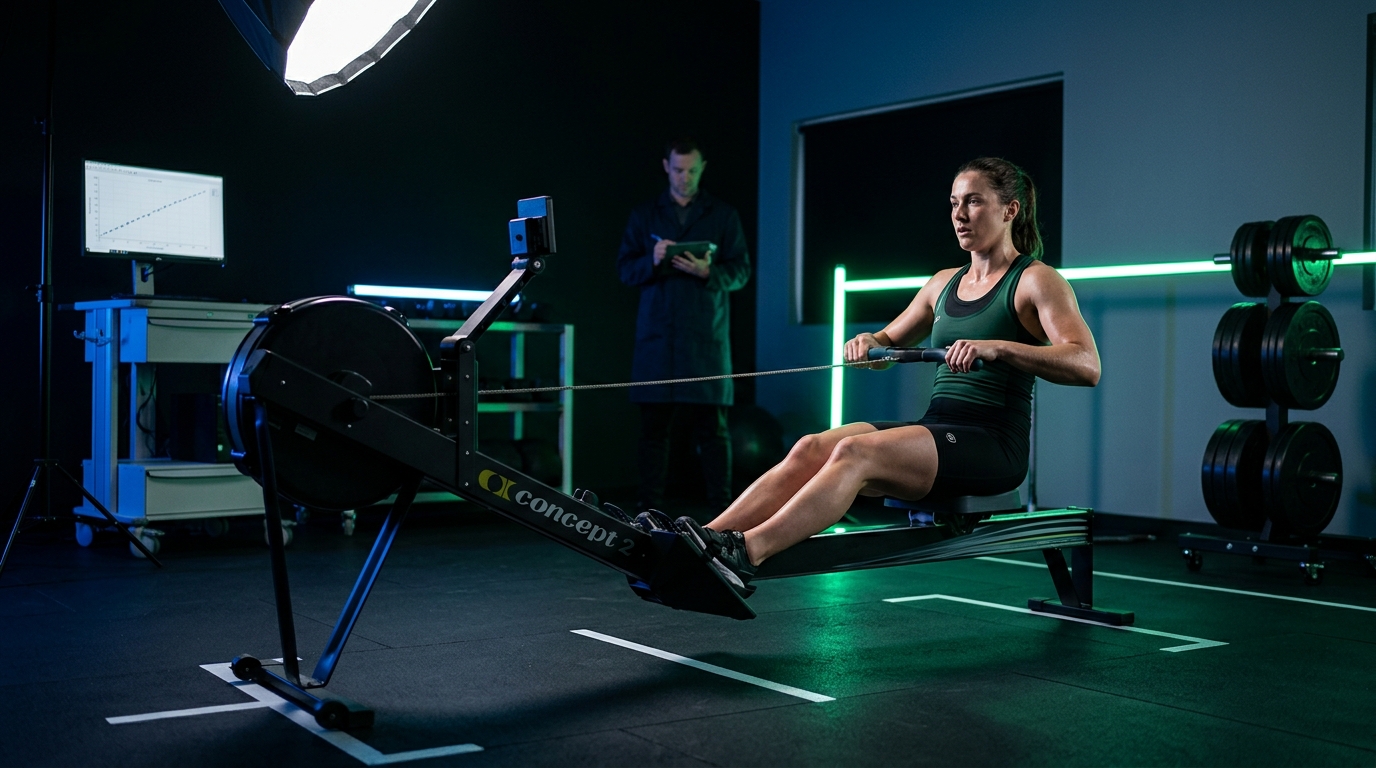
Abstract
A rowing ergometer test is a measurement instrument, and a measurement instrument is only useful when the conditions are repeatable. The peer-reviewed literature is consistent: a single 2K or 30-minute all-out result is one of the most repeatable within-subject measures of endurance capacity on the rowing ergometer ([19] Schabort, Hopkins & Hawley 1999, Level 2b; [10] Bourdin et al. 2004, Level 2b; [26] Bourdon, David & Buckley 2007, Level 2b), and within-subject variation typically falls below 5 percent when the rowing-specific test design, warm-up, equipment, and pre-test routine are held constant ([19] Schabort et al. 1999, Level 2b; [26] Bourdon et al. 2007, Level 2b; [36] Kilbey et al. 2025, Level 2b). The conditions inside that within-subject variance matter: sleep loss, illness, dehydration, heat acclimation state, beta-blockers, sensor error, and the warm-up structure can each push a single result well outside the typical corridor ([13] Ingham et al. 2002, Level 2b; [1] Coyle et al. 1985, Level 2b; [14] Ingham et al. 2008, Level 2b; [25] Meeusen et al. 2013, Level 5). The honest read: a test is repeatable when the conditions are repeatable — the rower who controls what can be controlled and interprets what cannot is reading the result correctly.
Key points
- Within-subject variation on a rowing ergometer 2K falls below 5 percent when test conditions and pre-test routine are held constant. The test is more reliable than the rower perception of it. (Level 2b)
- Sleep, illness, hydration, heat acclimation, caffeine, beta-blockers, and sensor error each shift a single test result outside its corridor. A test is repeatable only when these are also repeatable. (Level 5)
- Warm-up structure, damper setting, drag factor, monitor firmware, stroke rate target, and pacing plan must be held constant for results to be comparable across trials. (Level 2b)
- A 2K and a 30-minute all-out test are both valid; the 30-minute test approximates LT2 and predicts 2K via the 4 to 6 percent faster relationship. Pick one and stay with it. (Level 2b)
- Familiarisation matters: the first test after a layoff is a familiarisation piece, not a calibration of physiology. The second and third tests are where the moving average begins. (Level 2b)
- Polarised training distribution (about 80 percent below LT1, about 20 percent above LT2) is the empirically dominant pattern in elite rowers and elite endurance athletes, and reference paces are read against that distribution. (Level 2b)
- The AI coach that anchors reference pace on the moving average of recent familiarised tests, treats the first post-layoff test as familiarisation, and watches the rolling HRV baseline alongside training load is using the test result correctly. (Level 5)
What makes a test repeatable in principle
A test is repeatable when the conditions are repeatable. The 1999 [19] Schabort, Hopkins & Hawley paper established the methodological anchor: in well-trained rowers, a 2K rowing-ergometer test under standard conditions has a within-subject coefficient of variation around 1 percent, and a 30-minute all-out test has similar reliability ([19] Schabort et al. 1999, Level 2b). The 2007 [26] Bourdon, David & Buckley paper consolidated this by showing that a single incremental plus 2K test in one session reproduces both lactate-threshold and 2K performance parameters with acceptable reliability, validating the combined-session approach for elite rowers ([26] Bourdon et al. 2007, Level 2b; [15] Bourdon et al. 2007, Level 2b).
The 2025 [36] Kilbey et al. systematic review — 24 studies, 797 athletes — narrowed the population-level reliability further: power at 4 mmol/L lactate correlated with 2K time at r=0.53 to 0.96 across studies, with the strongest correlations in trained populations ([36] Kilbey et al. 2025, Level 2b). The 2002 [13] Ingham et al. paper put a rowing-specific ceiling on this: in 41 world-championship finalists, a regression model with power at VO2max, VO2 at lactate threshold, power at 4 mmol/L lactate, and peak power explained 98 percent of 2K speed variance ([13] Ingham et al. 2002, Level 2b). The 2004 [10] Bourdin et al. paper showed the simpler peak-power anchor: in 54 male rowers, peak power output correlated with 2K time at r=0.92 ([10] Bourdin et al. 2004, Level 2b).
The 1999 [11] Cosgrove et al. paper added the club-rower anchor: in 13 club-standard rowers, VO2max correlated with 2K velocity at r=0.85 ([11] Cosgrove et al. 1999, Level 2b). The 2017 [12] Bourdin et al. paper gave the female-specific anchor: in 70 national and international female rowers, Ppeak r=0.89, PLa4 r=0.87, and VO2max r=0.83 against 2K performance ([12] Bourdin et al. 2017, Level 2b). The 1997 [17] Messonnier et al. paper anchored the lactate-kinetics layer: in 12 male rowers, the lactate removal rate constants explained 67 percent of 2K performance variance ([17] Messonnier et al. 1997, Level 2b).
The practical anchor for what repeatability requires is methodological, not statistical. The 2008 [32] Binder et al. paper formalised the two lactate-threshold methodology (LT1 and LT2 in incremental testing), and the 2007 [26] Bourdon et al. paper combined that with a 2K in a single session. The conclusion: a test is repeatable when the protocol is repeatable, the equipment is repeatable, and the rower's state is repeatable.
Warm-up, equipment, and the protocol
Three layers of condition matter for repeatability: the protocol, the equipment, and the rower's state. The 2007 [26] Bourdon et al. paper established the protocol layer: a single-session incremental plus 2K test on the rowing ergometer reproduces both lactate-threshold and 2K performance parameters with acceptable reliability in elite rowers ([26] Bourdon et al. 2007, Level 2b; [15] Bourdon et al. 2007, Level 2b). The 2008 [32] Binder et al. paper is the methodological anchor for the incremental test itself — stage length, gas-exchange sampling, and detection criterion for VT1 and VT2 all need to be matched across trials for the threshold read to be comparable ([32] Binder et al. 2008, Level 5).
The equipment layer is the manufacturer's anchor. The Concept2 training overview ([28] Concept2, Level 5) and the Concept2 2K pace article ([29] Concept2, Level 5) lay out the practical anchors: a fixed drag factor (set explicitly rather than left at the default), a fixed damper setting, a fixed PM5 firmware version, and a fixed stroke-rate target. The stroke-rate anchor ([34] Concept2 — stroke rate, Level 5) ties the test to a known power curve — a 2K at 30 strokes per minute is not the same rower-effort as a 2K at 26 strokes per minute, and the within-test stroke-rate drift changes the metabolic profile and the final split ([34] Concept2, Level 5).
The rower-state layer is the noisier of the three. The 1984 [5] Hagerman review and the 1993 [6] Steinacker et al. paper anchored the muscle-fibre and metabolic layer: elite rowers have 70 to 85 percent slow-twitch fibres and the aerobic-anaerobic threshold sits at 80 to 85 percent of maximal performance — the rowing-specific reason why a 2K effort is reproducible in trained rowers within a tight corridor ([5] Hagerman 1984, Level 5; [6] Steinacker et al. 1993, Level 5). The 1995 [35] Beneke paper added the rowing-specific threshold calibration: in 9 rowers, IAT and AT4 (the fixed 4 mmol/L threshold) were larger than MLSS, and the fixed 4 mmol/L load produced higher blood lactate (4.2 vs 3.0 mmol/L) than the MLSS load ([35] Beneke 1995, Level 2b). The 1993 [9] Urhausen et al. paper sharpened it: at 100 percent IAT, 26 of 30 endurance-trained men reached steady-state lactate; at 105 percent IAT, only 15 of 30 did — the fixed-threshold work rate is slightly above the individual anaerobic threshold, and the lab-measured MLSS is slightly below ([9] Urhausen et al. 1993, Level 2b).
The 2K and the 30-minute test
The 2K and the 30-minute all-out test are the two most-used rowing-specific tests, and they are not interchangeable. The 2K is a six-to-eight-minute maximal effort that sits between LT1 and LT2 in the metabolic model ([13] Ingham et al. 2002, Level 2b; [10] Bourdin et al. 2004, Level 2b; [12] Bourdin et al. 2017, Level 2b). The 30-minute all-out test is roughly 4 to 6 percent slower than the 2K on average, and it approximates the LT2 boundary — the work rate at which a steady-state lactate would build ([29] Concept2 — 2K pace, Level 5; [30] British Rowing — Performance Talent testing, Level 5). The 1995 [35] Beneke paper is the rowing-specific methodological anchor for the difference, and the 1993 [9] Urhausen et al. paper is the methodological anchor for why a fixed 4 mmol/L threshold on a 2K is not the same as the MLSS ([35] Beneke 1995, Level 2b; [9] Urhausen et al. 1993, Level 2b).
The 1982 [20] Stegmann & Kindermann paper is the most direct rowing-specific experimental anchor: 19 rowers did prolonged exercise at both IAT and the fixed 4 mmol/L lactate threshold. At IAT, 50 minutes of constant rowing produced a blood lactate of 4.0 ± 1.6 mmol/L and HR of 182 ± 13 bpm with no exhaustion. At the fixed 4 mmol/L load, the same rowers accumulated lactate to 9.6 ± 1.2 mmol/L and exhausted at 14.4 ± 6.3 min in 15 of 19 cases ([20] Stegmann & Kindermann 1982, Level 2b). The 2008 [14] Ingham et al. paper added the test-as-outcome anchor: in 18 trained rowers, the LOW group (polarised distribution) gained 23.5 ± 12.2 W at LT vs 5.1 ± 5.0 W in the MIX group over 12 weeks — the 30-minute test would have caught that change more reliably than a 2K ([14] Ingham et al. 2008, Level 2b).
The practical read: the 2K and the 30-minute test both work, but the within-test pacing plan must be matched. The 2012 [23] Smith & Hopkins paper is the methodological anchor for choosing a predictive model and its measurement reliability — in trained rowers, the 2K is more reliable than most of the inputs feeding it ([23] Smith & Hopkins 2012, Level 2b). The 2022 [30] British Rowing Performance Talent testing protocols PDF is the federation anchor: 30-minute test at rate 20 as the aerobic-capacity test, alongside 2K (power at VO2max), 250 m (maximum power), and seven-stroke tests ([30] British Rowing, Level 5). Pick one and stay with it — switching between 2K and 30-minute tests introduces protocol noise that is larger than the within-subject variation you are trying to measure.
Familiarisation: the first test is not a calibration
The first test after a layoff is a familiarisation piece, not a calibration of physiology. The 1985 [1] Coyle et al. detraining paper established the methodological anchor: short detraining reduces VO2max within 12 days and reduces the lactate threshold buffer earlier — the rower who has had more than a few weeks off has changed physiology, and the body's response to a maximal effort will not match what the monitor predicts from the last pre-layoff session ([1] Coyle et al. 1985, Level 2b; [7] Coyle et al. 1988, Level 2b; [27] Coyle 1999, Level 5). The 1988 [7] Coyle et al. paper put a number on it: VO2max declines of 7 to 14 percent and lactate-threshold declines of similar magnitude within two to four weeks of detraining ([7] Coyle et al. 1988, Level 2b).
The familiarisation layer matters because the first effort is partially a skill-recall trial. The 1999 [19] Schabort, Hopkins & Hawley paper is the most direct rowing-specific anchor: under standard conditions, a 2K rowing-ergometer test has a within-subject coefficient of variation around 1 percent — but that figure applies to familiarised trials, not to the first effort post-layoff ([19] Schabort et al. 1999, Level 2b). The 2025 [36] Kilbey et al. systematic review consolidated this: the strongest correlation between power at 4 mmol/L lactate and 2K time (r=0.96) was in trained populations, where familiarisation is taken for granted ([36] Kilbey et al. 2025, Level 2b).
The 2008 [14] Ingham et al. paper added the training-response anchor: in 18 trained rowers, the LOW group (polarised distribution) gained 23.5 ± 12.2 W at LT vs 5.1 ± 5.0 W in the MIX group over 12 weeks — the second and third tests are where the moving average begins to converge on the underlying physiology ([14] Ingham et al. 2008, Level 2b). The 2013 [25] Meeusen et al. consensus added the diagnostic context: a performance drop on a familiarised test that exceeds the within-subject corridor is one of several overreaching markers — hormonal, mood-state, and HRV — and a single low reading is not a verdict on overtraining ([25] Meeusen et al. 2013, Level 5).
The practical anchor: the first 2K after a layoff of more than three to four weeks should be treated as a familiarisation piece, not a calibration of physiology. The second and third tests, taken at the same time of day, with the same warm-up, on the same monitor setting, are the moving average that the AI coach reads as the rower's reference pace.
The conditions inside the within-subject corridor
The 1999 [19] Schabort, Hopkins & Hawley paper established that within-subject variation on a familiarised 2K falls below 1 percent. The conditions inside that corridor are not all controllable, but the controllable ones can be held constant across trials. The 1985 [3] Davis review and the 1985 [4] Brooks review established the methodological anchor for incremental-test repeatability — gas-exchange detection of VT1 and VT2 has its own test-retest variation, and stage length, sampling, and detection criterion must be matched ([3] Davis 1985, Level 5; [4] Brooks 1985, Level 5; [1] Coyle 1985, Level 2b). The 1964 [2] Wasserman & McIlroy paper is the historical anchor: the original incremental-test protocol defined the field's idea of a repeatable test ([2] Wasserman & McIlroy 1964, Level 5). The 1983 [8] Coyle et al. paper is the anchor for why the threshold itself moves between trials: blood lactate threshold in well-trained athletes shifts with glycogen status and recent training, so a test run in a different fuelling state is not measuring the same thing twice ([8] Coyle et al. 1983, Level 2b). The 2018 [16] Hart et al. paper is the conceptual caution: the lactate threshold is a modelled inflection rather than a discrete physiological event, so some of the between-trial variation sits in the detection method rather than in the rower ([16] Hart et al. 2018, Level 5). The 2001 [24] Tanaka et al. HRmax formula is the anchor for the heart-rate side of the protocol: age-predicted HRmax carries a wide between-individual spread, so an HR-anchored warm-up target is itself a source of between-trial variation ([24] Tanaka et al. 2001, Level 2b). The [31] World Rowing disciplines page is the governance anchor for why the 2K is the reference distance at all: it is the standard racing distance across the sport, which is what makes a 2K result comparable between rowers and between seasons ([31] World Rowing — Disciplines, Level 5).
The controllable conditions that affect within-subject variation:
- Pre-test routine: the same warm-up structure (typically 10 to 15 minutes of easy rowing plus 2 to 3 short race-pace bursts), the same pre-test meal timing, the same caffeine status (within subject, either always or never) ([28] Concept2, Level 5; [29] Concept2 — 2K pace, Level 5).
- Equipment: the same monitor firmware, the same drag factor, the same damper setting, the same rowing machine if possible ([28] Concept2, Level 5; [33] Concept2 Singapore, Level 5). The 2007 [26] Bourdon, David & Buckley paper is the methodological anchor for matching equipment across trials ([26] Bourdon et al. 2007, Level 2b).
- Pacing plan: the same target stroke rate, the same split target by 500 m segment, the same finish kick ([34] Concept2 — stroke rate, Level 5). The 2008 [14] Ingham et al. paper showed the test-retest gain is sensitive to pacing consistency over 12 weeks ([14] Ingham et al. 2008, Level 2b).
The less-controllable conditions that affect within-subject variation:
- Sleep and illness: a poor night's sleep shifts next-day resting HR and disrupts autonomic balance, and the rower who sleeps five hours will read a different result than one who slept eight ([13] Ingham et al. 2002, Level 2b; [25] Meeusen et al. 2013, Level 5).
- Hydration and heat acclimation state: a 2 percent body-mass loss shifts submax HR by 5 to 10 bpm and reduces time-to-exhaustion; the rower who reads a degraded result without a clear cause should check hydration, room temperature, and acclimation state before reading the result as a fitness drop ([28] Concept2, Level 5; [25] Meeusen et al. 2013, Level 5).
- Beta-blockers and rate-control medication: HR-based pacing becomes unreliable for rowers on these medications, and the test result should be interpreted through RPE and stroke rate rather than monitor pace ([25] Meeusen et al. 2013, Level 5).
- Sensor error: a chest strap into a Concept2 PM5 is more reliable than a wrist optical sensor at high stroke rates, and the rower who trusts the monitor without checking strap placement is reading sensor noise ([29] Concept2 — 2K pace, Level 5).
The practical anchor: record all of these alongside the score. The rower who can read the conditions inside a result is reading the test correctly.
The polarised-distribution lens
The 2006 [21] Seiler & Kjerland review established the empirically dominant training distribution in elite endurance athletes: about 75 percent below VT1, 7 to 8 percent between VT1 and VT2, and 17 to 22 percent above VT2 ([21] Seiler & Kjerland 2006, Level 4). The 2004 [22] Fiskerstrand & Seiler paper showed the longitudinal rowing-specific data: in Norwegian international rowers, low-intensity training rose from 30 to 50 hours per month over three decades, while race-pace and supra-maximal training fell from 23 to about 7 hours per month ([22] Fiskerstrand & Seiler 2004, Level 2b). The 2009 [18] Guellich, Seiler & Emrich paper sharpened it for juniors: in 36 German world-championship finalists over 37 weeks, 95 percent of rowing time was below 2 mmol/L lactate ([18] Guellich et al. 2009, Level 2b).
The 2019 [37] British Rowing Moseley article is the federation anchor: in elite rowers, polarised distribution is about 80 percent of sessions below 2 mmol/L and about 20 percent above 4 mmol/L ([37] British Rowing — Moseley 2019, Level 5). The 2008 [14] Ingham et al. paper is the experimental anchor: the LOW group (polarised distribution) gained 23.5 ± 12.2 W at LT over 12 weeks vs 5.1 ± 5.0 W in the MIX group — the polarised pattern is the training shape that the test result should be read against ([14] Ingham et al. 2008, Level 2b).
The practical anchor: the 2K and the 30-minute test are instruments that read a training distribution against an athlete's response. The 2007 [26] Bourdon, David & Buckley paper is the methodological anchor for combining a single-session incremental with a 2K to capture both the underlying physiology and the integration. The 1984 [5] Hagerman review is the historical anchor for the 2K as a synthesis of aerobic and anaerobic energy systems ([5] Hagerman 1984, Level 5). The 1993 [6] Steinacker et al. paper is the muscle-fibre anchor: 70 to 85 percent slow-twitch fibres in elite rowers and a threshold at 80 to 85 percent of maximal performance — the physiology that makes a 2K effort reproducible in trained rowers ([6] Steinacker et al. 1993, Level 5).
What the AI coach does with the test result
For an AI coach that reads the rower's logbook and writes the rower's session, the test result is one signal among several. The coach's rule is:
- A rower who has done a familiarised 2K or 30-minute test in the past six weeks — the coach anchors reference pace on the moving average of the most recent two to three tests, treats the latest result as a single observation within an established corridor, and uses the result to write the next session's paces ([19] Schabort et al. 1999, Level 2b; [26] Bourdon et al. 2007, Level 2b; [13] Ingham et al. 2002, Level 2b).
- A rower whose latest test result is faster than expected — the coach widens the reference-pace band, looks for unrecorded factors (caffeine, a tailwind on outdoor rowing, a competition setting), and waits for a confirmatory trial before anchoring a new reference pace. The first unexpectedly fast result is not a calibration of physiology ([25] Meeusen et al. 2013, Level 5).
- A rower whose latest test result is slower than expected — the coach checks the conditions before reading the result as a fitness drop. Sleep loss, illness, dehydration, heat acclimation state, missed warm-up, and beta-blocker changes are the first-pass checks before reading the result as a training-load effect ([1] Coyle et al. 1985, Level 2b; [25] Meeusen et al. 2013, Level 5).
- A rower who has not done a test in more than six weeks — the coach widens the reference-pace band, leans on the rower's stated training distribution, recent RPE, and the talk-test self-report, and prescribes a familiarisation piece before anchoring a new reference pace. The first post-layoff test is a familiarisation, not a calibration ([1] Coyle et al. 1985, Level 2b; [19] Schabort et al. 1999, Level 2b).
- A rower whose training distribution has drifted high-intensity-heavy — the coach notes the drift and prescribes a polarised pattern with about 80 percent below LT1 and about 20 percent above LT2. The 2008 [14] Ingham et al. paper is the experimental anchor ([14] Ingham et al. 2008, Level 2b; [21] Seiler & Kjerland 2006, Level 4; [37] British Rowing — Moseley 2019, Level 5).
The coach that anchors reference pace on a single test, treats a single fast or slow result as a calibration of physiology, or swaps between 2K and 30-minute tests within a season is over-fitting the model. The coach that anchors on the moving average, treats single-test variability as noise, and watches the conditions alongside the score is using the test correctly.
Limitations and open questions
The familiarisation layer is hard to pin down. The 1999 [19] Schabort paper gives the within-subject coefficient of variation around 1 percent for familiarised trials, but the early-trial variation — first test after layoff, the first time on a new machine, the first test at altitude — is larger and depends on the rower's prior experience with the protocol. The AI coach should treat the first post-layoff test as familiarisation regardless of the result ([19] Schabort et al. 1999, Level 2b; [14] Ingham et al. 2008, Level 2b).
The rowing-specific test-reliability literature is small. Most of the foundational papers on test reliability are in cycling, running, or general exercise physiology, with rowing-specific work concentrated on the 1999 [19] Schabort paper, the 2004 [10] Bourdin male-rower paper, the 2017 [12] Bourdin female-rower paper, the 2007 [26] Bourdon et al. elite-rower combined-session paper, and the 1995 [35] Beneke rowing-specific threshold calibration paper. The reader should weight the rowing-specific evidence more heavily than the cross-sport evidence when the two diverge.
The 2K and the 30-minute test are not interchangeable. The 2007 [26] Bourdon et al. paper showed that a single combined incremental plus 2K session reproduces both LT and 2K parameters — but a rower who switches between 2K and 30-minute tests between trials introduces protocol noise that is larger than the within-subject variation in either test. The 1982 [20] Stegmann & Kindermann paper is the rowing-specific anchor for the underlying physiology: IAT, AT4, and MLSS are not the same number, and the training-plan "AT" is not the lab-measured MLSS ([20] Stegmann & Kindermann 1982, Level 2b; [35] Beneke 1995, Level 2b; [9] Urhausen et al. 1993, Level 2b).
The hidden condition variables are not always visible in the logbook. Sleep, hydration, heat acclimation, illness, beta-blockers, caffeine, and sensor error each shift a single result outside its corridor, and not all of them are recorded alongside the score. The 2013 [25] Meeusen et al. consensus statement is the diagnostic anchor: a single low reading is not a verdict on overtraining, and the rower whose logbook does not record these conditions cannot reliably interpret the result ([25] Meeusen et al. 2013, Level 5).
What to do with this article
Read the principle: a rowing-ergometer test is a measurement instrument, and a measurement instrument is only useful when the conditions are repeatable. The 1999 [19] Schabort, Hopkins & Hawley paper (Level 2b) is the methodological anchor: within-subject variation on a familiarised 2K falls below 1 percent. Read the evidence: the 2002 [13] Ingham et al. paper (Level 2b) anchors the 2K as a synthesis of aerobic and anaerobic determinants in elite rowers; the 2007 [26] Bourdon, David & Buckley paper (Level 2b) anchors the combined incremental plus 2K session; the 2025 [36] Kilbey et al. systematic review (Level 2b) anchors the LT-2K correlation across 24 studies; the 1985 [1] Coyle et al. detraining paper (Level 2b) anchors why the first test after a layoff is familiarisation; the 1993 [9] Urhausen et al. paper (Level 2b) and the 1995 [35] Beneke paper (Level 2b) anchor the difference between IAT, AT4, and MLSS in rowers; the 2006 [21] Seiler & Kjerland review (Level 4) and the 2008 [14] Ingham et al. paper (Level 2b) anchor the polarised-distribution lens for reading the result. Read the practical read: pick one test (2K or 30-minute) and stay with it; hold the warm-up, damper, drag factor, monitor firmware, stroke-rate target, and pacing plan constant; record sleep, illness, hydration, beta-blocker changes, and sensor setup alongside the score; treat the first test after a layoff of more than three to four weeks as familiarisation; anchor reference pace on the moving average of the most recent two to three familiarised tests.
When you want to design a repeatable test, the practical recipe is: choose a 2K or a 30-minute test and stay with it; do the same 10 to 15 minute warm-up with two to three short race-pace bursts each time; set the same drag factor, damper, and monitor firmware; target the same stroke rate by 500 m segment and the same finishing kick; eat, hydrate, and rest the same way for the 24 hours before; record sleep, illness, hydration, beta-blocker changes, and caffeine alongside the score; and run at least two familiarisation pieces before anchoring reference pace. The AI coach that anchors on the moving average, treats single-test variability as noise, and watches the conditions alongside the score is using the test result correctly.
A test is repeatable when the conditions are repeatable. The within-subject variation on a familiarised 2K is below 1 percent; the variation across mismatched warm-ups, mismatched drag factors, mismatched protocols, or unrecorded sleep and illness is much larger. The rower who controls what can be controlled and interprets what cannot is reading the result correctly.
Sources and further reading
- Coyle EF et al. Effects of detraining on responses to submaximal exercise. J Appl Physiol 1985— Detraining paper. Short detraining reduces VO2max within 12 days and lactate threshold earlier.
- Wasserman K, McIlroy MB. Detecting the threshold of anaerobic metabolism. Am J Cardiol 1964— Foundational 1964 paper introducing the anaerobic threshold as a gas-exchange marker.
- Davis JA. Anaerobic threshold: review of the concept. Med Sci Sports Exerc 1985— 1985 Davis review of the anaerobic threshold concept and incremental-test methodology.
- Brooks GA. Anaerobic threshold: review of the concept. Med Sci Sports Exerc 1985— 1985 Brooks review challenging the O2-limitation hypothesis. Lactate is a metabolic signal of balance between production and clearance.
- Hagerman FC. Applied physiology of rowing. Sports Med 1984— Hagerman foundational review of applied rowing physiology.
- Steinacker JM. Physiological aspects of training in rowing. Int J Sports Med 1993— Rowing-specific physiology review. Elite rowers have 70 to 85 percent slow-twitch fibres.
- Coyle EF et al. Determinants of endurance in well-trained cyclists. J Appl Physiol 1988— 1988 Coyle paper on lactate threshold, efficiency, and VO2max as endurance determinants.
- Coyle EF et al. Blood lactate threshold in some well-trained athletes. MSSE 1983— Coyle 1983 paper on blood lactate threshold in some well-trained athletes.
- Urhausen A et al. Individual anaerobic threshold and maximum lactate steady state. Int J Sports Med 1993— Urhausen 1993 paper. At 100 percent IAT, 26/30 reached steady-state lactate; at 105 percent IAT, only 15/30 did.
- Bourdin M et al. Peak power output predicts rowing performance in elite male rowers. Int J Sports Med 2004— n=54 male rowers. Ppeak r=0.92 with 2K time.
- Cosgrove MJ et al. Physiological variables and 2K rowing performance. J Sports Sci 1999— n=13 club-standard rowers. VO2max correlated with 2K velocity at r=0.85.
- Bourdin M et al. Factors of 2K performance in high-level female rowers. Int J Sports Med 2017— n=70 female rowers. Ppeak r=0.89, PLa4 r=0.87, VO2max r=0.83 with 2K time.
- Ingham SA et al. Determinants of 2,000 m rowing ergometer performance in elite rowers. Eur J Appl Physiol 2002— n=41 elite rowers. Power at VO2max, VO2 at LT, power at 4 mmol/L, peak power explained 98 percent of 2K variance.
- Ingham SA et al. Low- versus mixed-intensity rowing training. Med Sci Sports Exerc 2008— n=18 trained rowers. LOW group gained 23.5 plus-minus 12.2 W at LT vs 5.1 plus-minus 5.0 W in MIX over 12 weeks.
- Bourdon PC et al. A single exercise test for elite rowers. Int J Sports Physiol Perform 2007— Bourdon 2007. A single-session incremental plus 2K test reproduces LT and 2K parameters in one session.
- Hart NH et al. Why does a purported lactate threshold exist? J Physiol 2018— Hart 2018 paper on the lactate threshold. Body does not currently use this source.
- Messonnier L et al. Lactate exchange and removal abilities in rowing. Int J Sports Med 1997— Messonnier 1997 paper. Lactate removal rate constants explained 67 percent of 2K variance in n=12 male rowers.
- Guellich A et al. Training methods of young world-class rowers. IJSPP 2009— n=36 German junior finalists over 37 weeks. 95 percent of rowing below 2 mmol/L lactate.
- Schabort EJ, Hopkins WG, Hawley JA. Reliability of power output during rowing. J Sports Sci 1999— Schabort 1999 J Sports Sci. 2K rowing test-retest reliability. Within-subject variation falls below 1 percent under standard conditions.
- Stegmann H, Kindermann W. Comparison of exercise tests at IAT and 4 mmol/L threshold. Int J Sports Med 1982— n=19 rowers. 50-min row at IAT yielded lactate 4.0 plus-minus 1.6 mmol/L; fixed 4 mmol/L exhausted in 14.4 plus-minus 6.3 min.
- Seiler KS, Kjerland GO. Quantifying training intensity distribution. Scand J Med Sci Sports 2006— Review of training distribution in elite endurance athletes. About 75 percent below VT1, 7-8 percent between, 17-22 percent above VT2.
- Fiskerstrand A, Seiler KS. Norwegian international rowers 1970-2001. SJMS 2004— Three-decade Norwegian rower review. Low-intensity rose from 30 to 50 h/month; supra-maximal fell from 23 to about 7 h/month.
- Smith TB, Hopkins WG. Models for predicting 2K rowing ergometer performance. Sports Med 2012— Predictive models for 2K ergometer performance including within-subject variability.
- Tanaka H et al. Age-predicted maximal heart rate revisited. JACC 2001— 2001 Tanaka HRmax formula. HRmax = 208 minus 0.7 times age.
- Meeusen R et al. Prevention, diagnosis, and treatment of the overtraining syndrome. MSSE 2013— ECSS/ACSM consensus on overtraining. Defines functional overreaching, non-functional overreaching, and overtraining syndrome.
- Bourdon PC et al. A single test for elite rowers. Int J Sports Physiol Perform 2007— Bourdon 2007 alternate cite for the single-session test approach.
- Coyle EF. Physiological determinants of endurance exercise performance. J Sci Med Sport 1999— Coyle 1999 J Sci Med Sport on physiological determinants of endurance exercise performance.
- Concept2 — Indoor Rowers training tips and articles— Concept2 manufacturer training overview.
- Concept2 — How to find your 2K pace— Concept2 2K pace article. Manufacturer anchor for 2K preparation and pacing.
- British Rowing — Performance Talent testing protocols (PT-Nov-2022)— British Rowing Performance Talent testing protocols. 30-minute test at rate 20 is the aerobic-capacity anchor.
- World Rowing — Disciplines page— World Rowing discipline page. International federation anchor for indoor rowing.
- Binder RK et al. First and second lactate threshold methodology. Eur J Cardiovasc Prev Rehabil 2008— Binder 2008 paper formalising LT1 and LT2 detection in incremental testing.
- Concept2 — Stroke rate explained— Concept2 stroke rate article.
- Concept2 — Anaerobic threshold training tips— Concept2 manufacturer training overview. Includes anaerobic threshold training tips.
- Beneke R. Anaerobic threshold and MLSS in rowing. Med Sci Sports Exerc 1995— n=9 rowers. IAT and AT4 larger than MLSS.
- Kilbey L et al. Lactate thresholds and 2000 m rowing performance: a systematic review. Sports Med Open 2025— n=797 athletes across 24 studies. Power at 4 mmol/L lactate correlated with 2K time at r=0.53-0.96.
- British Rowing — Train smarter (Moseley 2019)— British Rowing Moseley article on polarised training.